
Germany / 1561 / DISPUTED
1561 Nuremberg celestial phenomenon
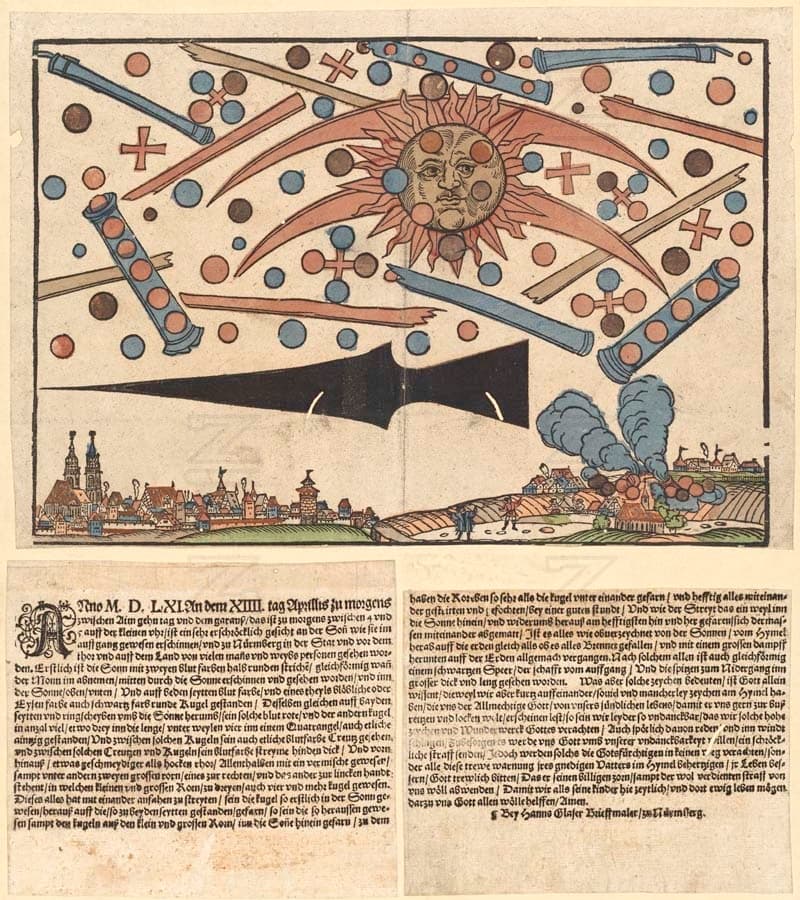
What can be verified is a colored woodcut broadsheet printed by Hans Glaser in Nuremberg in 1561 and preserved by the Zentralbibliothek Zürich. Its text places a frightening apparition around sunrise on 14 April and describes colored arcs, spheres, crosses, cylinders, a long dark spear-like form and smoke, before turning the spectacle into a warning to repent. That artifact proves that such a story was printed; it is not a camera record, instrument observation or collection of independent witness statements. Atmospheric optics such as parhelia are plausible context, but the exact sky cannot be reconstructed from one theological and commercial print.
This case is disputed. The archive preserves the claims while separating evidence from interpretation.
- Documentation
- Moderate documentation
- Primary location
- Nuremberg
- Source base
- 4 linked records
- Research use
- Comparison case
What the 1561 record can establish
- Confirmed artifact
- A 1561 colored broadsheet by Hans Glaser survives in the Zentralbibliothek Zürich.[1][2]
- Historical context
- The page is prodigy and warning literature with explicit religious interpretation.[2][3]
- Evidence limit
- No camera, instrument or independent named deposition accompanies the reviewed artifact.[1][2]
- Careful assessment
- Natural sky effects are plausible; the print does not support an extraterrestrial battle.[3]
Case dossier
The primary record is not a modern report written after technical investigation. It is a single-leaf illustrated news print from 1561. The Zentralbibliothek Zürich catalogue attributes the printing to Hans Glaser, identifies Nuremberg as the place of production and preserves it under shelfmark PAS II 12/60 with a persistent DOI.
The broadsheet says that between roughly four and five in the morning on 14 April an apparition was seen around the rising sun by people in and around the city. Its sequence includes reddish arcs, many colored circular forms, crosses, tubes from which spheres seem to emerge, a long black spear-like shape and objects falling with smoke. These details are claims inside the printed narrative, not separately preserved observations.
The picture should not be read as a literal frame captured from the sky. A woodcut had to condense sequence, motion, color and moral meaning into one designed page. Glaser's text also interprets the spectacle explicitly as a sign from God and urges readers not to ignore it. The artifact belongs to early-modern prodigy and warning literature as well as to the history of reported sky phenomena.
The surviving print is strong evidence for publication history: creator, format, repository, dimensions and rights status can be checked. It is much weaker evidence for the physical sky. No camera image, instrument measurement, weather log or named set of independent witness depositions accompanies the page in the reviewed source package.
Twentieth-century UFO literature recategorized the spheres, cylinders and spear-like form as machines or an aerial battle. That reading uses concepts unavailable to the original page and removes its theology and print conventions. It is legitimate to study that later reception, but not to present it as Glaser's own identification or as an eyewitness conclusion from 1561.
Parhelia, halo displays, meteors, clouds and other atmospheric effects can account for parts of the imagery, and Public Domain Review identifies a meteorological event as more likely than an extraterrestrial battle. No single reconstruction is proven by the print. The archive therefore classifies the case D / DISPUTED: a genuine historical artifact with uncertain underlying stimulus and no evidentiary basis for spacecraft.
Timeline
- The broadsheet places the reported apparition around sunrise, roughly between four and five in the morning.
- Hans Glaser prints the colored woodcut and letterpress broadsheet in Nuremberg.
- Carl Jung's Flying Saucers discusses the print, helping bring it into modern UFO literature.
- Public Domain Review publishes a source-linked presentation and identifies the underlying work as public domain worldwide.
- The archive re-audits the primary catalogue, rights status and later UFO interpretation.
Questions about the Nuremberg broadsheet
What happened over Nuremberg in 1561?
A broadsheet claimed that people saw a complex apparition around the rising sun on 14 April; only the printed account survives in the reviewed record.
Is the Nuremberg woodcut authentic?
Yes as a historical print: it is institutionally catalogued and held in Zurich. Authentic print does not mean literal or technically accurate event image.
Does it show an ancient UFO battle?
That is a later interpretation. The original text frames the scene as a religious sign, not spacecraft identified by witnesses.
Could sundogs explain the account?
Parhelia and other atmospheric effects are plausible for parts of the description, but the print cannot prove one exact reconstruction.
Why is the case in a UFO archive?
Because modern UFO literature repeatedly recast the historical print as a craft battle; the page documents and corrects that reinterpretation.
Sources
- [1] ArchiveZentralbibliothek Zürich catalogue and digitizationZentralbibliothek Zürich / e-manuscripta
- [2] ArchiveGraphikportal object recordGraphikportal / Zentralbibliothek Zürich
- [3] ResearchPublic Domain Review: Nuremberg celestial phenomenonThe Public Domain Review
- [4] ArchiveSource Library object page and transcription accessSource Library
The hero is the authentic public-domain 1561 broadsheet. Its woodcut is a designed historical interpretation, not a photograph, sensor record or literal scale diagram of the sky.