
Mexico / 1883 / DISPUTED
1883 Bonilla Solar Transit Observations
On August 12 and 13, 1883, José A. y Bonilla reported objects crossing the projected solar disk at Zacatecas Observatory, Mexico. His three observing intervals add up to 447 crossings. The account and a photographic reproduction appeared in L'Astronomie in September 1885. The journal favored atmospheric explanations; a 2011 preprint instead modeled comet fragments passing near Earth. Neither interpretation supplied an independently measured trajectory. This is a documented early astronomical report with uncertain object identity, not evidence of alien craft or a confirmed near-extinction event.
This case is disputed. The archive preserves the claims while separating evidence from interpretation.
- Documentation
- High documentation
- Primary location
- Zacatecas
- Source base
- 4 linked records
- Research use
- Comparison case
Observation versus interpretation
- Recorded observation
- 12–13 August 1883 at Zacatecas. Three reported intervals total 447 crossings in 205 minutes, not 447 photographs.[1]
- Publication and image
- September 1885 journal issue; January 1886 annual-volume imprint. Figure 118 is a diagram; figure 119 reproduces a photograph.[1]
- Unmeasured distance
- The 2011 range estimates depend on assumed speeds and geometry. They are not Bonilla's measured distances or an independently established encounter orbit.[2]
Case dossier
Bonilla's report begins at about eight in the morning on August 12, 1883, during solar observations at Zacatecas. Using a telescope with a 16-centimetre aperture, he projected a solar image 250 millimetres across. He described dark bodies passing across the disk and looking bright beyond its edge. In two hours he counted 283 crossings. Clouds interrupted observation; around the Sun's meridian passage, another 40 minutes yielded 48. On August 13, after clouds cleared at about eight, he and his assistant counted 116 in 45 minutes. These are the author's reported observations, not independently reproduced measurements.
The often repeated total of 447 is the sum of those three intervals, which cover 205 minutes, or three hours and 25 minutes. It is not a count of photographs or continuous coverage of the two days. Bonilla describes irregular arrivals: sometimes one or two bodies, sometimes many nearly together, making counting difficult. He estimated individual crossings at a third or half a second, at most one second. Those transit times must not be confused with the photographic exposure. Apparent brightness outside the solar disk also does not establish that an object generated its own light.
The September 1885 issue of L'Astronomie prints the account on pages 347–350. Its bound annual volume bears a January 1, 1886 title-page imprint, which explains a bibliographic distinction lost in later retellings. Figure 118 is a drawing of apparent tracks, not a photograph or a reconstructed orbit. Figure 119 reproduces one of the photographs Bonilla said he took. For that image he specifies wet collodion and a one-hundredth-second exposure, with the body in focus and the Sun out of focus; he also mentions slight developer fogging. A journal reproduction is not the original negative or a complete photographic sequence.
Bonilla says he telegraphed the Mexico and Puebla observatories, where the phenomenon had not been seen. Combined with the focusing behavior, he interpreted this as placing the bodies nearer than the Moon. His article does not include the other observers' original replies, synchronized sight lines or a measured kilometre range. The unsigned editorial note instead favored birds, insects or atmospheric dust. Its measurements of a tiny image on the photograph are not physical dimensions of a distant object. Neither Bonilla's inference nor the editor's alternatives establish a species, altitude or extraterrestrial origin.
In October 2011, Héctor Javier Durand Manterola, María de la Paz Ramos Lara and Guadalupe Cordero proposed a fragmented-comet interpretation in an arXiv preprint. Their calculation assumes speeds of 15–75 kilometres per second and motion perpendicular to the line of sight, producing distances of 538–8,062 kilometres. These are conditional model outputs, not speeds or distances measured by Bonilla. The paper acknowledges that his timing method is unknown. Its later mass and impact estimates add further assumptions about size, shape and composition; no fragment was recovered to establish those properties.
The same preprint extrapolates from a rounded rate of 131 bodies per hour over 25 hours to 3,275 fragments. That larger number includes unobserved time and is not a new discovery in the original log. A predicted catastrophic impact also remains conditional on the model: there is no independently determined encounter orbit demonstrating that Earth narrowly escaped one. The proposed comet interpretation is therefore not an official identification. It is a testable suggestion built from a sparse nineteenth-century description, whose missing distance and timing information cannot be repaired by treating assumptions as observations.
In Stuart Gary's October 20, 2011 ABC report, astronomer Paul Francis questioned how such numerous bright nearby comet fragments could have escaped wider notice. That criticism challenges the comet model; it does not independently identify what Bonilla saw.
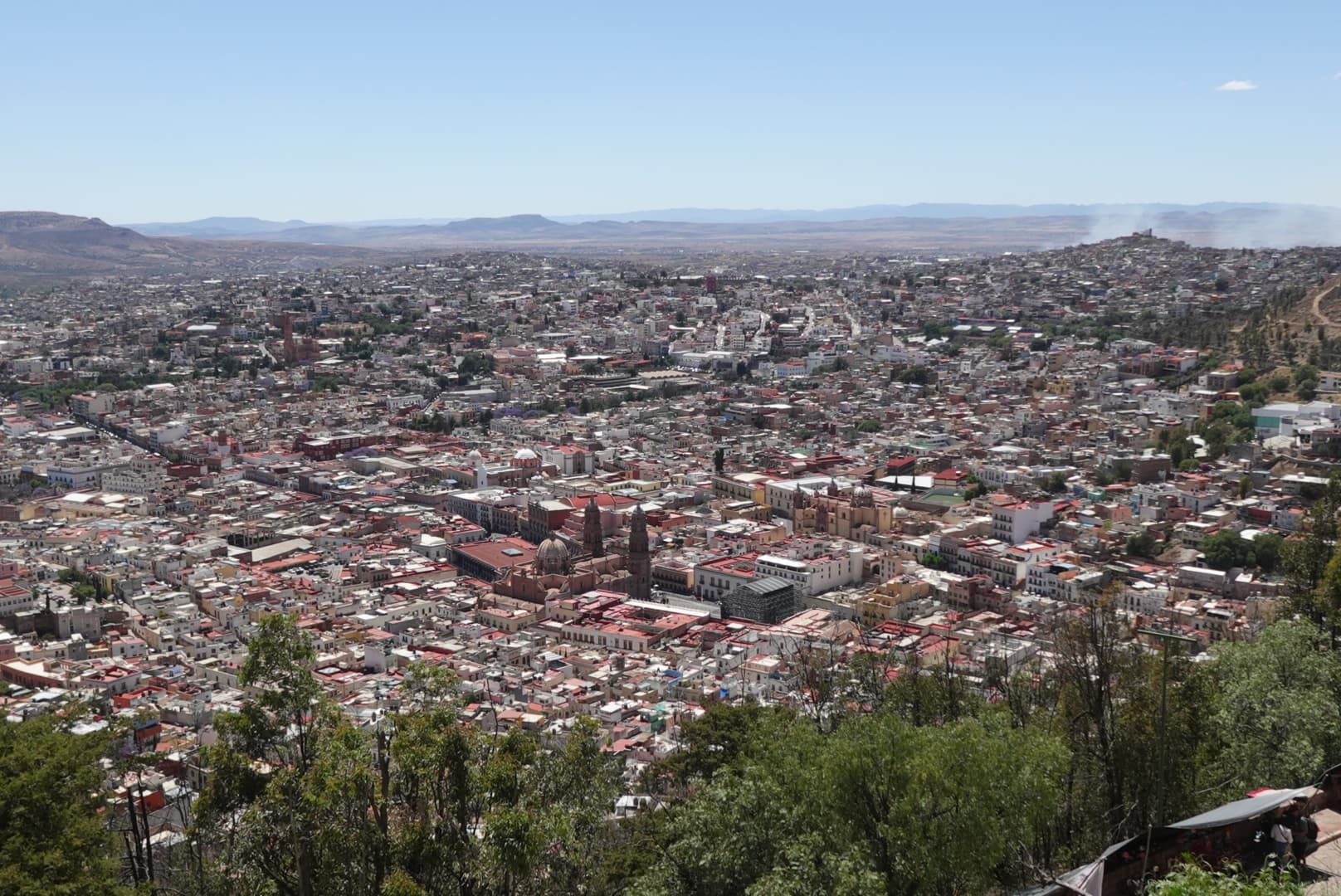
The archive value is the separation of a historical observation, its published image and competing interpretations. Bonilla's report deserves examination on its own terms, not a retroactive claim that he photographed spacecraft. The journal's drawing and photograph can be inspected in the linked original pages; the modern Zacatecas panorama shown here is only location context. No motion picture, recovered material or independently verified three-dimensional trajectory accompanies this record. Atmospheric objects remain plausible, and the comet proposal remains disputed. Neither uncertainty nor an early publication date turns the record into proof of an extraordinary origin.
Related checks and records
Timeline
- Bonilla reports 283 crossings in two hours and 48 in a later 40-minute interval, separated by cloud interruption.
- Bonilla and his assistant report 116 crossings in 45 minutes after the clouds clear.
- L'Astronomie publishes the report, track drawing, photographic reproduction and an atmospheric editorial interpretation.
- Durand Manterola, Ramos Lara and Cordero post their fragmented-comet model on arXiv.
Bonilla observation questions
Did Bonilla photograph 447 UFOs?
447 sums the reported visual crossings during three intervals. Bonilla describes several photographs, and the journal reproduces one. The count is not a photographic catalogue of 447 identified objects.
Was a near-Earth comet confirmed?
No. The 2011 preprint proposes a model with assumed speed, geometry and physical properties. Its distances, population and impact consequences are not independently measured event facts.
Where can the original image be inspected?
The source PDF contains the report on printed pages 347–350, with the photographic reproduction on page 349. The local panorama is a licensed 2026 city photograph, not an 1883 observation or a verified view of Bonilla's telescope.
Sources
- [1] ArchiveBonilla, L'Astronomie, September 1885, pp.347–350José A. y Bonilla / L'Astronomie / Harvard scan
- [2] Research2011 comet-model preprint: assumptions, not measured trajectoriesDurand Manterola, Ramos Lara and Cordero / arXiv
- [3] News reportABC, 20 October 2011: independent criticism of the comet proposalStuart Gary / ABC Science
- [4] ArchiveModern Zacatecas panorama and image licenceVaquita marina / Wikimedia Commons