
Japan / 1803 / DISPUTED
Utsuro-bune legend
Utsuro-bune is securely documented as a story and image tradition, but the reviewed local record does not establish that the reported landing happened. The archive registry ties the narrative to 22 February 1803 and Hitachi Province, while surviving descriptions are known through Edo-period texts, later copies and illustrations rather than a contemporary administrative case file. The story describes coastal people finding a rounded hollow vessel, an unfamiliar woman and unreadable writing, then returning the vessel to sea. The registered sources do not supply an eyewitness manuscript, official inquiry, physical remains or an independently fixed beach. Differences in dates, locations and pictures must therefore be treated as variants in transmission. Modern UFO readings are a later interpretive layer; the most careful classification is historical folklore with unresolved textual provenance, not evidence of extraterrestrial visitation.
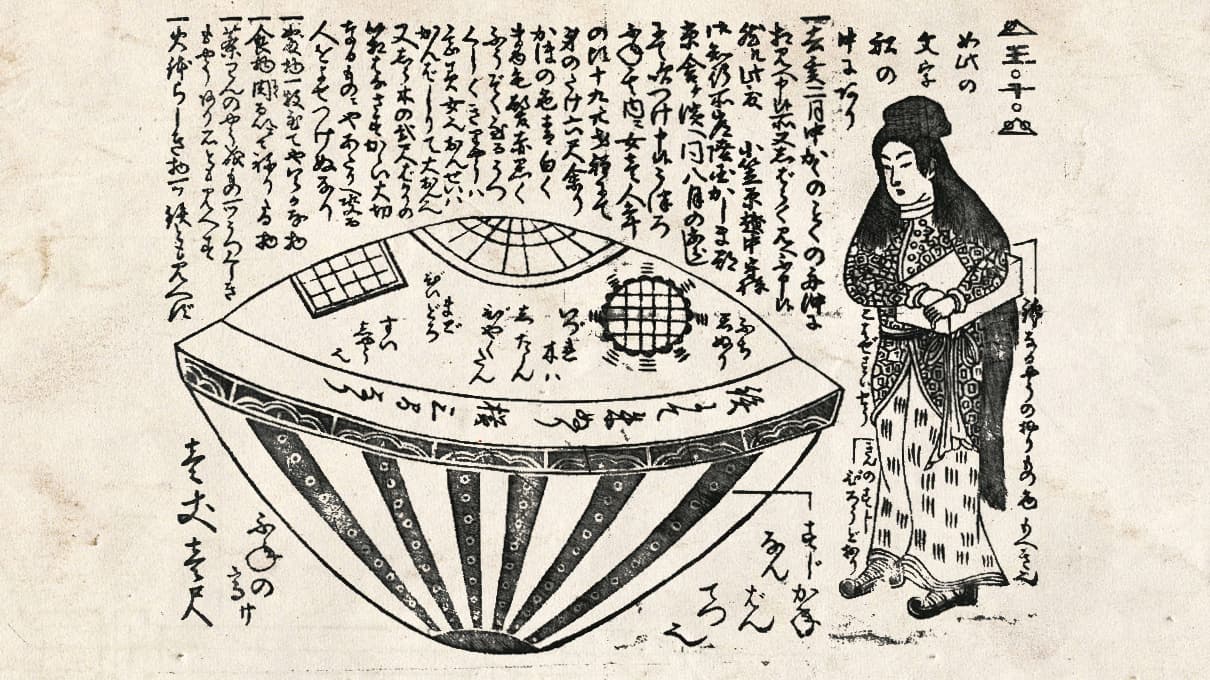
This case is disputed. The archive preserves the claims while separating evidence from interpretation.
- Documentation
- Moderate documentation
- Primary location
- Hitachi Province
- Source base
- 2 linked records
- Research use
- Comparison case
What the record supports
- Documented
- An Edo-period story and illustration tradition associated with 1803 and Hitachi Province exists.[1]
- Narrative
- The transmitted tale describes a hollow rounded vessel, a foreign-looking woman, unknown writing and a return to sea.[1]
- Image boundary
- The displayed picture is a later textual illustration, not an event photograph or measured reconstruction.[2]
Case dossier
The stable core of the tale is modest. People on a coast in Hitachi Province encounter an unusual rounded or hollow boat. Inside is a young woman whose appearance, language or possessions mark her as foreign to the narrators. The vessel bears unfamiliar signs, and the woman guards a box or object. The boat is eventually returned to the water. These are motifs reported by transmitted texts, not facts preserved in a police, port or domain record available in this repository.
The date requires care. The structured archive uses 22 February 1803, but the locally registered source metadata does not preserve the passage that produces that exact date or reconcile alternative calendrical renderings. The day may be retained as the catalog date, not promoted as independently verified chronology. Where later accounts give another day or convert a Japanese-era date differently, that is a textual and calendar variant until the underlying edition is inspected.
The location is equally bounded. Hitachi Province is consistently attached to the archive entry, but no original map, beach survey, domain log or port record is locally available to fix a precise shoreline. Named beaches in retellings should not be treated as interchangeable coordinates. The page therefore gives Hitachi as the narrative setting and marks the exact landing place as an open record gap.
The pictures are evidence for reception, not for the event. Public Domain Review is registered as a collection of Edo images, and the local Wikimedia-derived JPEG shows one traditional rendering of the vessel and figures. Its drawn forms belong to the manuscript and copying history. They cannot establish the craft’s dimensions, materials, markings, the woman’s appearance or what happened in 1803.
Folkloric readings fit the available record better than a hardware claim because the evidence consists of narrative motifs and illustrated copies. A castaway, foreign visitor, taboo container, unreadable script and return to sea can be studied within storytelling, border anxiety and images of outsiders without assuming that every detail is invented or that a literal vessel has been identified. The local material is insufficient to choose one specific folkloric origin.
The modern UFO comparison is visually understandable: a rounded vessel, windows or panels and unknown writing resemble later saucer imagery when removed from their textual setting. Resemblance is not provenance. No locally reviewed source connects the tale to sensors, recovered technology, astronomical flight or non-human occupants. The case belongs in the archive to show how an older maritime legend was reclassified by modern UFO culture—and why that reclassification must remain separate from the Edo record.
Timeline
- Catalog date assigned to the Hitachi narrative; the exact calendar derivation is not preserved in the local source record.
- Texts and illustrated copies transmit the hollow-vessel story; the local registry does not contain a complete manuscript stemma.
- Copying and illustration preserve multiple visual and textual forms; their differences are transmission evidence, not multiple landings.
- UFO writers and popular culture reinterpret the rounded vessel as a pre-modern flying-saucer encounter.
- This archive separates the 1803 narrative, later manuscript images and modern UFO interpretation, while recording unresolved provenance gaps.
Utsuro-bune questions
Did Utsuro-bune really happen in 1803?
A tradition dated to 1803 is documented, but no contemporary official file, physical evidence or independently authenticated eyewitness manuscript in the local dossier verifies the landing.
Where did the vessel supposedly land?
The archive supports Hitachi Province as the narrative setting. The exact beach is a public-record gap because the local material does not reconcile location variants.
Is the famous Utsuro-bune image a photograph?
No. It is a public-domain illustration from a later textual tradition. It records how the tale was pictured, not what a camera or verified eyewitness recorded in 1803.
What do the Edo texts prove?
They establish that the narrative and its imagery circulated. Without manuscript-level provenance they do not establish a literal landing, a single original version or the accuracy of later copies.
Was Utsuro-bune an alien spacecraft?
There is no locally reviewed evidence for that conclusion. It depends on treating a literary drawing as technical documentation and unknown writing as non-human, neither of which the sources establish.
Why archive the case?
It is a useful boundary case showing how maritime folklore, manuscript copying and later UFO culture interact. Archiving the reinterpretation does not endorse it.
Sources
- [1] ArchiveUnidentified Floating Object: Edo Images of Utsuro-bunePublic Domain Review
- [2] ArchiveUtsuro-bune illustrationWikimedia Commons
Public-domain illustration preserved through a later textual tradition. It shows how the story was pictured; it is not a photograph of 1803, an eyewitness sketch verified at the scene, or a technical reconstruction.