United States / 1942 / EXPLAINED
Battle of Los Angeles UFO case
The Battle of Los Angeles was a real wartime air-defense emergency, not evidence that an alien craft attacked California. After a radar contact and escalating reports, antiaircraft batteries fired about 1,400 rounds between roughly 03:00 and 04:15 on 25 February 1942. No bombs fell, no aircraft was shot down and postwar Japanese records disclosed no raid. Contemporary officials disagreed, but later military histories judged that a meteorological balloon probably triggered the firing and that smoke, flares and shell bursts created further apparent targets. Five civilian deaths were attributed indirectly to traffic accidents and heart attacks during the blackout. The famous searchlight image is a retouched newspaper print and cannot identify what, if anything, was in the beams.
This archive treats the case as explained or substantially resolved by conventional evidence.
- Documentation
- High documentation
- Primary location
- Los Angeles, California
- Source base
- 7 linked records
- Research use
- Comparison case
What the 1942 record supports
- Confirmed event
- A blackout, searchlight operation and barrage of about 1,400 antiaircraft rounds occurred over greater Los Angeles early on 25 February 1942.[1][2][3]
- Casualty boundary
- Five civilian deaths were attributed indirectly to traffic accidents and heart attacks during the blackout, not to bombs or confirmed enemy fire.[4][6]
- Target boundary
- No bombs fell, no aircraft was shot down, no wreckage was recovered and postwar Japanese records disclosed no Los Angeles air raid.[1][2]
- Leading explanation
- Official histories and a 1949 inquiry account point to meteorological balloons, followed by smoke and shell bursts misread as additional targets.[1][5]
- Photograph warning
- The iconic Los Angeles Times print was substantially retouched; it documents newspaper presentation, not the outline of an alien craft.[6]
Case dossier
Southern California entered the night expecting attack. Pearl Harbor was less than three months past, West Coast air defense was thin and inexperienced, and Japanese submarine I-17 had shelled the Ellwood oil installations near Santa Barbara on 23 February. Naval intelligence warned on 24 February that another attack might come within ten hours. Reports of flares and blinking lights near defense plants produced an evening alert from 19:18 to 22:23. This verified context matters: the people and crews involved were reacting to a plausible wartime threat, not participating in a peacetime UFO investigation.
Early on 25 February, coastal radar reported an unidentified target about 120 miles west of Los Angeles moving toward shore. Antiaircraft units were alerted at 02:15, and the regional controller ordered a blackout at 02:21. The radar target was followed toward the coast but then disappeared from the reporting picture. The information center nevertheless received a flood of visual reports. At 03:06, an illuminated balloon was reported over Santa Monica and four batteries opened fire. Other batteries joined them, and the barrage continued intermittently until about 04:15. The Army Air Forces kept its limited pursuit aircraft on the ground while commanders waited to understand the scale and direction of any attack.
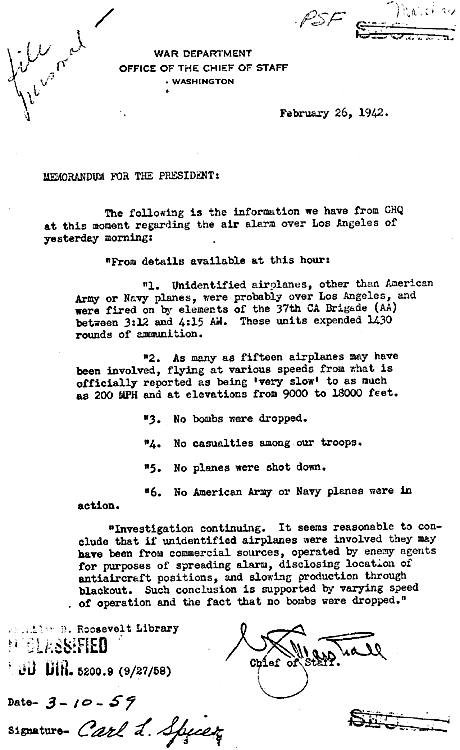
The measurable event was the response. Contemporary and official summaries place the expenditure at about 1,400 to 1,440 three-inch rounds; Marshall's 26 February memorandum gave 1,430. Searchlights, tracers and exploding shells were visible across a broad arc from Santa Monica toward Long Beach. Falling fragments and rounds that failed to burst at altitude damaged roofs, vehicles and other property. No bomb damage was found, no aircraft was brought down, no wreckage was recovered and no American Army or Navy aircraft was in action. Those negative findings sharply limit later claims that the batteries fought a large, solid craft.
Civilian harm must be described precisely. Later Los Angeles Times reporting and the 1946 federal history Wartime Exile attributed five deaths to the episode: traffic accidents in blacked-out streets and heart attacks during the alarm. Other people were injured while rushing to posts or enforcing blackout rules, and antiaircraft debris caused scattered property damage. The public record used here does not show that an aerial attacker killed anyone, nor that the five deaths were direct artillery strikes. They were indirect casualties of the blackout, alarm and defensive response.
Official interpretation was not uniform. Navy Secretary Frank Knox called the event a false alarm caused by wartime nerves. The Army initially withheld its view, then local commanders concluded after witness interviews that one to five unidentified airplanes might have been present. War Secretary Henry Stimson publicly offered speculative possibilities involving commercial aircraft flown by enemy agents or light aircraft from submarines. Marshall's memorandum similarly said as many as fifteen aircraft may have been involved but explicitly framed that as an estimate and said the investigation continued. None of these contemporary statements identified a recovered aircraft or extraordinary technology.
The postwar military record narrowed the explanation. The official Army Air Forces history noted that meteorological balloons were known to have been released, that the artillery was criticized for firing at targets too slow to be aircraft, and that drifting shell smoke impaired observation. A 1949 Antiaircraft Journal account by Colonel John G. Murphy, who served on the inquiry board, said one regiment launched a meteorological balloon around 01:00 and another balloon preceded a renewed burst of firing. This is strong conventional evidence, although it is a retrospective account and does not independently explain the first offshore radar return.
The iconic photograph has a separate provenance problem. Los Angeles Times archive editor Scott Harrison inspected an unretouched negative or copy negative and a copy negative made from the retouched print. He reported that newspaper artists widened and brightened some searchlight beams, removed others and strengthened white marks for reproduction on newsprint. A different, more heavily marked version appeared in 1945. Retouching was routine production practice, not proof of a secret object being erased; equally, the painted convergence cannot be treated as the outline of a craft. Because the Times image lacks a clear commercial reuse license and the existing local file reproduces a full newspaper photo page, this dossier links to the archive analysis but does not display that page as evidence.
The UFO interpretation is later cultural reuse of an unresolved wartime alarm. The event predates the 1947 flying-disc wave, and its contemporary documents discuss enemy aircraft, balloons, radar, civil defense and institutional failure—not extraterrestrial visitors. Later UFO media isolated the most dramatic retouched image and recast 'unidentified' as extraordinary. A careful conclusion is narrower: the alert and barrage are exceptionally well documented; the immediate reports were contradictory; a meteorological balloon and feedback from the defense response plausibly explain most of the visible episode; and the first radar return is not reconstructed well enough in public records to identify with certainty. None of that supplies positive evidence for nonhuman technology.
Timeline
- Japan attacks Pearl Harbor; West Coast defenses enter a prolonged state of alarm.
- Japanese submarine I-17 shells the Ellwood oil installations north of Santa Barbara.
- An evening alert follows intelligence warnings and reports of lights near defense plants, then is lifted.
- Radar and visual reports lead to blackout and an antiaircraft barrage of about 1,400 rounds; no aircraft is shot down.
- The Navy calls the episode a false alarm; Army statements retain possible unidentified aircraft while the inquiry continues.
- Colonel John G. Murphy publishes a retrospective inquiry account identifying meteorological balloons as the trigger.
- Los Angeles Times archive reviews document the retouched and unretouched versions of the iconic photograph.
Battle of Los Angeles questions
Did the Battle of Los Angeles really happen?
Yes. The blackout, searchlights, antiaircraft firing, falling fragments and official dispute are extensively documented. What was not confirmed was an enemy or extraordinary aircraft.
What did the military shoot at?
The best-supported trigger is an illuminated meteorological balloon. After firing began, smoke, flares and shell bursts probably generated further apparent targets. The first offshore radar return remains insufficiently documented for certain identification.
Were five people killed by antiaircraft shells?
The cited records attribute five deaths indirectly to traffic accidents and heart attacks during the blackout. Shell fragments damaged property and injuries were reported, but the five deaths should not be described as direct shell strikes.
Does the famous photograph show a UFO?
It shows searchlights and bright marks, but the widely circulated newspaper version was substantially retouched for print. It has no scale or distance and cannot establish a solid craft at the point where the beams appear to meet.
Did Japan attack Los Angeles from the air that night?
Postwar Japanese statements and military histories say no Japanese aircraft raided Los Angeles. I-17 had shelled Ellwood two days earlier, but that real submarine attack should not be merged with the later air alarm.
Why is it included in a UFO archive?
Later UFO culture reframed an unidentified wartime alert through a dramatic retouched image. The case is useful for studying how ambiguous records become extraordinary narratives, not because it proves nonhuman technology.
Sources
- [1] Official fileAir Defense of the Western Hemisphere: The Battle of Los AngelesOffice of Air Force History / U.S. Army Air Forces
- [2] Official fileGuarding the United States and Its Outposts: West Coast defensesU.S. Army Center of Military History
- [3] ArchiveMemorandum for the President on the Los Angeles air alarmWar Department, Office of the Chief of Staff / Wikimedia Commons mirror
- [4] Official fileWartime Exile: The Exclusion of the Japanese Americans From the West CoastU.S. Department of the Interior / War Relocation Authority
- [5] ResearchActivities of the Ninth Army AAA: L.A. ‘Attacked’Antiaircraft Journal / United States Coast Artillery Association
- [6] News reportFrom the Archives: The 1942 Battle of L.A.Los Angeles Times
- [7] ResearchThe Great Los Angeles Air Raid Terrified Citizens—Even Though No Bombs Were DroppedSmithsonian Magazine
The displayed Marshall memorandum is a local copy of a public-domain U.S. federal document. It records the Army's preliminary 26 February account and is not a photograph of any target. The iconic Los Angeles Times searchlight page is not displayed: the published image was substantially retouched, the local legacy file reproduces a full newspaper photo page, and a clear commercial republication license was not verified.