
United States / 2023 / EXPLAINED
2023 North American High-Altitude Object Shootdowns
Between 10 and 12 February 2023, U.S. fighters shot down three objects over northern Alaska, Yukon and Lake Huron after the North American Aerospace Defense Command detected them during heightened scrutiny following the Chinese surveillance balloon incident. The Alaska and Yukon objects flew near 40,000 feet; the Lake Huron object was tracked near 20,000 feet. Officials treated their uncertain identity and operating altitudes as civil-aviation and possible surveillance risks. Searches later ended without recovering debris from any of the three, so no public physical examination established an exact model or owner. President Joe Biden said the intelligence community considered balloons linked to private, recreational or research activity the most likely explanation and found no evidence tying the objects to China's surveillance program or another country's surveillance fleet. The events are well documented as air-defense operations, but the objects remain individually unidentified in the public record.
This archive treats the case as explained or substantially resolved by conventional evidence.
- Documentation
- High documentation
- Primary location
- Northern Alaska, Yukon and Lake Huron
- Source base
- 11 linked records
- Research use
- Comparison case
What the official record establishes
- Confirmed operations
- Official records confirm three radar-supported intercepts and shootdowns over Alaska, Yukon and Lake Huron from 10 to 12 February 2023.[3][4][6]
- Separate from China balloon
- The three small objects were not publicly linked to China's surveillance program and, unlike that balloon, yielded no recovered debris.[2][3]
- Detection change
- NORAD adjusted radar settings after the Chinese balloon, making more slow-moving objects visible; officials found no evidence of a sudden increase in the sky.[2][5]
- No recovered debris
- Searches in Arctic conditions, remote Yukon terrain and Lake Huron ended without locating material attributable to the three targets.[5][8]
- Best current assessment
- Benign balloons or similar lightweight platforms are the leading assessment, but the exact model, owner and purpose of each object were not physically confirmed.[2]
Case dossier
The three shootdowns must be separated from the Chinese surveillance balloon destroyed off South Carolina on 4 February 2023. That larger balloon had been tracked across North America, attributed by the United States to a Chinese surveillance program and substantially recovered. The later objects were smaller, encountered between 10 and 12 February, and were not publicly linked to that program. Grouping all four under one label obscures the most important evidentiary difference: investigators recovered and analyzed the Chinese balloon, but did not recover the Alaska, Yukon or Lake Huron objects.
NORAD detected the first smaller object on ground radar on 9 February over northern Alaska. Fighters investigated it, and officials described it as roughly the size of a small car at about 40,000 feet, an altitude used by civilian aircraft. On 10 February, an F-22 from Joint Base Elmendorf-Richardson fired an AIM-9X missile and brought it down over U.S. territorial water off Alaska's northern coast. The Pentagon said the immediate reason was the reasonable hazard to civil flight. At that stage it had no public description of the object's capabilities, purpose or origin.
The second object was detected over Alaska late on 10 February and tracked as it crossed into Canadian airspace. U.S. F-22s followed it, while Canadian CF-18 fighters and a CP-140 patrol aircraft joined the response. After consultation between President Biden and Prime Minister Justin Trudeau, an American F-22 shot it down over Yukon on 11 February. Canadian officials described a small cylindrical object near 40,000 feet. This was the first time NORAD's binational system had conducted an airborne-object shootdown, but that operational milestone did not establish what the object was.
The Lake Huron sequence began with a radar contact near Montana on 11 February. Fighters searched after dark but did not find an object, and the contact became intermittent as it moved toward Wisconsin. It was reacquired and visually tracked through Michigan on 12 February. Officials said it was near 20,000 feet and posed both an aviation concern and an unresolved security question. An F-16 fired two AIM-9X missiles: the first missed and fell harmlessly into the lake; the second struck the target. This correction, confirmed by General Mark Milley, is important because early accounts often omitted the missed shot.
The apparent wave was partly a change in detection practice. After the Chinese balloon crossed the continent, NORAD enhanced and narrowed radar settings to pick up more slow-moving objects. President Biden later said there was no evidence of a sudden increase in the number of objects in the sky; authorities were seeing more partly because radar scrutiny had changed. That does not make the three tracks imaginary. It explains why small objects that might previously have been filtered out or monitored differently appeared within three days and received national attention.
Public descriptions were provisional and did not amount to technical identifications. Officials compared the Alaska object with a small car, called the Yukon object cylindrical and discussed the Lake Huron target as a small structure with possible strings or a payload. Pilots also differed in how they described the objects, which is unsurprising when intercepting small, slow targets without a stable reference at altitude. No authenticated close-up photograph, onboard video or complete radar package for the three targets has been released publicly. Later illustrations and news footage should therefore not be presented as images of the objects themselves.
Recovery was the decisive evidentiary failure. Canadian teams searched the Yukon area until 17 February, when severe winter conditions and the falling probability of recovery ended the effort. U.S. Northern Command also concluded searches near Deadhorse, Alaska, and in Lake Huron after airborne, surface and subsurface work found no debris. Arctic sea ice, weather, remote terrain and deep water constrained the operations. Because nothing attributable to the three targets entered a public chain of custody, later claims that any one object was definitively a hobby balloon, weather device or surveillance platform remain assessments rather than recovered-hardware identifications.
On 16 February, Biden said the intelligence community's current assessment was that the three objects were most likely balloons connected to private companies, recreation, weather work or scientific research. He also said nothing then suggested a connection to China's surveillance-balloon program or surveillance vehicles from another country. This is the strongest published conventional assessment, but its wording matters: most likely is not a recovered-item identification. The case belongs in a UAP archive because it shows how a genuine unidentified-airspace problem can trigger military action while remaining compatible with ordinary technology and incomplete public evidence.
Related video
Timeline
- A U.S. F-22 shoots down the separately identified Chinese surveillance balloon off South Carolina; substantial debris is later recovered.
- NORAD detects a small object on ground radar over northern Alaska and sends fighters to investigate.
- An F-22 fires an AIM-9X and downs the Alaska object over U.S. territorial water after officials cite a civil-aviation hazard.
- A second object is detected over Alaska, followed into Canadian airspace and tracked jointly by U.S. and Canadian aircraft.
- After Biden-Trudeau consultation, a U.S. F-22 shoots down the cylindrical Yukon object near 40,000 feet.
- A radar contact appears near Montana; a night search does not visually locate it and the track later becomes intermittent.
- The contact is reacquired over the Great Lakes; an F-16's first AIM-9X misses, and its second missile downs the object over Lake Huron.
- General Mark Milley publicly confirms that the first Lake Huron missile missed and landed harmlessly in the water.
- Biden says the objects were most likely benign balloons and that increased radar scrutiny helped produce the cluster of detections.
- Canadian and U.S. authorities end the Yukon, Alaska and Lake Huron recovery efforts without locating attributable debris.
Frequently asked questions
Did the 2023 high-altitude object shootdowns really happen?
Yes. U.S. and Canadian official records document radar detections, fighter missions and three shootdowns over Alaska, Yukon and Lake Huron.
Were the objects extraterrestrial craft?
No public evidence supports that conclusion. The White House said the leading assessment was benign balloons connected to private, recreational or research activity.
Were they Chinese spy balloons?
Officials said they had no evidence connecting the three smaller objects to China's surveillance-balloon program or another country's surveillance fleet.
Why were the objects shot down?
They were unidentified, operated at altitudes used by civilian aircraft and could not immediately be cleared of a surveillance risk. Officials chose locations where the engagements could be conducted more safely.
What did the pilots see?
Descriptions varied: officials discussed small car-sized, cylindrical and structure-like targets. No authenticated close-up imagery or complete cockpit-sensor package has been released publicly.
Was any debris recovered?
No attributable debris from the Alaska, Yukon or Lake Huron objects was publicly recovered. Searches ended on 17 February because of conditions and declining recovery probability.
Why did three detections occur in three days?
After the Chinese balloon, NORAD changed radar settings to detect more slow-moving objects. Officials said the cluster reflected increased scrutiny, not evidence of a sudden increase in objects.
Sources
- [1] Official filePresident Biden's remarks on recent aerial objectsThe White House
- [2] Official filePentagon briefing on the Alaska object shootdownU.S. Department of Defense
- [3] Official fileNORAD statement on the Yukon object shootdownU.S. Department of Defense
- [4] Official fileCanada briefing notes on the 2023 high-altitude objectsDepartment of National Defence Canada
- [5] Official fileNORAD and Pentagon briefing on the Lake Huron objectU.S. Department of Defense
- [6] Official fileAustin and Milley press conference on the aerial-object responseU.S. Department of Defense
- [7] Official fileU.S. Northern Command recovery update on airborne objectsU.S. Northern Command
- [8] Official fileCanadian national-security update on the Yukon objectDepartment of National Defence Canada
- [9] News reportU.S. and Canada end searches for three downed objectsAssociated Press
- [10] News reportWhite House briefing coverage after the North American shootdownsABC News / YouTube
- [11] Official fileF-22 Raptors ascend above Alaska: contextual Air Force photographDefense Visual Information Distribution Service
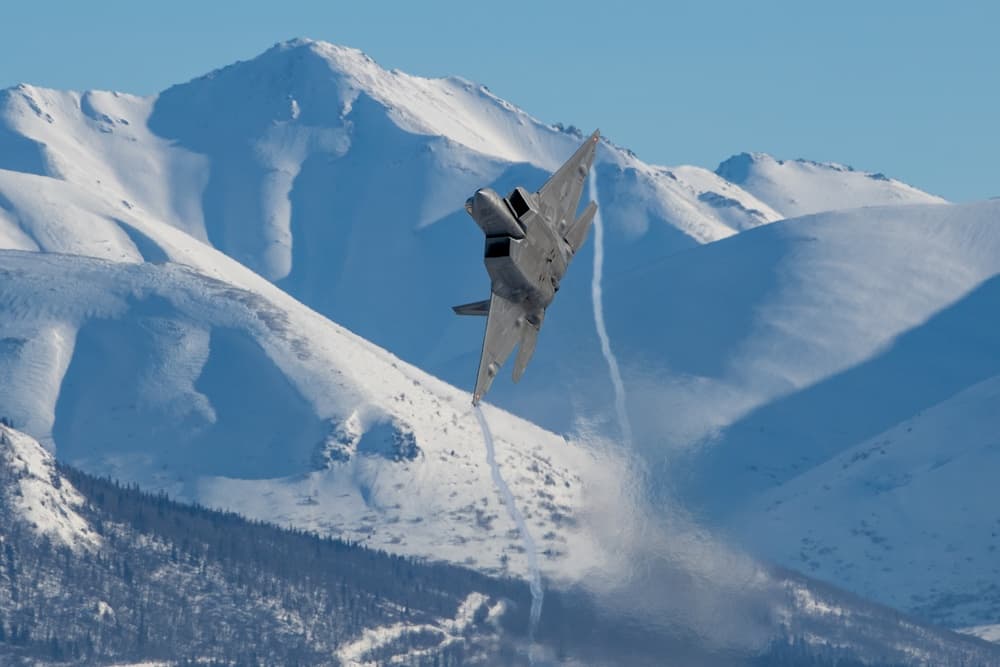
The main image is a U.S. Air Force photograph of an F-22 assigned to the 525th Fighter Squadron flying near Joint Base Elmendorf-Richardson on 27 February 2023. DVIDS marks it public domain. It illustrates the Alaska location and interceptor type but was taken after the shootdown and does not show the mission or any of the three objects. The ABC News video is later briefing coverage, not original target footage.