
United States / 2023 / EXPLAINED
Eglin AFB UAP case resolution
On 26 January 2023, a U.S. military pilot near Eglin Air Force Base detected four radar targets between about 16,000 and 18,000 feet, then visually observed only one and captured one electro-optical and one infrared still image. The video recorder was already inoperable, so no event video exists. AARO concluded with moderate confidence that the imaged object was very likely a lighter-than-air craft, based on its reported behavior, viewing geometry, wind and sun conditions, and comparison testing with a commercial lighting balloon. The other three radar targets lacked imagery and could not be analyzed. A radar circuit-breaker trip during the approach had occurred repeatedly on the same aircraft before the event, so the public record does not support attributing that fault to the object.
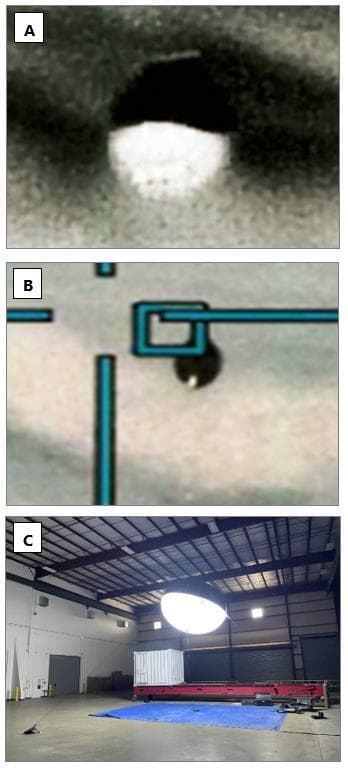
This archive treats the case as explained or substantially resolved by conventional evidence.
- Documentation
- High documentation
- Primary location
- Eglin Air Force Base training range, Florida
- Source base
- 6 linked records
- Research use
- Comparison case
What the public record establishes
- Initial detection
- A military pilot detected four radar targets at roughly 16,000–18,000 feet, but visually located only one of them.[1]
- Released imagery
- The public report reproduces one electro-optical and one infrared event still. The recorder was already inoperable, so no original event video exists.[1]
- Pilot description
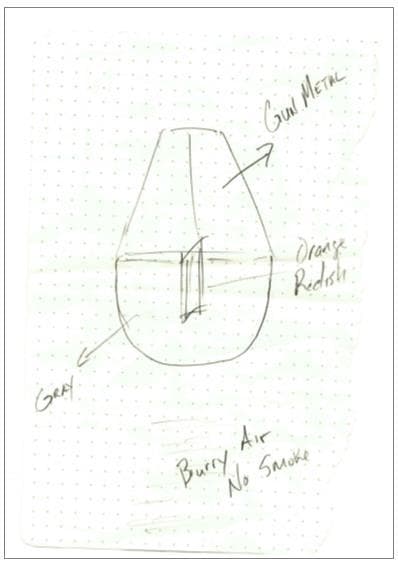
- The pilot described a gray paneled object with an orange-red center, about twelve feet across, moving very slowly or appearing stationary.[1]
- Radar fault boundary
- The same radar circuit breaker had tripped three times on that aircraft in preceding months; no public measurement links the fault to the object.[1]
Official analysis images
Case dossier
The incident began as an operational radar contact, not a public sighting. A military pilot flying near Eglin Air Force Base on 26 January 2023 detected four returns between roughly 16,000 and 18,000 feet. They initially appeared arranged in a formation. Because unidentified traffic in a sensitive training area could create a collision or range-security risk, the report entered military channels and was later reviewed by the All-domain Anomaly Resolution Office (AARO). The released report does not identify the aircraft, pilot or exact coordinates, and that redaction limits independent reconstruction.
The pilot maneuvered toward the contacts and visually located only one of the four. The witness described a gray, paneled object with an orange-red center, about twelve feet across, moving very slowly or appearing stationary. Its rounded or conical outline was compared with an Apollo spacecraft. A later interview added a vertically oriented engine, but that feature was absent from the initial report and is not visible in the released still images. AARO therefore treated it as an uncorroborated later recollection rather than a confirmed component.
The aircraft captured two still images of that single object: one electro-optical frame and one infrared frame. These are genuine event records reproduced in the AARO report, but they are low-detail and do not preserve a continuous trajectory. The onboard video recorder was known to be inoperable before and during the flight, so no original event video was recorded. Claims that AARO withheld cockpit motion footage are not supported by the report; what remains publicly inspectable is the pair of stills and AARO's comparison material.
As the aircraft closed to within about 4,000 feet, the radar stopped functioning after a circuit breaker tripped. Maintenance history showed that the same breaker had tripped three times in the preceding months on that aircraft. AARO therefore found the fault most consistent with a pre-existing equipment problem. The timing deserves documentation, but timing alone does not establish causation, and the public file contains no electrical measurement showing that the nearby object interfered with the radar.
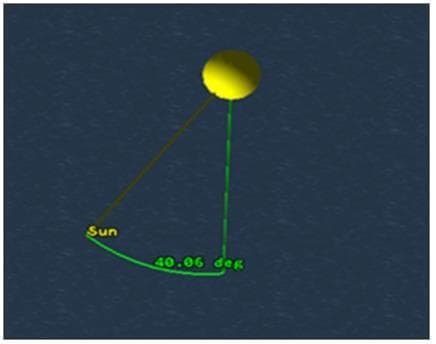
AARO tested several lighter-than-air possibilities against the report. The candidate classes included a large balloon, a weather balloon, a Mylar balloon and a commercial helium lighting balloon. Investigators compared the pilot's geometry, the Sun's position and reported winds with the appearance of a commercial lighting balloon, and conducted a laboratory comparison that reproduced some visual and thermal features. The report also notes that the described 'blurry air' could reflect a tether, environmental distortion or motion blur rather than propulsion.
Two partner reviews strengthened the conventional assessment without turning it into an exact identification. An Intelligence Community partner judged the object non-anomalous with high confidence after considering altitude, coordinates, viewing angle, heading and solar geometry. A science-and-technology partner also judged it very likely a balloon, using military and commercial radar deconfliction and noting that reflected Earth light and red tether points could help explain its appearance. These are summarized partner conclusions; their complete analytical workbooks are not included in the public release.
The case entered public debate before the resolution report was released. At a House Oversight hearing on 26 July 2023, Representative Matt Gaetz described information he said he obtained during a visit to Eglin, including four objects and a sensor failure. That testimony confirms congressional interest and preserves a second-hand account, but it is not the pilot's raw statement or sensor file. The AARO report dated 14 October 2023 provides the more detailed official evidentiary record and explains why the equipment fault was not attributed to the object.
Eglin belongs in the archive because it shows both the value and limits of a resolved UAP case. The report documents a professional witness, radar contacts, genuine EO/IR stills, an equipment anomaly and a published analytical process. It also separates what was not established: no video exists, three radar targets were never imaged, the exact balloon model and owner were not identified, and no anomalous performance was confirmed. The strongest current conclusion is therefore AARO's moderate-confidence lighter-than-air assessment, not proof of an exotic craft and not proof that every detail has been reconstructed.
Timeline
- Radar detects four targets between about 16,000 and 18,000 feet near Eglin AFB.
- The pilot approaches and visually observes one target; the other three receive no EO/IR imagery.
- One electro-optical and one infrared still image are captured; the inoperable recorder produces no video.
- At about 4,000 feet from the object, the radar circuit breaker trips and the radar stops.
- Maintenance records show three earlier circuit-breaker trips on the same aircraft, weakening a causal link to the object.
- A later pilot interview adds a vertical engine description that is absent from the initial report and images.
- A House Oversight hearing records a second-hand congressional account of four objects and a sensor fault.
- AARO dates its case-resolution report and concludes the imaged object is very likely lighter than air with moderate confidence.
- AARO publicly points readers to the Eglin case-resolution report.
- AARO's FY2024 annual report describes the office's broader resolution and data-quality framework.
Frequently asked questions
What happened near Eglin AFB on 26 January 2023?
A military pilot detected four radar contacts, approached them, visually saw one object and obtained two still sensor images. AARO later resolved the imaged object as very likely lighter-than-air.
Were there four visible objects?
No. Four targets appeared on radar, but the pilot visually located and imaged only one. The other three cannot be characterized from the public record.
Are the Eglin images event photographs?
The EO and IR stills are genuine event sensor records reproduced by AARO. They are low-detail stills, not ordinary photographs and not a continuous video. A separate comparison panel shows AARO's later balloon test.
Is there an original video of the Eglin UAP?
No. AARO states that the recorder was inoperable before and during the flight. The public event record contains two still images, not motion footage.
Why did AARO favor a balloon explanation?
Reported motion, viewing geometry, wind and sunlight were consistent with a lighter-than-air object. A commercial lighting-balloon test also reproduced relevant appearance features, although it did not identify an exact model.
Did the object disable the aircraft radar?
The public evidence does not establish that. The same circuit breaker had tripped three times previously, so AARO considered a pre-existing equipment fault more likely.
Is the 2023 Eglin UAP case solved?
AARO closed the imaged-object portion with moderate confidence as very likely lighter-than-air. The exact model and owner were not identified, and the other three radar contacts remain uncharacterized, so the resolution is a class assessment rather than a unique identification.
Sources
- [1] Official fileAARO Eglin UAP case-resolution reportAll-domain Anomaly Resolution Office
- [2] Official fileAARO UAP case-resolution reports indexAll-domain Anomaly Resolution Office
- [3] Official fileHouse hearing on unidentified anomalous phenomenaU.S. House Committee on Oversight and Accountability
- [4] Official fileFY2024 consolidated annual report on UAPAll-domain Anomaly Resolution Office / Department of Defense
- [5] Official fileAARO mission and oversight officeOffice of the Under Secretary of Defense for Intelligence and Security
- [6] Official file96th Test Wing flight line at Eglin AFB96th Test Wing / United States Air Force
The main image combines the two genuine EO/IR event stills reproduced by AARO with a clearly labeled frame from AARO's later commercial lighting-balloon comparison. The comparison frame is not event imagery. The pilot drawing and Sun-geometry figure are later analytical records. No original event video exists because the recorder was already inoperable.