United States / 2019 / UNRESOLVED
2019 USS Omaha Sphere Video
A short monochrome video publicly released in May 2021 shows a small round target near the ocean horizon while shipboard voices track it and one operator says, "splash" as the image disappears. Filmmaker Jeremy Corbell attributed the recording to USS Omaha on 15 July 2019. Pentagon spokesperson Susan Gough confirmed that Navy personnel recorded the imagery and that the UAP Task Force included it in ongoing examinations. That confirmation did not publicly verify the ship, date, exact location, target size, speed, water entry or underwater continuation. A Navy FOIA response later found that Omaha's retained logs and voice records for 1-18 July 2019 were unavailable, preventing direct public correlation with the claimed date. The clip is an authentic Navy-made record of an unresolved observation, but the stronger "transmedium sphere" interpretation remains unproven.
This case remains unresolved in the public record, with credibility grade B.
- Documentation
- High documentation
- Primary location
- Pacific Ocean off California
- Source base
- 10 linked records
- Research use
- Comparison case
What the public record supports
- Confirmed fact
- The Pentagon confirmed that Navy personnel recorded the imagery and that the UAP Task Force included it in examinations.[1][2]
- Attributed detail
- USS Omaha, 15 July 2019, exact location and the transmedium description come chiefly from the private publication chain, not the narrow Pentagon confirmation.[2][3][4]
- Records gap
- The Navy reported that Omaha logs and voice records for 1-18 July 2019 were unavailable, preventing direct public correlation.[1]
Case dossier
The recorded display and the disappearance
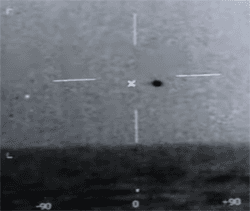
The public case begins with a brief video of a sensor display rather than the original sensor file. A dark, roughly circular spot appears against a pale sky and sea horizon while personnel call bearings and range-related observations. Near the end, a voice says, "It splashed," and the target disappears from the displayed scene. The edited public clip does not show a measurable splash, an uninterrupted track below the surface or a recovered object. [3] · [4]
The May 2021 private release
Jeremy Corbell published the clip on 14 May 2021 and said it had been recorded from USS Omaha off Southern California on 15 July 2019. He also circulated claims about target dimensions, speed, multiple contacts and a later submarine search. Those details shaped the case's public identity, but they came through a private release and associated reporting rather than a publicly released Navy event file. The distinction matters because provenance of the imagery and validation of every accompanying claim are separate questions. [2] · [3]
The Pentagon’s narrow confirmation
Pentagon spokesperson Susan Gough told The Debrief that Navy personnel had taken the video and that the UAP Task Force had included it in ongoing examinations. This is the strongest public official statement tied to the clip. It supports military origin and investigative relevance; it does not identify the target or independently confirm the reported ship, date, geographic coordinates, dimensions, velocity, water entry or transmedium performance. [2]
Range, contrast and the waterline
The displayed geometry is difficult to reconstruct. The public copy lacks the original file, full sequence, sensor mode and settings, platform position and motion, calibrated range, target track and environmental measurements. A small round image can represent targets of very different size at different distances, while the horizon and waterline can hide or merge a low-contrast target. Operator commentary is valuable contemporaneous context, but it is not a substitute for a continuous calibrated track. [3] · [4]
What the Navy records search found
A 2021 Navy FOIA request specifically sought records for the reported 15 July Omaha event and ship logs for 13-18 July. The Navy response stated that USS Omaha searched digital, optical-disc, voice and paper holdings, but the prior crew had not retained or created records for 1-18 July 2019. Naval History and Heritage Command and the Federal Records Center likewise did not locate those dates; later July logs were released. The missing interval does not disprove the clip, but it removes the most direct public route for checking time, position, watches and contemporaneous annotations. [1] PDF pp. 1–3
A missing interval is not a classified file
The Navy’s 15 September 2021 letter explains that this ship class kept underway deck logs as digital voice recordings, periodically transferred to optical discs and sent to NHHC. Its search covered digital files, discs, voice recordings and paper. The response supplied logs for 19–31 July while identifying a gap for 1–18 July. Separately, the partial denial concerned third-party personal identifiers under FOIA exemption (b)(6). Those privacy redactions should not be confused with the missing earlier records: the letter does not say a complete 15 July event file was located and withheld as classified. It flags a retention problem, without establishing why the earlier material was absent. [1] PDF pp. 1–3
The wider July 2019 encounters
The clip also sits within a broader series of July 2019 encounters involving Navy ships near Southern California. Documents obtained by The War Zone describe personnel reporting and responding to unmanned aircraft or drone activity around several vessels. That broader record establishes a real operational concern and a conventional category under active consideration. It does not by itself identify the round target in this particular clip or prove that all reported contacts had one cause. [5] · [6]
Different ships, dates and sensors
The wider fleet record cannot be treated as a single continuous observation. The War Zone’s June 2022 investigation distinguishes Russell’s 17 July night-scope encounter, Paul Hamilton’s 21 July report and Gabrielle Giffords’ 25 July contacts, among other events. Ships differed in their equipment, responses and assessments. The triangular appearance discussed in congressional testimony concerned night-vision imagery and its optical recording chain; it was not an analysis of Omaha’s round infrared target. Evidence identifying drones in one sequence does not automatically identify this target, just as the unresolved sphere does not invalidate the other ships’ drone reports. [5]
The 2024 congressional account
At the 13 November 2024 House hearing, retired Rear Admiral Tim Gallaudet described Omaha watchstanders seeing an object enter the water and characterized that as transmedium travel. In that exchange he said he did not remember the exact date, and he did not present himself as an eyewitness aboard Omaha. The transcript is a primary record of what Gallaudet told Congress, not a contemporaneous shipboard observation or a newly released sensor track. His interpretation belongs in the case history with clear attribution; its inclusion in an official hearing does not turn the claimed underwater continuation into a measured result. [9]
Conventional explanations still need measurements
Conventional possibilities include a balloon, drone, distant aircraft or another small object whose range is unknown, combined with infrared-display contrast, horizon geometry and loss of track. Sensor or compression artifacts may affect the apparent outline, although the confirmed Navy provenance means the case should not be dismissed as a wholly fabricated internet animation. Claims of exceptional speed or underwater continuation require the missing calibrated and corroborating data. [2] · [3] · [4]
What remains unresolved
USS Omaha belongs in the archive because it clearly demonstrates two different evidentiary levels. A short Navy-recorded clip and operator audio establish that personnel tracked something they had not identified in the moment. The public material does not establish what it was or that it crossed from air into water. The case therefore remains UNRESOLVED with credibility B: meaningful provenance, limited measurement and an interpretation that must stay narrower than the most dramatic public claim. [1] · [2] · [3]
Original public release
Jeremy Corbell's upload is the earliest identified public release used for this case. It contains Navy-recorded imagery, but its title and description include private claims beyond the Pentagon's narrow confirmation.
Related video
Related checks and records
Timeline
- The later Navy FOIA response says USS Omaha's retained logs and voice records for this interval were unavailable.
- The private release later attributed the short infrared-display recording to USS Omaha operations off Southern California on this date.
- Several Navy ships in the region documented and responded to broader unmanned-aircraft activity during the same month.
- Jeremy Corbell publicly released the clip and described it as a spherical target entering the ocean.
- Pentagon spokesperson Susan Gough confirmed that Navy personnel recorded the imagery and that the UAP Task Force included it in examinations.
- News reports repeated the USS Omaha, date and transmedium interpretation while noting that the Pentagon had not confirmed all accompanying details.
- The Department of the Navy issued FOIA response DON-NAVY-2021-005821, documenting searches and the missing 1-18 July Omaha records.
- The War Zone published additional FOIA-backed records on the wider July 2019 Navy drone incidents, without identifying this specific target.
Frequently asked questions
Is the USS Omaha sphere video authentic?
The Pentagon confirmed that Navy personnel recorded the imagery. That authentic provenance does not authenticate every detail attached by its private uploader or identify the target.
Did the Pentagon confirm the object entered the water?
No public Pentagon statement confirmed water entry. The released clip records an operator saying "splash" and a loss of the displayed target near the horizon or waterline.
Was the video definitely recorded aboard USS Omaha on 15 July 2019?
That attribution comes principally from Jeremy Corbell's release. The Pentagon confirmed Navy provenance, while the relevant Omaha logs and voice records were unavailable in the FOIA search.
What does the video actually show?
It shows a small dark round image on a sensor display, shipboard tracking commentary and disappearance from view. The public copy lacks measurements needed to determine physical size, distance, speed or path.
Could it have been a drone or balloon?
Yes. Drone, balloon, distant aircraft or another ordinary target remain plausible because range, sensor settings and complete tracks are not public.
Is there radar or sonar proof of underwater travel?
No continuous public radar-sonar chain tied to this exact clip demonstrates underwater continuation. Broader July 2019 records concern multiple shipboard drone reports.
Why is the case still classified as unresolved?
The Navy provenance is meaningful, but the original sensor package, complete event file and calibrated corroboration needed for a reliable identification are not public.
Sources
- [1] Official fileDepartment of the Navy FOIA response DON-NAVY-2021-005821U.S. Department of the Navy / The Black Vault document mirror
- [2] News reportPentagon confirms the leaked video was recorded by Navy personnelThe Debrief
- [3] News reportOriginal public release of the 2019 Navy spherical-target clipJeremy Corbell / YouTube
- [4] News reportWhat the Pentagon did and did not confirm about the Navy clipSpace.com
- [5] ResearchFOIA-backed records on the wider July 2019 Navy drone incidentsThe War Zone
- [6] ArchiveSouthern California Navy drone document archiveThe Black Vault
- [7] ArchivePublic-domain still from the USS Omaha videoWikimedia Commons
- [8] News reportLater NewsNation report on the USS Omaha sphere videoNewsNation / YouTube
- [9] Official fileHouse hearing: Unidentified Anomalous Phenomena, Exposing the TruthU.S. House of Representatives / GovInfo
- [10] News reportPentagon confirms Navy personnel recorded referenced UAP imageryCBS News
The displayed image is a frame from the publicly circulated Navy-recorded clip. Wikimedia Commons marks the file as a U.S. federal-government work, but its public release chain passed through a private uploader. It documents the displayed target, not its identity or verified entry into the water.