
United States / 1947 / DISPUTED
West Rindge UFO debris case
On 7 July 1947, people at Earl Whitehead's Route 202 property in West Rindge, New Hampshire, noticed curls of smoke, small burned spots and scattered grass fires; the surviving record does not say they saw an object fall or any craft in the air. Metal pieces passed through local hands to Massachusetts Institute of Technology researchers. An FBI follow-up summarized a spectrographic examination as ordinary cast iron exposed to very high heat and said four measured pieces probably came from a machine-made hollow cylinder. The memo did not identify an exact source, preserve raw laboratory data or document an unbroken collection-to-test chain. It also revised an initial rough diameter from 14 inches to 8 inches. MIT inquiries reportedly rejected a locomotive or steam-engine source, while jet, V-2 and guided-missile comparisons remained speculation. The FBI Boston office intended to destroy specimens after 15 August 1947 unless headquarters requested them; no public record proves whether that occurred, and the FBI told NHPR in 2026 that it could locate no responsive later record. The best-supported conclusion is heated terrestrial cast iron of unknown specific origin, not authenticated UFO debris.
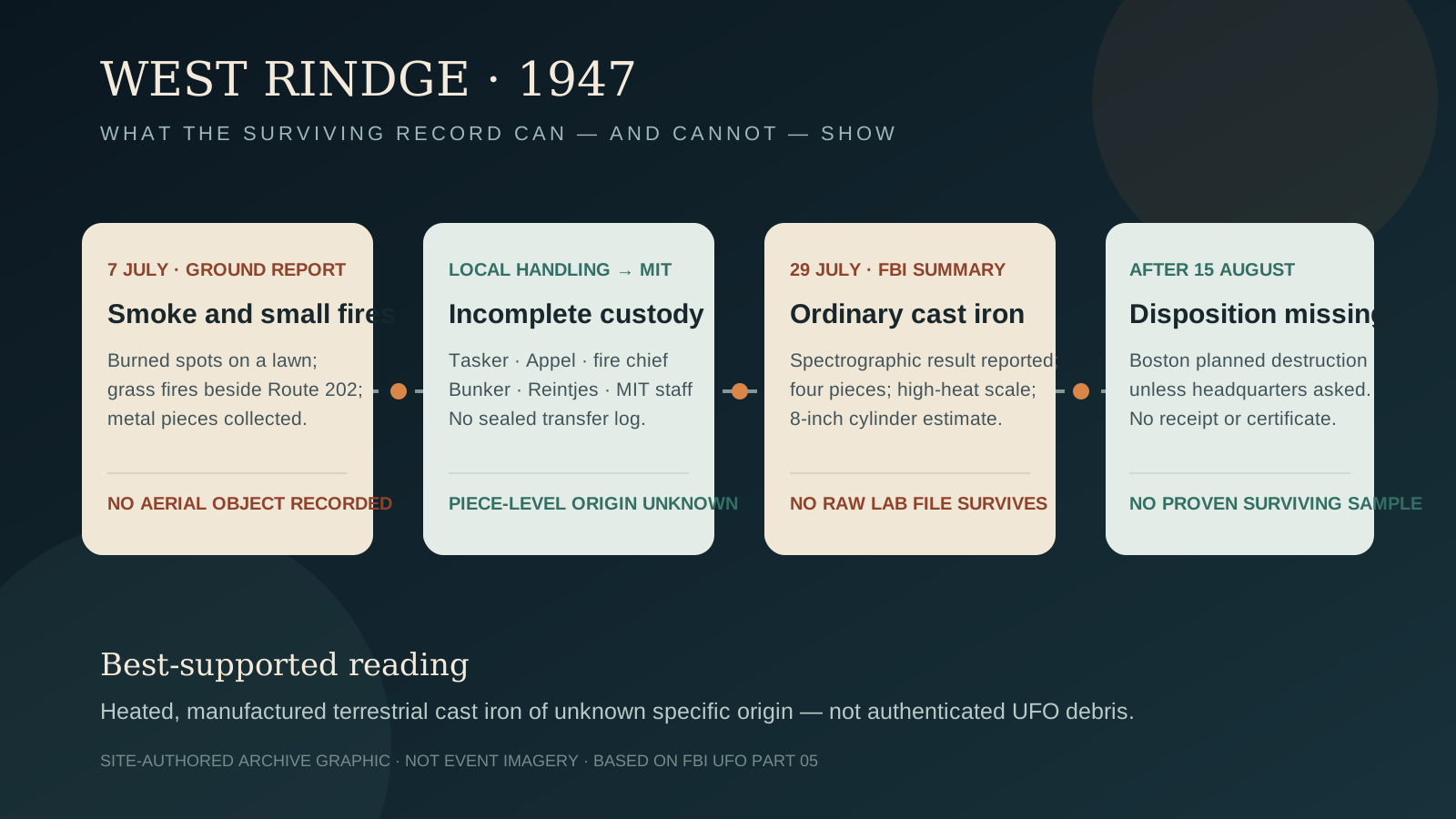
This case is disputed. The archive preserves the claims while separating evidence from interpretation.
- Documentation
- High documentation
- Primary location
- West Rindge, New Hampshire
- Source base
- 5 linked records
- Research use
- Comparison case
What the record actually establishes
- Observed
- Smoke, small burned spots and grass fires were reported. No falling or airborne object appears in the surviving event account.[1][3][4]
- Material result
- The FBI memo reports ordinary cast iron altered by very high heat, not an unknown alloy.[1][4]
- Handling gap
- Local holders, MIT and the FBI are named, but sealed transfers and piece-by-piece identifiers are absent.[1][3][4]
Case dossier
The event began with effects on the ground, not a recorded aerial sighting. At about 3 p. m. on 7 July, several people on Whitehead's porch reportedly saw curls of smoke. Inspection found burned spots about 1. 5 inches wide on the green lawn and small fires in dry grass on both sides of Route 202, distributed over an area described as a circle roughly 200 feet across. The fire department was called. Neither the 18 July teletype nor the 29 July memorandum says anyone saw a disc, aircraft, missile, meteor or other object descend. The named civilian chain is incomplete. Charles N. Tasker, a retired New England Telephone and Telegraph executive, relayed the report to MIT security officer and dean John W. Bunker. A man identified in the less-redacted reporting as Mr. Appel, also associated with the telephone company, reportedly delivered fragments to MIT professor J. Francis Reintjes. Tasker and the West Rindge fire chief were said to hold or seek additional pieces. The records do not provide collection labels, sealed containers, weights, photographs, signatures or a transfer log tying every tested piece to a particular burn spot. The testing claim is specific but survives only as an FBI summary. The 18 July teletype said two pieces were being analyzed. The 29 July memo said a spectrographic examination had been completed, identified ordinary cast iron subjected to very high heat, and explained that heat-produced scale had first been mistaken for another metallic alloy. It referred to four measured pieces and an informal MIT report. No signed report, spectrum, elemental table, microscopy, control sample, test protocol or laboratory accession record was located in the public file. The documents disagree about reconstruction. On 18 July, MIT scientists were reported to have roughly reconstructed a machine-tooled object about 14 inches in diameter and 3/16 inch thick. On 29 July, measurements of four pieces instead suggested an 8-inch-diameter hollow cylinder of the same thickness, and the memo said no physical reconstruction was being attempted. The later measurement is more developed, but without the pieces, drawings or measurements the discrepancy cannot be independently resolved. Several possible sources were discussed, but none became a demonstrated identification. Because the site was about 700 feet from railroad tracks, MIT reportedly checked a smokestack liner or other steam-engine part and obtained information ruling out a train or locomotive. Reintjes compared the appearance to V-2 lining he had seen in New Mexico; another scientist mentioned a jet-turbine lining; an unnamed scientist recalled cast-iron cylinders in guided-missile research. These were analogies, not matches supported by serial numbers, manufacturing records or comparative samples. The custody trail ends in an intention, not a receipt. MIT staff were gathering additional pieces for the Boston FBI office, which wrote that it would destroy the specimens unless headquarters requested transfer by 15 August. The public file contains no destruction certificate, headquarters receipt, retained subsample, later test or museum accession. NHPR reported that the FBI Boston field office could find no record responsive to its 2026 inquiry. That does not prove destruction, but it prevents any claim that a testable specimen survives. Later retellings introduced three distortions. They often call the material UFO or space debris although the witnesses reported only smoke and fire; they describe a newly discovered or newly declassified case even though redacted FBI pages and a public transcript existed years before the 2026 PURSUE reposting; and they compress tentative comparisons into a V-2 theory. The newly public names improve attribution, but neither the filing label nor renewed publicity supplies missing provenance.
Timeline
- Smoke, burned lawn spots and small grass fires are reported at the Whitehead property; metal fragments are collected, but no falling object is documented.
- The Boston FBI teletype records local handlers, two pieces under analysis and a rough 14-inch cylinder estimate.
- The follow-up memo reports ordinary heat-altered cast iron, four measured pieces and an 8-inch hollow-cylinder estimate; the Boston office closes the inquiry absent new instructions.
- Deadline stated for headquarters to request the specimens; otherwise Boston intended to destroy them. No public disposition record follows.
- Project Gutenberg publishes a searchable transcription of the already released FBI UFO file, showing the case was public well before 2026.
- PURSUE Release 01 republishes less-redacted FBI material; later local and public-radio reports restore names and revisit the missing specimens.
Questions about the West Rindge fragments
Did anyone see a UFO at West Rindge?
Not in the surviving incident account. It records smoke, burns, fires and fragments, not an aerial object or descent.
What were the fragments made of?
The July 29 FBI memo says spectrographic examination identified ordinary cast iron subjected to very high heat.
Who handled and tested them?
Tasker and a fire chief reportedly gathered pieces; Mr. Appel delivered pieces to MIT; Bunker relayed information; Reintjes and other MIT scientists were associated with the examination. The piece-by-piece chain is incomplete.
Does a specimen or laboratory report survive?
None has been demonstrated publicly. Only the FBI summary is available; destruction was planned, and no later disposition record was located.
Were the pieces from a V-2 or train?
MIT reportedly ruled out a locomotive source. V-2, jet and missile ideas were tentative comparisons without a demonstrated match or transport path.
Sources
- [1] Official fileFBI UFO Part 05: West Rindge memorandaFederal Bureau of Investigation Vault
- [2] Official filePURSUE UAP records release portalU.S. Department of War
- [3] News reportFBI probe into West Rindge metal fragmentsMonadnock Ledger-Transcript
- [4] News reportDeclassified files detail the West Rindge incidentNew Hampshire Public Radio
- [5] ArchiveFBI records relating to UFOs, searchable transcriptProject Gutenberg
The graphic is a site-authored evidence-chain aid, not event imagery. No fragment photograph with verified provenance and reusable rights, and no relevant original video, was found.