
Brazil / 1957 / INSUFFICIENT DATA
Fort Itaipu UFO incident
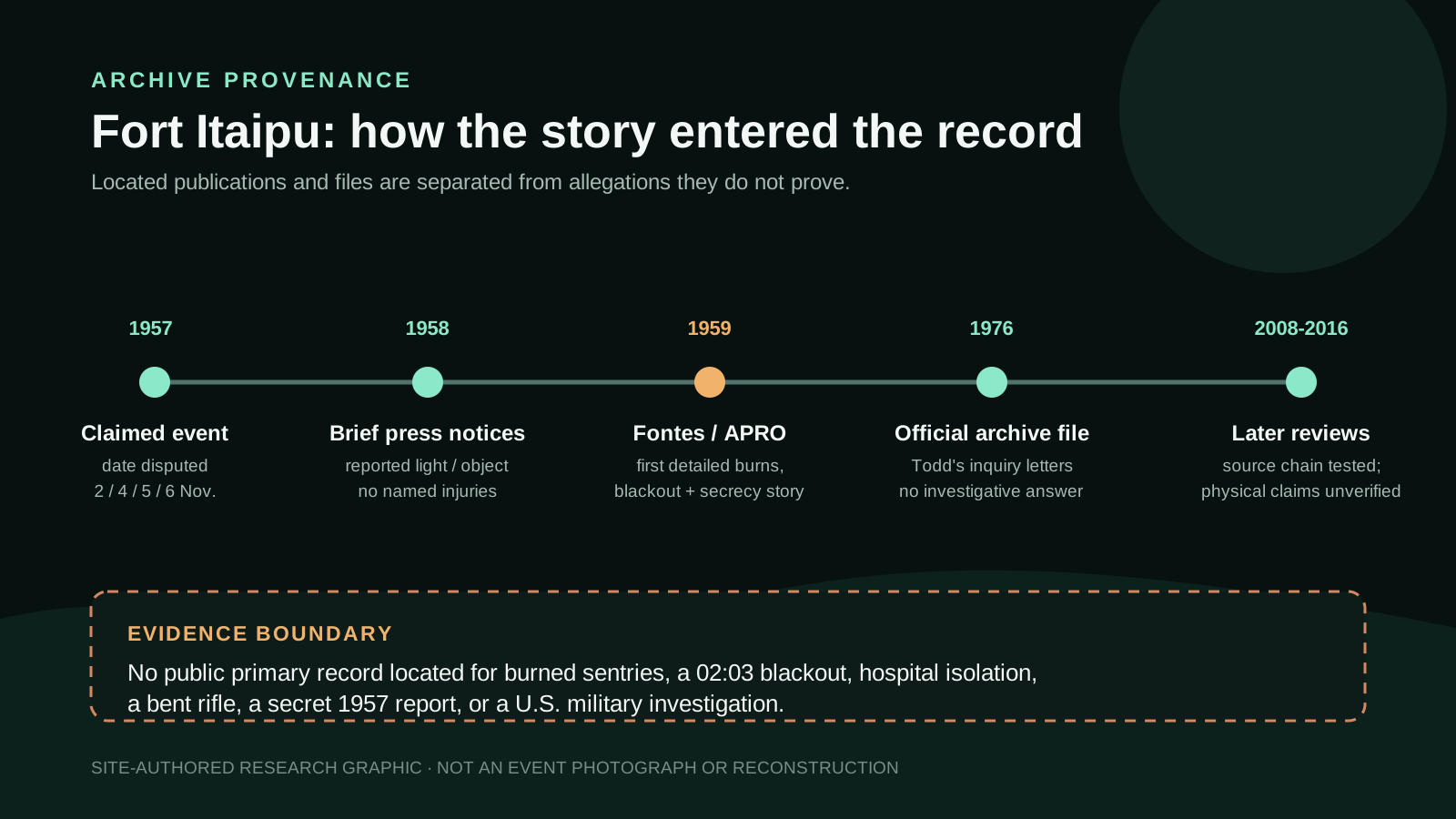
The Fort Itaipu case is best understood as a disputed reporting chain, not a documented military encounter. Olavo T. Fontes first published the detailed story in the September 1959 APRO Bulletin, attributing it to unnamed officers and claiming two unnamed sentries suffered burns during a close approach by an orange disc, while electrical systems failed and secrecy followed. No witness statement, medical record, power log, incident report, photograph or physical object supporting those details is publicly available. A Brazilian National Archives file, BR DFANBSB ARX.0.0.167, contains two 1976 letters from researcher Robert Todd repeating the allegations and a Brazilian air attaché's forwarding note; it does not contain a 1957 report, investigative findings or even a reply. Edison Boaventura Jr.'s later inquiry found early 1958 magazine notices and recollections compatible with a light seen near the fort, but his archival checks and interviews did not corroborate burns, a blackout or a bent rifle. The archive therefore retains C / INSUFFICIENT_DATA and treats every dramatic physical-effect claim as unverified.
This case has insufficient public data for a strong conclusion.
- Documentation
- High documentation
- Primary location
- Fortaleza de Itaipu, Praia Grande, São Paulo
- Source base
- 6 linked records
- Research use
- Comparison case
What the Fort Itaipu record establishes
- Confirmed archive fact
- The official three-page file records a 1976 request for information and its forwarding; it contains no 1957 investigation or answer.[1]
- Limited early core
- Early 1958 notices, known through later archival research, support only a reported light or object near the fort and give conflicting dates.[3][4]
How the story entered the public record
Case dossier
The location is real and well defined. Fortaleza de Itaipu stands at Praia Grande on the entrance to Santos Bay. Municipal history dates construction from 1902 and describes three component forts: Duque de Caxias, Jurubatuba and Rego Barros. That coastal artillery setting explains why later accounts repeatedly call the site a heavily defended fortress, but official location history says nothing about a November 1957 UFO event.
The earliest event-specific material located in the reviewed research is not a military record. Boaventura reported that O Cruzeiro briefly wrote on 22 February 1958 that an unidentified aerial object had moved over the fort for more than five minutes on 2 November and was seen by officers. A 24 May item reportedly added the commander and electrical interference while admitting that the authorities had not officially confirmed the story. Another 1958 magazine used 5 or 6 November. These conflicting dates support only a broad early-November window and a reported light or object; they do not independently establish injuries.
Fontes transformed that sparse background into the famous case in September 1959. He wrote that at 02:00 on 4 November two sentries watched an orange, disc-shaped craft descend to roughly 120-180 feet above the guns. He alleged a hum, an intolerable heat wave, first- and second-degree burns over more than ten percent of their bodies, a total electrical failure at 02:03, a secret report, U.S. and Brazilian investigators, and hospitalization in Rio. He named none of the sentries or officers and acknowledged that he never examined or interviewed the patients. The article's proposed microwave and ultrasonic weapons were Fontes's speculation, not measured findings.
The official archive changes the provenance picture, but not in the way popular summaries imply. On 17 May 1976 Robert Todd asked the Brazilian Embassy where he could obtain information about the alleged incident. On 25 May the Brazilian air attaché forwarded Todd's request to the Air Staff, calling it an occurrence that 'would have been recorded' according to the attached letter. Todd wrote again on 13 September, asking for an alleged secret-police report and the identity of North American investigators. The three-page file preserves these questions only. A government stamp and archival custody authenticate the correspondence, not Todd's premises.
Boaventura's 2008 investigation tested the physical claims against people and records. He reported contacting former soldiers, commanders, a period infirmary worker, the commander's sons, an Army museum and an electricity-history foundation. No named injured sentry or medical record emerged; the infirmary worker said he had never heard of such burns; searches found no blackout record or bent rifle. One commander's son recalled his father repeatedly describing a luminous object above the gun battery but never burned soldiers. These are late recollections and negative searches, so they cannot prove that nothing at all was seen; they substantially weaken the later injury and equipment claims.
The responsible conclusion is narrower than either 'alien attack' or 'complete fabrication.' Sparse 1958 notices and late family testimony provide limited support for a light being reported near the installation in early November 1957. The famous close-disc description, precise 02:03 electrical failure, burns, hospital transfer, secret investigation and U.S. military visit remain traceable to an unnamed chain published by Fontes two years later. No conventional object can be tested against reliable geometry because the time, date, direction, duration and named observers are not securely established. The unresolved element is the historical report's thin core, not an extraordinary vehicle.
Timeline
- Later early-press summaries and family recollection place a reported light near Fort Itaipu; published dates conflict between 2, 4, 5 and 6 November.
- According to Boaventura's archival review, O Cruzeiro briefly reports an object over the fort, seen by officers, without burns.
- O Cruzeiro reportedly repeats the sighting and mentions electrical interference while stating that military authorities did not officially confirm it.
- Olavo T. Fontes publishes the first detailed burn, blackout and secrecy narrative in the APRO Bulletin, based on unnamed military sources.
- Robert Todd sends two inquiry letters; the Brazilian air attaché forwards the first. The surviving file contains no investigative answer.
- Edison Boaventura Jr. checks archives and interviews former personnel, finding no names, medical file, blackout record or bent rifle supporting the dramatic claims.
- Kevin Randle traces the later literature back to Fontes and concludes that the physical-effect story lacks independent documentation.
Fort Itaipu case questions
Did the Fort Itaipu incident definitely happen on 4 November 1957?
No. The famous account uses 4 November, while early magazine references reportedly used 2, 5 or 6 November. Only early November is defensible.
Does the National Archives file confirm burned soldiers?
No. It preserves Todd's 1976 allegation and a forwarding memorandum. It contains no medical evidence, witness statement or official finding.
Was a blackout at the fort verified?
No. The precise 02:03 failure appears in Fontes's 1959 story. Later searches of press and electricity-history records found no corroborating log.
What is the best-supported version of the event?
A light or aerial object may have been reported near Fort Itaipu in early November 1957. The public record cannot securely establish its date, observers, geometry or identity.
Is there original event imagery?
No authenticated photograph or film of the alleged 1957 event was located. Later illustrations and programs are reconstructions, not witness imagery.
Sources
- [1] Official fileNational Archives file BR DFANBSB ARX.0.0.167: 1976 Fort Itaipu inquiry correspondenceArquivo Nacional do Brasil / Ministério da Aeronáutica
- [2] ArchiveThe APRO Bulletin, September 1959: 'Shadow of the Unknown,' Part IIIAerial Phenomena Research Organization / Olavo T. Fontes
- [3] ResearchFifty years later: the research record on the Fort Itaipu storyPortal Vigília / Edison Boaventura Jr.
- [4] ResearchFort Itaipu and Olavo Fontes revisitedA Different Perspective / Kevin Randle
- [5] Official fileBrazilian National Archives: overview of the UFO collectionArquivo Nacional do Brasil
- [6] Official fileFortaleza de Itaipu: more than a century of historyMunicípio de Praia Grande
No authenticated event photograph, film, medical image or physical artifact was located. The displayed graphic maps publication and archive provenance only; it is not a reconstruction of the object, injuries or fort systems.