
Iraq / 2016 / UNRESOLVED
2016 Mosul Orb Video
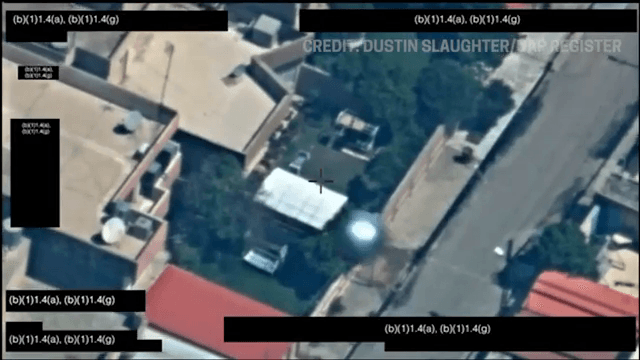
The Mosul Orb is the name given to a brief military video reportedly recorded over Mosul, Iraq, on 16 April 2016. A still was first published in January 2023. A federal court record now confirms that the National Air and Space Intelligence Center located a video of a metallic-looking spherical object owned by U.S. Special Operations Command, and that it was released after metadata redaction on 25 June 2025. The public clip shows a bright round form crossing the frame, but it provides no public range, dimensions, sensor geometry or complete metadata. The date, location and MC-12 platform remain attributed to the initial publishers rather than independently confirmed by the court record.
This case remains unresolved in the public record, with credibility grade B.
- Documentation
- High documentation
- Primary location
- Mosul
- Source base
- 7 linked records
- Research use
- Comparison case
What the record supports
- Confirmed provenance
- A federal court record confirms that NASIC found a SOCOM-owned video of a metallic-looking sphere and that the Air Force released it after metadata redaction.[1][2]
- Reported acquisition
- The 16 April 2016 date, Mosul location and MC-12 platform come from the 2023 publisher chain, not independently from the public court record.[3][4]
- What the clip shows
- The 4.39-second public copy shows a bright spherical-looking form crossing part of a moving urban view.[2]
Case dossier
The case now has a stronger provenance record than it did when the first still circulated, but the official record is narrower than many online summaries suggest. The March 2026 memorandum opinion in Slaughter v. Department of the Air Force states that an Air Force search found a video of an unidentified metallic-looking spherical object owned by U.S. Special Operations Command. That finding confirms government custody and the release chain; it does not identify the object or certify every claim attached to the name Mosul Orb.
Jeremy Corbell and George Knapp first published a still on 24 January 2023 and attributed the recording to 16 April 2016 over Mosul. Their account described an MC-12 reconnaissance aircraft, a roughly four-second full-motion sequence and a brief internal appearance in U.S. intelligence briefing material. The Black Vault, Fox News and Arab News preserved those claims, but they trace back to the same disclosure chain. No public acquisition record independently supplies the date, coordinates, platform, sensor mode or original analytic notes.
The January 2023 publication therefore established a public image and a reported military context, not a fully authenticated case file. The round, bright-looking object was visually striking, and the Mosul label made it easy to circulate. Yet a still could not show whether the apparent motion belonged to the object, the observing aircraft, camera movement or a combination. Reporting that the image had entered a briefing also did not amount to an official finding of anomalous performance.
The provenance changed through Dustin Slaughter's Freedom of Information Act litigation. NASIC initially reported no responsive records on 14 November 2023. Slaughter appealed and filed suit on 26 March 2024. Later searches found three responsive videos, including the SOCOM sphere recording. The court opinion says classification review concluded that this video could be declassified after metadata redaction; SOCOM made the redactions, and the Air Force released it to Slaughter on 25 June 2025.
The released copy lasts about 4.39 seconds. A bright spherical-looking form enters from the right and crosses part of an urban scene while the sensor view is also moving. The file is valuable because it replaces inference from a single still with observable motion and confirms that the image came from a longer sequence. It does not, however, reveal a physical diameter, slant range, altitude, wind field, camera line of sight, platform track or the unredacted time and sensor data needed to calculate velocity.
Those omissions keep ordinary explanations open. A balloon, small drone, airborne debris, distant conventional object or perspective effect could all look compact and fast in an uncalibrated moving view. The clip alone cannot select one explanation, and it also does not display visible wings, rotors or exhaust that would settle the matter. The responsible result is not that the object was extraordinary, but that the public data are insufficient for a specific identification.
The 2016 Mosul video must also be separated from AARO's Middle East orb. AARO's 2025 mission brief says its example was recorded in 2022 by an MQ-9 and showed no anomalous performance; poor data quality prevented attribution. The different year and stated platform make it a separate case. The Mosul Orb belongs in this archive because it now has a documented federal release chain and a publicly inspectable clip, while also illustrating how provenance can improve without supplying the measurements needed to resolve an object.
Government-released sphere video
This 4.39-second upload is the public copy released to FOIA requester Dustin Slaughter. Metadata is redacted, and the clip is not an AARO video or proof of anomalous performance.
Related video
Timeline
- The initial publishers later attribute the recording to an MC-12 over Mosul; the public official record does not independently confirm these acquisition details.
- Corbell and Knapp publish the still and the name Mosul Orb during the first episode of Weaponized.
- The Air Force initially tells Slaughter that its NASIC search found no responsive records.
- Slaughter files an administrative appeal challenging the adequacy of the first search.
- Slaughter files the federal FOIA lawsuit after the appeal remains unresolved.
- After classification review and metadata redaction by SOCOM, the Air Force releases the sphere video to Slaughter.
- Slaughter publishes the released video and an account of the FOIA process through The UAP Register.
- The federal court's memorandum opinion documents the SOCOM ownership, review and release chain while ordering more detail about the Air Force's broader search.
Frequently asked questions
Is the Mosul Orb video a real government-held record?
Yes. A federal court opinion states that NASIC found the SOCOM-owned video and that it was released after classification review and metadata redaction.
Was it officially confirmed as recorded over Mosul in 2016?
Not by the public court record. The date, location and MC-12 platform are attributed to the initial 2023 publishers and remain unverified by released acquisition metadata.
What does the released video show?
It shows a bright spherical-looking form moving across part of the frame during a 4.39-second sequence while the sensor view also moves.
Does the video prove high speed or unusual propulsion?
No. Reliable speed requires range, viewing geometry, platform motion and timing data that are not available in the public copy.
Is this the same as AARO's Middle East orb?
No. AARO says its example was recorded by an MQ-9 in 2022. The Mosul recording is attributed to 2016 and an MC-12, so the records describe separate events.
What are the leading ordinary explanations?
A balloon, small drone, debris, a distant conventional object and perspective or imaging effects remain viable. Public data cannot select one confidently.
Why is the case still in the archive?
It has a documented federal release chain and a public video, and it is a useful example of how provenance can become stronger while physical interpretation remains limited.
Sources
- [1] Official fileFederal court memorandum opinion in Slaughter v. Department of the Air ForceU.S. District Court for the District of Columbia / GovInfo
- [2] ArchiveU.S. Air Force sphere video ('Mosul Orb')Dustin Slaughter / The UAP Register
- [3] News reportU.S. Air Force releases new UAP video depicting metallic-looking sphereThe UAP Register
- [4] ResearchThe Black Vault record of the January 2023 Mosul Orb disclosureThe Black Vault
- [5] News reportMosul Orb: U.S. silence on an object filmed over IraqFox News
- [6] News reportArab News report on the image published as the Mosul OrbArab News
- [7] Official fileAARO Mission Brief 2025: separate 2022 Middle East orbAll-domain Anomaly Resolution Office
The main image is an unaltered frame from the government-held video released through FOIA in 2025. It shows the public clip, but it does not establish range, size, speed or identity.