
United Kingdom / 2024 / DISPUTED
2024 U.S. Air Base Drone Incursions in the United Kingdom
From 20 November 2024, U.S. military authorities reported small unmanned aircraft near or over RAF Lakenheath, RAF Mildenhall, RAF Feltwell and RAF Fairford. The number, size and configuration varied, and British authorities opened a criminal investigation and deployed counter-drone support. The public record confirms a real installation-security incident, not merely online rumor. It does not identify an operator, foreign sponsor or extraordinary aircraft, and it contains no released raw sensor data that would allow independent reconstruction. Later flight restrictions and an official Ministry of Defence report show that the response continued beyond the first sightings. The most careful classification is therefore a confirmed drone-incursion case with unresolved attribution, not evidence of non-human technology.
This case is disputed. The archive preserves the claims while separating evidence from interpretation.
- Documentation
- High documentation
- Primary location
- RAF Lakenheath, Mildenhall, Feltwell and Fairford
- Source base
- 9 linked records
- Research use
- Comparison case
What the public record supports
- Confirmed event
- U.S. authorities confirmed repeated small-UAS activity around four named RAF sites from 20 November 2024.[2]
- Official response
- Britain opened a criminal investigation, coordinated with U.S. forces and deployed a specialist RAF counter-UAS unit.[3][4][5]
- Unresolved attribution
- No public final report identifies the operators, motive, launch points, foreign sponsor or technical capabilities.[2][3][4][5]
- Media boundary
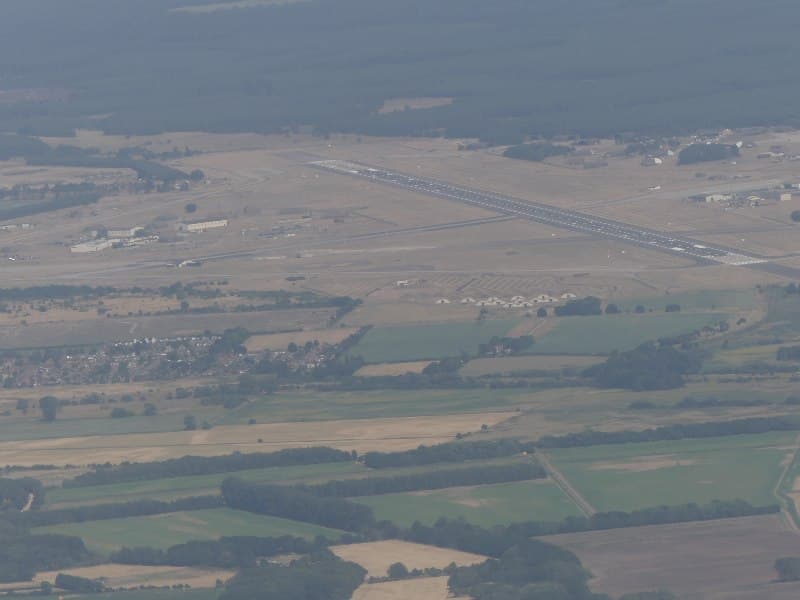
- The hero is a 2022 context photograph of RAF Lakenheath; the embedded video is local contemporaneous footage, not authenticated sensor evidence.[9]
Case dossier
The case began as a cluster of nighttime reports rather than one continuous encounter. U.S. Air Forces in Europe-Air Forces Africa said small unmanned aerial systems had been observed near and over RAF Lakenheath, RAF Mildenhall and RAF Feltwell between 20 and 22 November. A later update added RAF Fairford and said activity had continued since 20 November. These installations serve different U.S. Air Force functions and are separated by considerable distance, so the official language establishes repeated activity around several sites, not one object traveling along a verified route.
The U.S. statements were specific about what was known and careful about what was not. Officials described fluctuating numbers and systems of different sizes and configurations. They said installation personnel were monitoring the airspace and coordinating with British authorities, while withholding force-protection details. As of the 26 November update, no residents, facilities or assets had been affected. The statements did not name an operator, describe recovered hardware, announce an arrest or attribute the flights to a state actor.
Public attention grew through local observation, livestreams and news coverage. Viewers described lights above the Lakenheath area and military aircraft operating after dark. Such footage can document that lights or aircraft were visible, but most public clips do not provide original files, calibrated range, altitude, exact camera orientation or a verified link to a specific official track. The Biggsy video retained on this page is contemporaneous local aviation footage. Its title identifies drones above the base, but the public metadata does not establish the operator, aircraft type or relationship to every official report.
The British response moved the episode beyond a base press statement. In the House of Lords on 27 November, the government said the Ministry of Defence was working with U.S. visiting forces, Home Office police and other partners. It described a live criminal investigation and said Ministry of Defence Police had established a Gold Command for the East Anglia sites. Ministers also emphasized that unauthorized drone flights near military sites are illegal and that counter-drone capabilities were available, but declined to disclose operational procedures.
Later records show that the response was sustained. Regulations made on 20 December and effective on 23 December restricted unmanned-aircraft flights around eleven Ministry of Defence locations for national-security reasons, including Lakenheath, Mildenhall, Feltwell and Fairford. The instrument is broader than this one incident and should not be read as a finding about who flew the November systems. It does show that the government converted concern around military airspace into a formal, enforceable restriction.
A written parliamentary answer on 5 March 2025 said Ministry of Defence Police remained the lead investigative body for the November activity over Lakenheath, Mildenhall and Feltwell. The Ministry's Annual Report and Accounts 2024-25 later recorded that the Royal Air Force's No. 2 Counter-Uncrewed Air Systems Wing had deployed in November to detect and track unauthorized incursions at Defence and U.S. Visiting Forces bases. These records confirm investigation and detection work; neither publishes the raw tracks, device identifications, case outcome or an attribution.
The evidence is strongest for institutional response and weakest for technical attribution. Official U.S. and British records independently confirm reports, monitoring, a criminal investigation, a specialist deployment and later airspace controls. Publicly available material does not include the sensor logs, radio traffic, recovered aircraft, serial numbers or a completed investigative report that could determine who operated the systems. News reports of troop numbers or specific equipment add context but remain secondary unless repeated in an official release.
Ordinary commercial or hobby drones, deliberate surveillance, testing, nuisance flights and more than one unrelated operator all remain possible at the level allowed by the public evidence. Misidentified aircraft or stars may explain some public videos, but they do not erase the official acknowledgements of small UAS near the bases. Conversely, the inability to identify every operator does not imply exotic technology. The case belongs in the archive because it shows how an unresolved airspace-security event can acquire UAP language while remaining firmly within a drone-investigation framework.
Related video
Timeline
- USAFE-AFAFRICA later identifies this date as the start of continuing small-UAS activity around U.S.-used RAF sites.
- Small systems are reported near or over RAF Lakenheath, Mildenhall and Feltwell.
- U.S. military confirmation brings the three-base reports into the public record.
- An official update adds RAF Fairford, describes varying numbers and configurations, and reports no impact to residents or assets.
- The government tells Parliament that a criminal investigation is active and a Gold Command has been established for the East Anglia sites.
- The government makes national-security regulations restricting unmanned-aircraft flights around eleven defence sites.
- The permanent restricted-airspace regulations enter into force.
- A written parliamentary answer says Ministry of Defence Police is leading the investigation into the November activity over three East Anglia bases.
- The MOD Annual Report is presented to Parliament and confirms the November deployment of No. 2 Counter-Uncrewed Air Systems Wing.
- This archive review finds no public final attribution, released raw sensor package or completed investigative report.
Frequently asked questions
What happened over the U.S.-used RAF bases in November 2024?
Authorities confirmed repeated small-drone activity near four bases, monitored it, opened a criminal investigation and deployed counter-drone support.
Which bases were involved?
The official update named RAF Lakenheath, RAF Mildenhall, RAF Feltwell and RAF Fairford.
Did the drones damage a base or stop operations?
The 26 November U.S. update said no residents, facilities or assets had been affected. Operational security details were not released.
Who operated the drones?
No public completed investigation has identified the operators, launch sites, motive or state sponsor.
Is the embedded YouTube video original evidence?
It is contemporaneous local aviation footage and preserves public observation context. It is not an official sensor recording and does not identify an operator or prove that every light was a drone.
Were the objects UFOs or UAP?
They were initially unidentified to the public, but official records consistently describe small unmanned aircraft or UAS. Unresolved attribution does not make them extraordinary craft.
Why is this case in a UFO/UAP archive?
It is a well-documented example of an unresolved airspace event being discussed in UAP terms even though the official investigation remained focused on drones and installation security.
Sources
- [1] Official fileUSAFE-AFAFRICA update on installation security in the United KingdomU.S. Air Forces in Europe-Air Forces Africa
- [2] Official fileHouse of Lords debate: Drones at RAF basesUK Parliament / Hansard
- [3] Official fileWritten answer on drone activity over RAF basesUK Parliament
- [4] Official fileMinistry of Defence Annual Report and Accounts 2024-25UK Ministry of Defence
- [5] Official fileAir Navigation (Ministry of Defence Restricted Airspace) Regulations 2024UK Legislation
- [6] News reportSmall drones spotted over four U.S. air bases in EnglandAssociated Press
- [7] News reportBritish authorities open criminal investigation into the drone incursionsAssociated Press
- [8] News reportWhat is known about the drones reported over U.S.-used RAF basesSky News
- [9] News reportDrones Above USAF Bases After Dark - RAF LakenheathBiggsy / YouTube
The main image is a 2022 aerial photograph of RAF Lakenheath by Simon Tomson, licensed CC BY-SA 2.0. It identifies one of the installations but predates the 2024 incursions and shows no reported drone. The embedded Biggsy video is contemporaneous local aviation footage hosted by YouTube; its public metadata and images do not establish an operator, origin or extraordinary performance.