
United Kingdom / 1956 / DISPUTED
1956 Lakenheath-Bentwaters UFO Incident
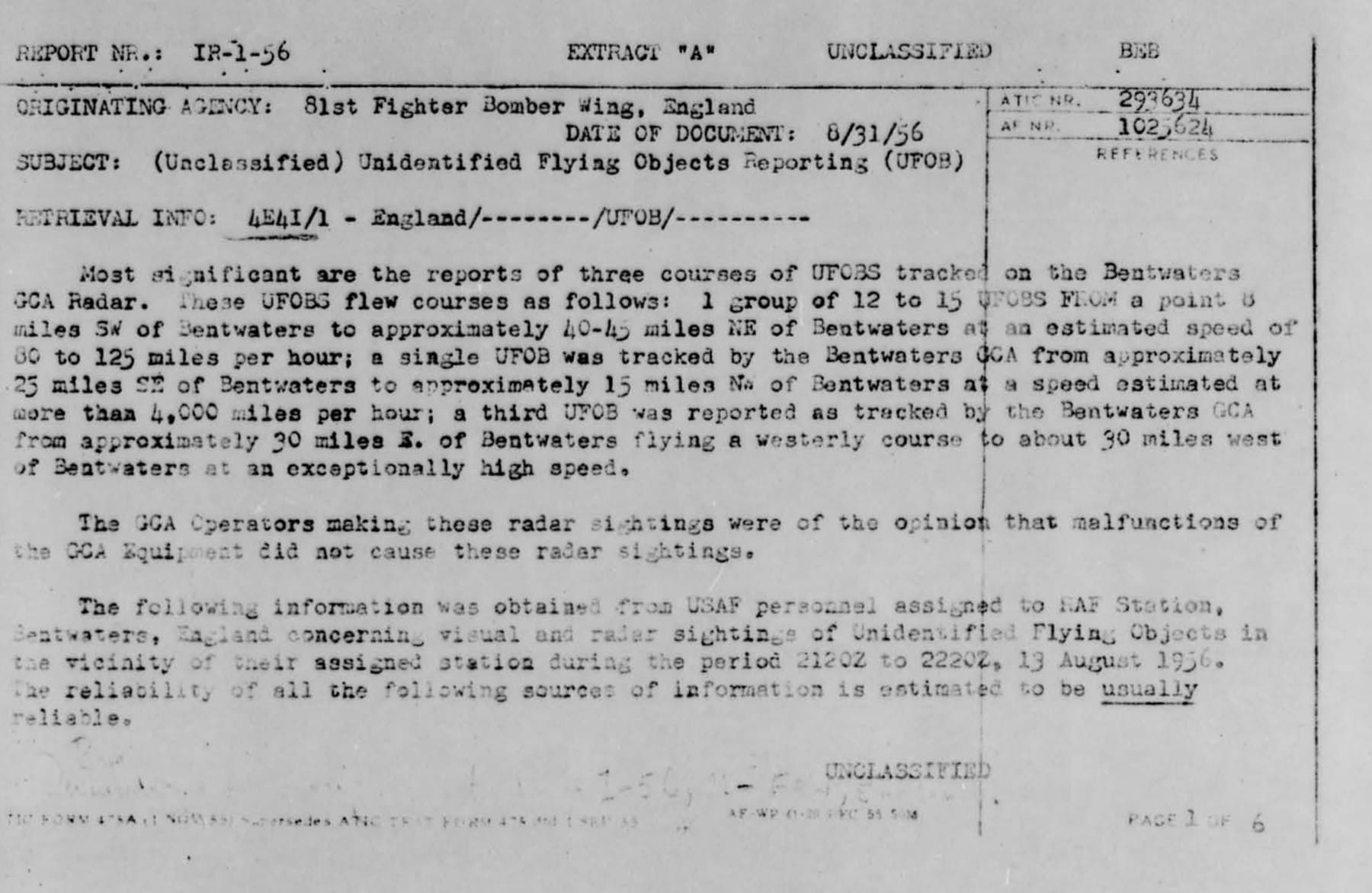
On the night of 13-14 August 1956, U.S. and British personnel at RAF Bentwaters and RAF Lakenheath in eastern England reported several unusual radar contacts and lights. A 31 August U.S. Air Force intelligence extract documents three Bentwaters radar sequences, while a BOI-485 message and later accounts describe Lakenheath tracking and RAF Venom interceptions. The public file contains no original radar film, audio, event photography or single internally consistent chronology. The famous claim that a target followed a Venom after radar contact conflicts with later-identified aircrew and squadron logbooks. Atmospheric propagation, meteors, balloons and ordinary aircraft may explain parts of the night, but no single conventional explanation has been demonstrated for every report. The case remains disputed: unusually well documented for its era, yet least secure in its most dramatic details.
This case is disputed. The archive preserves the claims while separating evidence from interpretation.
- Documentation
- High documentation
- Primary location
- RAF Bentwaters and RAF Lakenheath, Suffolk
- Source base
- 5 linked records
- Research use
- Comparison case
What the public record supports
- Confirmed record
- Contemporaneous Air Force messages and IR-1-56 record radar and visual reports at Bentwaters and Lakenheath on 13-14 August 1956.[2]
- Disputed interception
- The radar-lock and tail-chase account conflicts with later-identified Venom crews and squadron logbooks describing stationary, balloon-like returns.[2][5]
- Sensor boundary
- No original radar film, scope photograph, audio or complete calibration and weather package survives in the reviewed public file.[2][3][4]
- Best current assessment
- A mixture of propagation effects, balloons or celestial sources, meteors, aircraft and reporting uncertainty is better supported than one extraordinary vehicle.[2][3][4][5]
- Media boundary
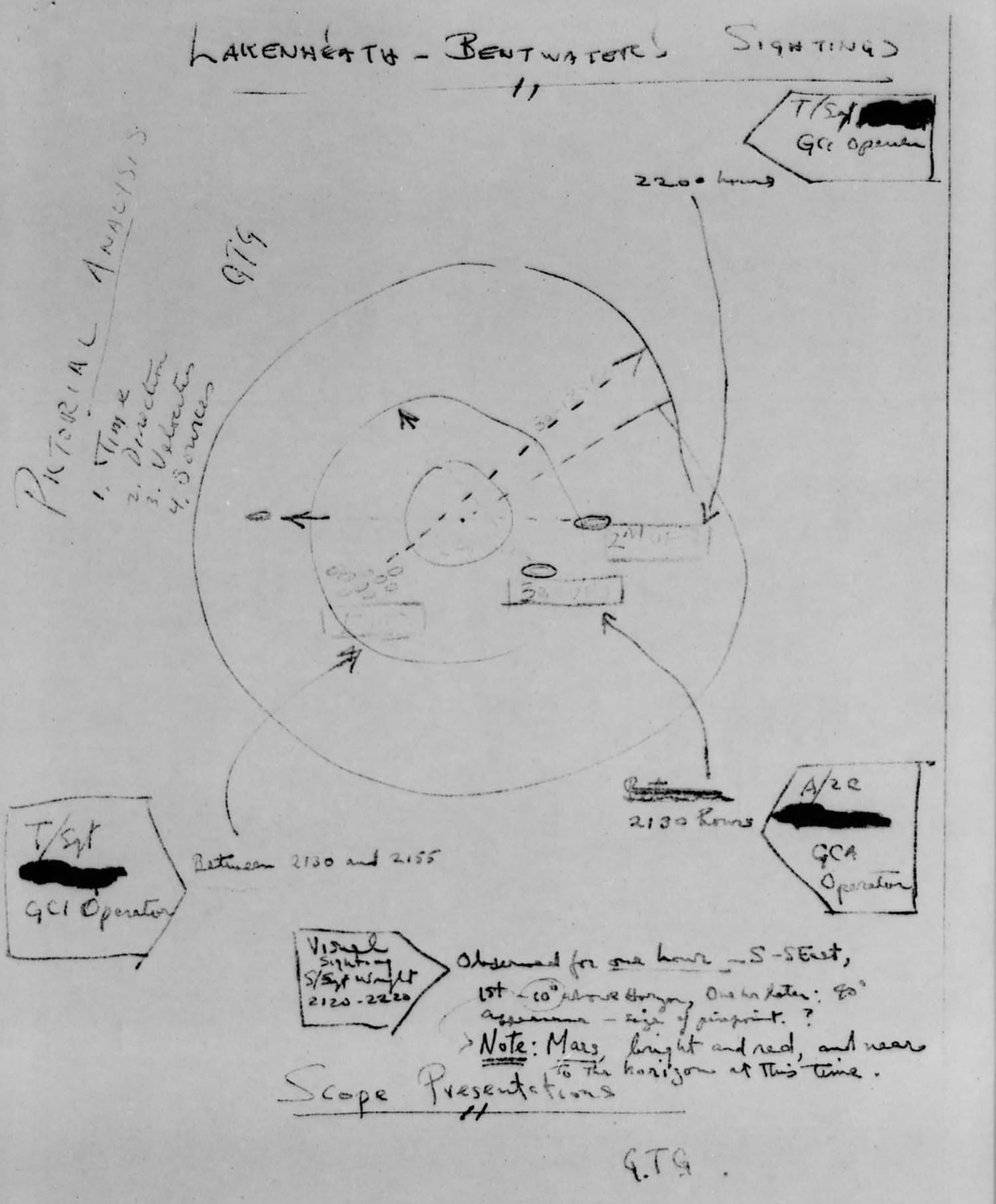
- The images shown are an official intelligence extract and a working reconstruction from the case file, not photographs of a target or raw radar displays.[2]
Blue Book scope reconstruction
Case dossier
The incident was not one uninterrupted observation. It is a collection of reports made around two airfields roughly 40 miles apart during the night of 13-14 August 1956. RAF Bentwaters hosted the U.S. Air Force's 81st Fighter-Bomber Wing, while RAF Lakenheath was another American-operated base in Suffolk. The surviving Project Blue Book file combines teletype traffic, intelligence extracts, witness statements, sketches, later correspondence and technical reviews. Those documents establish that military personnel filed unusual reports; they do not establish that every radar return and light had one common cause.
The 81st Wing's Report IR-1-56, dated 31 August, gives the clearest contemporary summary of Bentwaters. It says ground-controlled-approach operators reported three courses: a group of roughly 12 to 15 returns moving northeast at an estimated 80 to 125 miles per hour; a single return assigned an estimated speed above 4,000 miles per hour; and a third fast westbound return. These figures were operator calculations recorded in a typed extract, not preserved digital tracks. The report says the operators did not believe equipment malfunction caused the contacts, but it provides no radar film, calibration data or weather profiles for an independent reconstruction.
Visual reports accompanied some Bentwaters entries. The control-tower shift chief described an amber light and a bluish-white object, and the file says a C-47 crew also reported a light. The record preserves no image or measured angular track linking those observations to a particular radar return. Some times in the intelligence extract and later narratives differ, and the celebrated high-speed contacts were not necessarily simultaneous with every visual report. The careful conclusion is that radar and visual reporting overlapped during the night, not that the public record proves continuous radar-visual identity for each target.
The focus then shifted to Lakenheath. A BOI-485 teletype sent through Air Force channels describes Lakenheath controllers detecting a target after Bentwaters called, including reports that more than one radar position observed it and that personnel saw a luminous object from the ground. The message also describes one or more Venom night fighters being directed toward the contact. Like IR-1-56, BOI-485 is a compressed operational report. It is primary evidence that an incident was reported, but its speed, range and maneuver estimates are not substitutes for the missing raw radar record.
The best-known version says the first Venom crew obtained airborne-radar contact, lost it, and was then followed by the unknown target until the fighter withdrew. This motif appears in BOI-485 and in a detailed letter sent in 1968 by retired Lakenheath watch supervisor Forrest Perkins to the Condon project. Investigator Gordon Thayer regarded the Lakenheath portion as exceptionally difficult to explain and later called it a genuine UFO in the literal sense of unidentified. Perkins wrote twelve years after the event, however, and his account was not part of the original Blue Book packet when the Condon team first reviewed the case.
Later research complicated that story. Squadron logbooks and interviews identified Venom crews scrambled during the relevant hours. Pilot Leslie Logan and radar operator Freddie Fraser recalled a stationary or nearly stationary return consistent with a balloon, no visual contact and no chase behind their aircraft. Other 23 Squadron participants disputed the phrase radar lock-on; the APS-57 set's automatic tracking facility was reportedly disconnected, so operators manually followed returns. A squadron diary summarized the episode as probably a balloon. These interviews were recorded about four decades later and cannot erase every 1956 report, but they directly weaken the canonical tail-chase narrative.
The case accumulated several influential interpretations. Physicist James E. McDonald used it in 1969 to argue that the Condon study had understated strong UFO evidence. Thayer's 1971 AIAA paper rejected simple anomalous propagation as an adequate explanation for the Lakenheath sequence, although he acknowledged uncertainties in the record. The Project Blue Book file itself is less tidy than either later argument: it contains conflicting times, estimates, working notes and correspondence accumulated over years. An archive classification of unidentified or a researcher's phrase genuine UFO means the source did not identify a report; it is not an official finding of extraterrestrial technology.
A mixed explanation currently fits the evidence better than either a single extraordinary craft or the claim that nothing unusual was reported. Meteors from the Perseid season may account for brief lights; balloons or celestial objects fit some slow or stationary contacts; ordinary aircraft and operator interpretation may account for other entries; and anomalous propagation remains relevant to fast ground-radar returns even though it cannot be tested without the original data. The unexplained residue comes from incomplete records, uncertain cross-matching and disputed testimony. Lakenheath-Bentwaters belongs in the archive because it shows both the value and the limits of a military radar-visual case, not because it proves a non-human vehicle.
Timeline
- A 23 Squadron Venom on a routine flight was diverted toward a high target later described by the crew as balloon-like; later reconstruction separates this from the main night sequence.
- Bentwaters GCA operators reported the first of three radar sequences later summarized in IR-1-56.
- A slower group of multiple returns was reported moving northeast; exact count and speed were operator estimates.
- Bentwaters reported a third fast westbound radar contact; visual reports were also logged during the broader period.
- Lakenheath controllers reported additional contacts and RAF Venoms were scrambled; the exact order and number of distinct targets remain disputed.
- Air Force channels transmitted BOI-485, the compact message behind much of the later Lakenheath narrative.
- The 81st Fighter-Bomber Wing issued Report IR-1-56 Extract A summarizing Bentwaters radar and visual reporting.
- J. Allen Hynek recorded a review of conflicting Blue Book materials and retained copies for further study.
- Forrest Perkins supplied a detailed recollection to the Condon project; Gordon Thayer used it in Case 2 while noting missing and late-arriving records.
- Thayer published a technical AIAA review that preserved the case's reputation as a difficult radar-visual report.
- Logbooks and interviews with identified Venom personnel challenged the radar-lock and tail-chase account and supported balloon-like contacts for some sorties.
Frequently asked questions
What happened in the Lakenheath-Bentwaters UFO incident?
Military personnel reported several radar contacts and lights around RAF Bentwaters and RAF Lakenheath on 13-14 August 1956. Controllers directed RAF Venom fighters toward some reported contacts.
Was the incident recorded on radar?
Yes. Contemporary documents say several operators tracked contacts, but the public archive preserves typed summaries rather than original radar film or digital data.
Did a UFO chase an RAF Venom?
BOI-485 and a 1968 witness letter describe a target following a fighter. Later-identified crews and squadron logs deny that sequence and describe balloon-like stationary returns, so the claim remains disputed.
What did the Condon Report conclude?
Investigator Gordon Thayer considered the Lakenheath portion difficult to explain and used genuine UFO to mean unidentified. This was a case-level assessment, not a finding of extraterrestrial origin.
Could atmospheric conditions explain the radar contacts?
Anomalous propagation is plausible for some ground-radar returns, especially without raw data, but historical analysts disagreed about whether it could reproduce the full Lakenheath sequence.
Are there photographs or video of the object?
No verified event photograph or motion footage is known in the reviewed public record. The page shows official document imagery and a reconstruction, not the reported target.
Why does the case remain important?
It combines contemporaneous military documentation, radar and visual reporting, interceptor records and unusually clear conflicts between early summaries and later identified witnesses. It is a strong lesson in both evidence value and archival limits.
Sources
- [1] Official fileProject Blue Book: Lakenheath-Bentwaters case fileU.S. Air Force / Wikimedia Commons archive scan
- [2] ResearchCondon Report Case 2: Lakenheath radar-visual reportsUniversity of Colorado Condon Report / NCAS archive
- [3] ResearchAIAA review of the Lakenheath-Bentwaters radar-visual caseGordon D. Thayer / AIAA, archived by CUFOS
- [4] ResearchScience in Default: the Lakenheath-Bentwaters caseJames E. McDonald / AAAS
- [5] ResearchLakenheath collaboration: documentary reconstructionMartin Shough and collaborators
The main image is a crop of the U.S. Air Force's 31 August 1956 intelligence extract. The supplementary image is a hand-drawn working reconstruction preserved in the Blue Book file. Neither is an original radar-scope photograph or an image of the reported target. No reliable event video was found, so none is embedded.