
Official programs / Updated 2026-08-02 / 9 min read
What Is AARO and What Does It Investigate?
AARO is the U.S. Department of Defense office that coordinates official UAP review, case resolution and public reporting across multiple domains.
Reviewed and maintained byGlobal UFO Archive Editorial DeskEditorial policy
Quick answer
AARO is the U.S. Department of Defense office responsible for coordinating official UAP work across domains. Its public material is useful for definitions, reporting channels, and official case framing, but it should not be read as proof that any specific unresolved report has an extraordinary origin.

Key points
- AARO focuses on data-driven UAP review, not public entertainment.
- It receives military, federal, and aviation-related reporting streams.
- AARO is an analytic and coordinating office inside the U.S. Department of Defense, not a public UFO tip line for every civilian report.
- An AARO case resolution describes the office's assessment of the available record; it does not guarantee that every original sensor file is public.
What AARO does
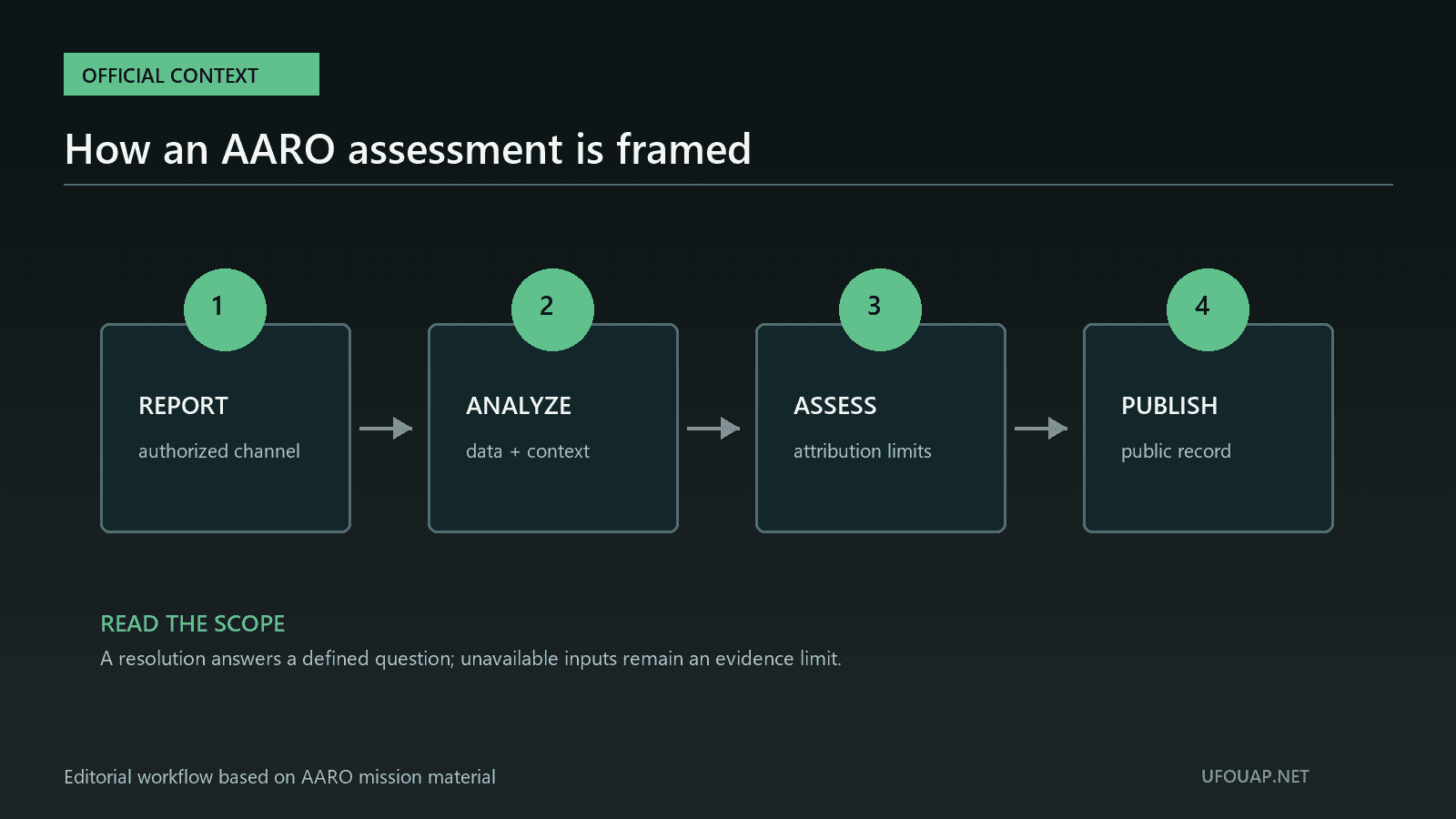
AARO coordinates UAP analysis across the U.S. government. Its public materials emphasize a rigorous scientific framework, data-driven review, case resolution, declassification where possible, and pathways for authorized reporting. For researchers and readers, AARO is important because it provides official terminology, case imagery, and reports that can anchor public discussion.
Mandate, scope and reporting channels
The All-domain Anomaly Resolution Office is responsible for coordinating U.S. government work on anomalous reports across air, space, sea and transmedium domains. Its public material emphasizes data collection, intelligence and scientific analysis, case resolution, historical review and authorized reporting. AARO directs current or former U.S. government personnel with relevant program knowledge to its secure reporting mechanism. Military personnel normally report through command channels, and civilian pilots are directed to air traffic control procedures. This division matters because an AARO page is not evidence that the office has formally investigated every public video.
How to read an AARO resolution
Start with the question the report actually answers. A resolution may identify an object category, estimate motion, or explain an apparent anomaly without reconstructing every witness claim. Check what inputs are named, whether geometry or sensor assumptions are provided, and which material remains unavailable to the public. A resolved assessment can be informative even when the public cannot reproduce every step; the remaining access gap should still be stated. Conversely, an unresolved label means the available data were insufficient for a confident attribution, not that an extraordinary origin was established.
FAQ
Can the public report directly to AARO?
AARO says it will announce when a public reporting mechanism is available; current pathways are focused on authorized personnel and aviation channels.
What is AARO's official UAP definition?
AARO uses UAP as a broad all-domain term for unidentified anomalous phenomena that may be reported in air, sea, space or transmedium contexts.
Is AARO the same as NASA?
No. AARO is a U.S. Department of Defense office. NASA is a civilian space and science agency that has studied UAP data-quality questions separately.
Does AARO say every UAP has a conventional explanation?
No. AARO publishes both resolved and unresolved assessments. It also states that many reports are attributable to ordinary objects or effects and that it has found no verified evidence of extraterrestrial technology in the records it has reviewed.
Official sources used
- All-domain Anomaly Resolution OfficeAARO mission and official resourceswww.aaro.mil
- AAROSubmit a Reportwww.aaro.mil
- All-domain Anomaly Resolution OfficeUAP case resolution reportswww.aaro.mil
- U.S. Department of DefenseAARO Mission Briefwww.aaro.mil