
Russia / 1977 / EXPLAINED
1977 Petrozavodsk phenomenon
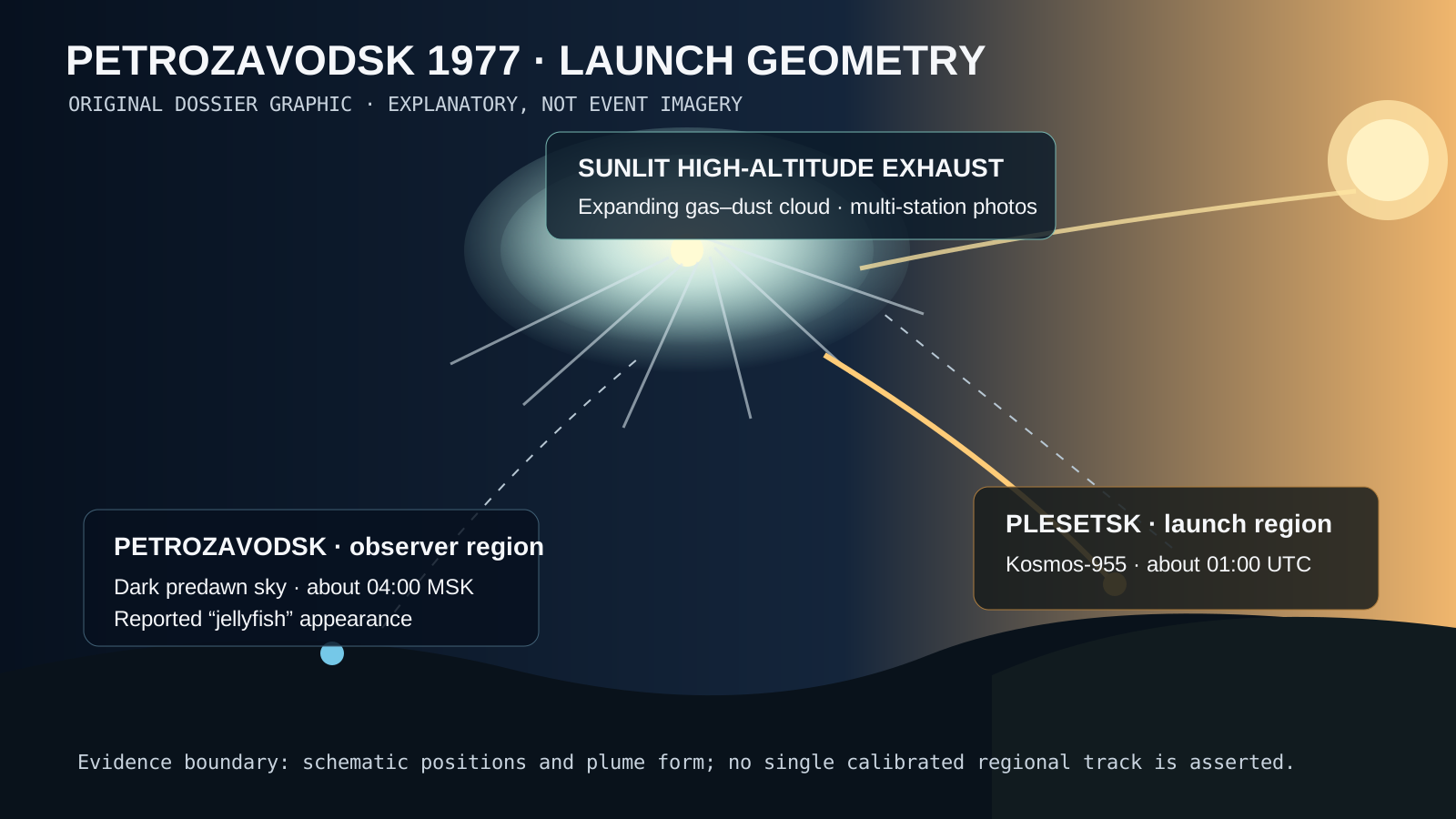
At about 04:00 Moscow time on 20 September 1977, witnesses in Petrozavodsk described a bright source that expanded into a ray-like ‘jellyfish’ and then receded toward Lake Onega. A TASS dispatch published on 23 September gave the episode national attention. Kosmos-955 had lifted off from Plesetsk at about 01:00 UTC, and all-sky cameras at three northern observatories photographed an expanding exhaust cloud from 01:04 to 01:08 UTC. Peer-reviewed analysis explains the unusual visibility: the observers remained under a dark dawn sky while high-altitude exhaust entered sunlight and scattered it. This tightly explains the principal timed display. It does not turn every differently timed or directed report across Finland and the northwestern USSR into one track, and it does not authenticate later claims that beams damaged windows.
This archive treats the case as explained or substantially resolved by conventional evidence.
- Documentation
- High documentation
- Primary location
- Petrozavodsk, Karelia, and the northwestern USSR/Fennoscandia observation region
- Source base
- 5 linked records
- Research use
- Comparison case
What the Petrozavodsk record establishes
- Confirmed event
- A large luminous cloud was reported widely and photographed by multiple northern observatories.[1][3]
- Launch match
- Kosmos-955 launched from Plesetsk minutes before the 01:04–01:08 UTC camera sequence.[1][5]
- Physical mechanism
- Sunlight scattering from high-altitude exhaust explains a bright expanding form against a dark dawn sky.[1]
- Coverage boundary
- Different regional reports cannot all be treated as one measured trajectory or one verified object.[3]
- Physical-effects boundary
- Later window-hole reports lack the timing, custody and residue evidence needed to link them to the display.[3]
Case dossier
The Petrozavodsk account: The contemporary description attributed to TASS correspondent Nikolai Milov said a huge ‘star’ appeared at about 04:00, sent pulsing shafts downward, spread like a jellyfish over the city, and later became a bright semicircle moving toward Lake Onega. It gave a duration of roughly 10–12 minutes and quoted local hydrometeorological director Yuri Gromov as saying his staff knew no natural analogue. These are vivid witness-based descriptions published three days later, not angular measurements or an instrument record above the city.
A broad observation field, not a single calibrated track: Early investigators collected reports from Karelia, the Leningrad area, Estonia and Finland. Their preliminary compilation admitted incomplete data, conflicting radar statements, and variations in direction and timing. Those reports show that unusual lights were noticed across a large region, but they were gathered through different witnesses, clocks, weather, horizons and later recollection. The all-sky photographs provide synchronized evidence for a high-altitude cloud; they do not prove that every low-looking light, aircraft report or later sighting was the same object.
The launch clock and camera clock: Catalogs identify Kosmos-955 (1977-091A) as a Vostok-M launch from Plesetsk at about 01:00 UTC. The Geophysica study reports the luminous plume over Arkhangelsk at 01:04 UTC, a burst over Loparskaya at 01:05, and a ray-edged expanding cloud at Sodankylä by 01:08. The few-minute sequence, launch location and wide photographic baseline are stronger evidence than matching a single verbal shape. A Finnish astronomical-society archive independently indexes the 20 September sequence at 01:05 as a Plesetsk satellite launch associated with Kosmos-955.
Why a plume looked extraordinary: At dawn, the lower atmosphere and observer can remain in Earth's shadow while a vehicle and its exhaust hundreds of kilometres high are already sunlit. Gas, ice and dust released during engine operation or staging then scatter sunlight inside a rapidly expanding three-dimensional cloud. The 2012 authors describe the photographed configuration as physically jellyfish-like and distinguish it from background aurora visible in the same Sodankylä frames. Perspective and free expansion can make radial streamers appear to hang over a city although the luminous material is far away and high above it.
Physical-effect claims require a separate ledger: A preliminary 1977 compilation mentioned holes found in paired windowpanes and explicitly said the possible connection required careful checking. The larger 1999 source collection says anomalous holes began to be found from October, not that a controlled sample was documented during the 20 September light display. No contemporaneous chain of custody, impact residue, reproducible mechanism or dated photograph ties the glass to the plume. The archive therefore records the allegation but does not describe the rocket light, a beam, or an unknown craft as having damaged buildings.
What the case establishes: The principal Petrozavodsk display was a real, widely seen optical event with near-contemporaneous press coverage and multi-station photographic records. The launch coincidence is not merely a convenient date match: camera times capture the plume's development minutes after liftoff, and atmospheric physics explains its expansion and contrast. ‘Explained’ applies to that core event. It does not certify every anecdote in the broader 1977–1978 ‘phenomenon,’ and it supplies no evidence of extraterrestrial technology.
Timeline
- Kosmos-955 lifts off on a Vostok-M from Plesetsk; surviving catalogs differ by a few minutes in displayed precision.
- All-sky cameras at Arkhangelsk, Loparskaya and Sodankylä record the rapid development of the luminous cloud.
- Petrozavodsk witnesses report the bright source, ray-like cloud and movement toward Lake Onega.
- Central Soviet newspapers publish Nikolai Milov's TASS dispatch, ‘Unidentified Natural Phenomenon.’
- Window holes and further lights are reported later; their dates and evidence chains do not make them measured effects of the 20 September plume.
- Russian program participants and atmospheric researchers publish the launch explanation and the multi-station photographic/physical analysis.
Questions about the 1977 Petrozavodsk phenomenon
What caused the 1977 Petrozavodsk phenomenon?
The principal timed display is well explained by the high-altitude exhaust cloud from the Kosmos-955 launch, illuminated by sunlight while observers remained under a dark dawn sky.
Did photographs record the event?
Yes. All-sky cameras at Arkhangelsk, Loparskaya and Sodankylä recorded the cloud's development from 01:04 to 01:08 UTC. These are observatory records of the plume, not close photographs of a craft over Petrozavodsk.
Was the phenomenon seen only in Petrozavodsk?
No. Reports and camera records covered parts of the northwestern USSR and Fennoscandia. Their broad spread fits a high-altitude cloud, but differing reports must not be collapsed into one calibrated track.
Did beams burn holes in windows?
That causal claim is not established. Holes were reported later, from October onward, and the reviewed sources preserve no contemporaneous chain of custody, residue analysis or reproducible mechanism tying them to the 20 September light.
Why did the launch remain controversial?
Plesetsk was a secret military site in 1977, witness reports varied, and later anecdotes were added to the core event. Once launch data and observatory records became available, the timed display had a much stronger conventional explanation.
Does ‘explained’ mean every report was solved?
No. It means the principal Petrozavodsk display has a strong time-, image- and physics-matched explanation. Reports outside that evidentiary core remain separate and do not become evidence of extraterrestrial technology.
Sources
- [1] ResearchOptical Phenomena due to Rocket Exhaust Products in the AtmosphereGeophysica / Geophysical Society of Finland
- [2] ResearchHistory of State UFO Research in the USSRRussian Academy of Sciences Commission, In Defense of Science No. 6
- [3] ArchivePetrozavodsk Phenomenon: reports and research documentsAstronet / L. M. Gindilis and Yu. K. Kolpakov
- [4] ArchiveRocket phenomenon archive: 20 September 1977, Kosmos-955Ursa Astronomical Association
- [5] Archive1977-091A — Kosmos-955 launch and orbit catalogLibrary of the Czech Academy of Sciences
The hero image is an original explanatory dossier graphic, not an event photograph. Observatory images are cited in the scientific source and are not copied here.