
United States / 1997 / EXPLAINED
1997 Phoenix Lights
The Phoenix Lights were a real sequence of reports on 13 March 1997, but the public story often merges two different events. Between roughly 8:00 and 8:45 p.m., witnesses across Arizona described moving lights, sometimes interpreted as one enormous V-shaped craft. Around 10:00 p.m., stationary lights southwest of Phoenix were filmed. Contemporary reporting linked that later display to parachute illumination flares dropped by Maryland Air National Guard A-10s over a training range behind the Sierra Estrella. Telescope and pilot accounts support aircraft as the leading explanation for the earlier formation, although no complete public radar or air-traffic record reconstructs every report. No public evidence establishes an extraterrestrial craft.
This archive treats the case as explained or substantially resolved by conventional evidence.
- Documentation
- High documentation
- Primary location
- Arizona, United States
- Source base
- 11 linked records
- Research use
- Comparison case
What the record supports
- Confirmed sequence
- Reports occurred in at least two time-separated layers: a moving formation earlier in the evening and filmed stationary lights around 10:00 p.m.[1][6]
- Later lights
- Military confirmation, range geometry and descent behavior strongly identify the later display as parachute illumination flares.[2][4]
- Earlier formation
- Witness descriptions varied; telescope and pilot accounts favor separate aircraft, but the complete flight and radar record is not public.[1][4][7]
Case dossier
The early reports across Arizona
The first layer of the case developed during the evening as reports moved from north-central Arizona toward the Phoenix metropolitan area. The National UFO Reporting Center later compiled an early call from near Paulden at about 8:16 p.m., followed by accounts from Prescott Valley, Dewey, Scottsdale and other communities. These reports establish that people described lights moving generally southward, but they were collected through phone calls and later submissions rather than one synchronized observational record. [6]
NUFORC's summary carries an important methodological warning: it was compiled from early information before written witness reports had arrived, and the organization expected later submissions could change its findings. Its sequence of towns and approximate times is therefore a provisional compilation of calls, not a measured track of one object. The page also labels a supposed military interception as insufficiently documented. That allegation should not be added to the chronology as a confirmed scramble merely because it appears in the same archive entry. [6]
A formation of lights or one solid object?
Witness descriptions of the moving formation were not uniform. Some saw five or more lights in a V or boomerang pattern and inferred a very large dark body between them; others reported separate lights whose spacing changed. A dark sky, limited angular references and the tendency to connect lights into one outline can produce a solid-craft impression. The archive therefore records the large-craft description as witness interpretation, not as a measured size or confirmed physical structure. [6] · [7]
The telescope and roadside pilot accounts
Two observations weigh against treating every early report as one giant object. Amateur astronomer Mitch Stanley told reporters that he viewed the formation through a telescope from Scottsdale and saw aircraft, with lights appearing in pairs. A later-submitted report attributed to an airline pilot likewise described individual lights or objects and said stars were not blocked between them. Both accounts are useful counterevidence, but neither supplies an authenticated flight track or identifies every aircraft involved. [1] · [3] · [7]
The airline-pilot account needs its submission history kept alongside the observation. NUFORC report 8345 lists an occurrence at 20:15 on 13 March 1997, a report received on 13 July 1999 and a posting on 26 April 2000. Its editor's note says the witness originally gave 15 March; after telephone conversations, staff suspected he meant the better-known 13 March event and provisionally changed the date. The witness describes watching from Interstate 10 while driving to work, not from an aircraft cockpit. The report remains relevant to separate lights, but it is neither a same-night flight report nor an unambiguous timing match. [7]
The later lights in the famous video
A second and visually different episode occurred around 10:00 p.m. Cameras in the Phoenix area recorded a row or arc of bright lights that appeared nearly stationary, then went out one after another. This is the imagery most often replayed under the name Phoenix Lights. It should not be used as direct visual evidence for the earlier moving V because the time, apparent motion and viewing geometry differ. [3] · [4]
The flare explanation and reporting gaps
Contemporary reporting traced the later lights to a Maryland Air National Guard A-10 training mission. Military spokespeople said high-intensity illumination flares had been dropped at about 15,000 feet over the North Tac training area. Such flares descend under parachutes, can remain visible for minutes and appear stationary from a distant observer. The training area lay southwest of Phoenix, in the same general direction as the recorded lights. [2] · [3]
The military explanation emerged through reports that should not be spliced into one precise mission log. Tucson Weekly's 24 July 1997 account quoted an approximately 20:30 return to Davis-Monthan; the 1998 Phoenix New Times investigation instead reported a flare release at 22:00 over North Tac. The 26 July Associated Press dispatch attributed the illumination-flare account to Maryland spokesman Drew Sullins. These reports support training activity and the later flare explanation, but the discrepancy means they cannot alone fix every aircraft's landing or release time. A primary sortie record would be needed to reconcile those details. [1] · [2] · [3]
The flare explanation also fits the way the lights disappeared. Local investigators noted that their line of sight placed the Sierra Estrella between Phoenix and the range; descending flares would vanish behind the ridge at slightly different times. Later comparison footage of military flares looked similar. The public record does not include every mission log, release time and camera calibration needed for a frame-by-frame reconstruction, but the location, military confirmation, descent behavior and ridge occultation form a converging explanation for the 10:00 p.m. display. [3] · [4]
Official reactions and the radar distinction
The official and political response added attention but little technical evidence. The Federal Aviation Administration reportedly found nothing unusual in its traffic information, and later local reporting said Luke Air Force Base radar found no anomalous track. Governor Fife Symington staged a costumed-alien joke at a June press conference, then in 2007 said he had personally seen a large geometric form that night. The delayed statement is part of the witness record, but it did not include contemporaneous notes, sensor data or an identification. [5] · [8] · [3]
Nothing unusual on radar is not the same claim as no radar returns. In the 1998 New Times investigation, Sky Harbor controller Bill Grava distinguished local airport coverage from higher-altitude traffic monitored in Albuquerque and from the distant North Tac range. Luke spokeswoman Stacey Cotton said a high formation outside restricted airspace, or a range flare drop, would not necessarily be unusual to operators. These are named officials' explanations reported by journalists, not raw radar plots available for readers to reanalyse. They do not identify the early formation, but they weaken the inference that missing public tracks demonstrate radar invisibility. [3]
Why the two episodes need separate conclusions
The most careful assessment is therefore divided. The filmed 10:00 p.m. lights are strongly explained as military illumination flares. Conventional aircraft are the best-supported category-level explanation for the earlier moving formation, especially given the telescope and pilot accounts, but the exact aircraft, routes and timing cannot be reconstructed from the released record. The case belongs in the archive because it demonstrates how separate observations, uneven documentation and repeated media imagery can become one enduring UFO narrative. [1] · [2] · [3] · [7]
Archive report
ABC15 Arizona's 2025 retrospective revisits the case with later interviews and archival material. It is not original footage of the 13 March 1997 sightings.
Related video
Related checks and records
- Illinois 2000: police accounts and the Polaroid's limits
Compare differing witness estimates before treating a series of lights as one measured flight path.
- Farmington: mass reports and a disputed balloon explanation
- Battle of Los Angeles: conflicting reports and retouched photographs
- Belgium: police reports, radar and the photograph hoax
Timeline
- An early call from near Paulden reports a cluster of red-orange lights moving south; NUFORC later publishes it as the opening report in its preliminary chronology.
- Reports of a moving V-shaped or boomerang-like group are made across north-central Arizona and the Phoenix area.
- Mitch Stanley observes the moving lights through a telescope from Scottsdale and later tells reporters that he saw aircraft.
- A row or arc of nearly stationary lights southwest of Phoenix is filmed; these become the best-known Phoenix Lights images.
- Governor Fife Symington stages a costumed-alien joke while addressing public attention to the sightings.
- Tucson Weekly publishes a local investigation linking aircraft and flare activity to the night while noting that FAA or radar records would be needed to settle every report.
- Associated Press reports the military explanation that Maryland Air National Guard A-10s dropped parachute illumination flares over a training range.
- Phoenix New Times explicitly separates the earlier moving formation from the later filmed lights and challenges unsupported video-analysis claims.
- Symington publicly says he personally saw a large geometric object in 1997; the statement is retrospective and includes no sensor record.
- ABC15 Arizona publishes a 28th-anniversary retrospective; it is later news coverage, not original event footage.
Frequently asked questions
Were the Phoenix Lights a real event?
Yes. Numerous reports and videos document lights on 13 March 1997. The dispute concerns what different groups of lights were, not whether people reported and filmed them.
Were there two Phoenix Lights events that night?
The evidence is best organized that way: an earlier moving formation and a later stationary display around 10:00 p.m. Their timing and visual behavior differ.
Were the famous Phoenix Lights videos military flares?
The later filmed lights are strongly supported as parachute illumination flares dropped during an A-10 training mission. Location, duration, military confirmation and disappearance behind the Sierra Estrella all fit.
What explains the earlier V-shaped formation?
Conventional aircraft are the best-supported explanation because a telescope observer and a later pilot report described separate aircraft or lights. The public record does not identify every flight.
Did Fife Symington see the Phoenix Lights?
In 2007, the former governor said he had seen a large geometric form in 1997. The claim was made years later and came without contemporaneous notes or sensor evidence.
Do the videos show one giant solid craft?
No. The famous recordings show separated points of light and do not provide calibrated distance, size or a visible structure connecting them.
Why is the case still in a UFO archive?
It is an important example of how different observations, incomplete records and repeated media imagery can merge into one mass-sighting narrative even when strong conventional explanations exist.
Sources
- [1] News reportCase Closed? Aircraft and flare activity on 13 March 1997Tucson Weekly
- [2] News reportFlares, not UFOs, caused light show, military saysAssociated Press / Deseret News
- [3] News reportThe Hack and the Quack: separating the two Phoenix Lights eventsPhoenix New Times
- [4] News reportThe Phoenix Lights are no mystery: local retrospectivePhoenix New Times
- [5] News reportArizona governor stages a close encounter at Phoenix Lights briefingLos Angeles Times / Associated Press
- [6] Reference databasePhoenix Lights preliminary chronologyNational UFO Reporting Center
- [7] Reference databaseLater-submitted airline-pilot report of the moving formationNational UFO Reporting Center
- [8] News reportFife Symington's 2007 retrospective Phoenix Lights statementCNN transcript
- [9] News reportThe Phoenix Lights: 28 years later, the mystery enduresABC15 Arizona / YouTube
- [10] Official fileOperation Snowbird training context at Davis-Monthan AFBDavis-Monthan Air Force Base
- [11] Official fileA-10 releases flares or chaff during Operation Snowbird: contextual imageDefense Visual Information Distribution Service
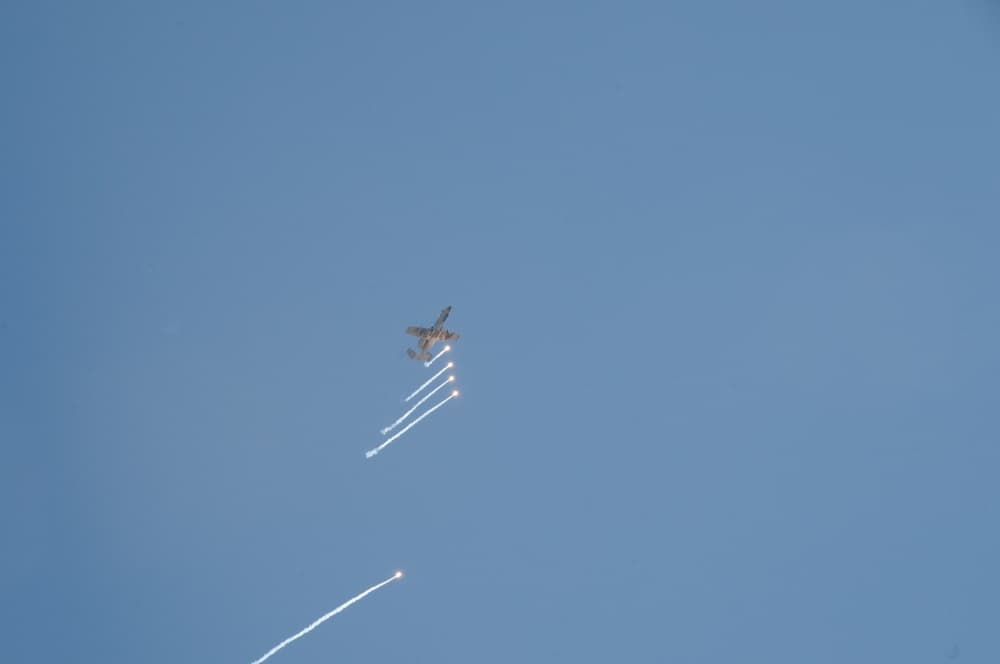
The main image is a U.S. Air Force photograph taken during Operation Snowbird at Davis-Monthan Air Force Base on 15 February 2017. It shows an A-10 releasing countermeasure flares or chaff during a simulated threat. DVIDS marks the image public domain. It is training context only: it was taken twenty years after the Phoenix Lights, does not show the 1997 aircraft or lights, and is not an example of the parachute illumination flares attributed to the later display. The ABC15 Arizona video is a 2025 news retrospective, not original event footage.