United States / 2009 / EXPLAINED
Morristown UFO hoax
The Morristown case is a confirmed deliberate hoax, not an unresolved aerial mystery. Joe Rudy and Chris Russo staged five red-light displays around Morris County, New Jersey, on 5, 26 and 29 January and 7 and 17 February 2009. Their published first-person account says they used road flares carried by helium balloons, recorded their preparations and launches, alerted news outlets and sometimes presented themselves as witnesses. Residents and motorists genuinely saw lights; the deception concerned their cause and the information supplied to investigators and media. Police suspected flares and balloons after the first event, while the larger final display prompted renewed calls, traffic disruption and a prosecutor's inquiry reported on 18-19 February. Rudy and Russo admitted responsibility on 1 April. Contemporary reports say they later pleaded guilty to disorderly conduct and each received a $250 fine and 50 hours of community service. The explanation is strongly supported by their documentation, the repeated-event chronology and the legal outcome. Important limits remain: no direct FAA advisory, incident file, 911 log, radar record or court docket was located, and reports differ on the largest number of lights released at once.
This archive treats the case as explained or substantially resolved by conventional evidence.
- Documentation
- High documentation
- Primary location
- Morris County, New Jersey
- Source base
- 7 linked records
- Research use
- Comparison case
What the record establishes
- Five launch nights
- The supported dates are 5, 26 and 29 January and 7 and 17 February 2009. February 18-19 records investigation and reporting, not another launch.[1][2][3][6]
- Confirmed mechanism
- Rudy and Russo admitted using road flares carried by helium balloons and supplied preparation and launch documentation. The archive omits procedural detail because the activity created fire and aviation risks.[1][3][4][6]
- Witness and media response
- People saw real red lights, but the perpetrators withheld the cause, contacted media and sometimes appeared as witnesses. Reports were therefore genuine observations inside a deliberately contaminated information environment.[1][4][7]
Case dossier
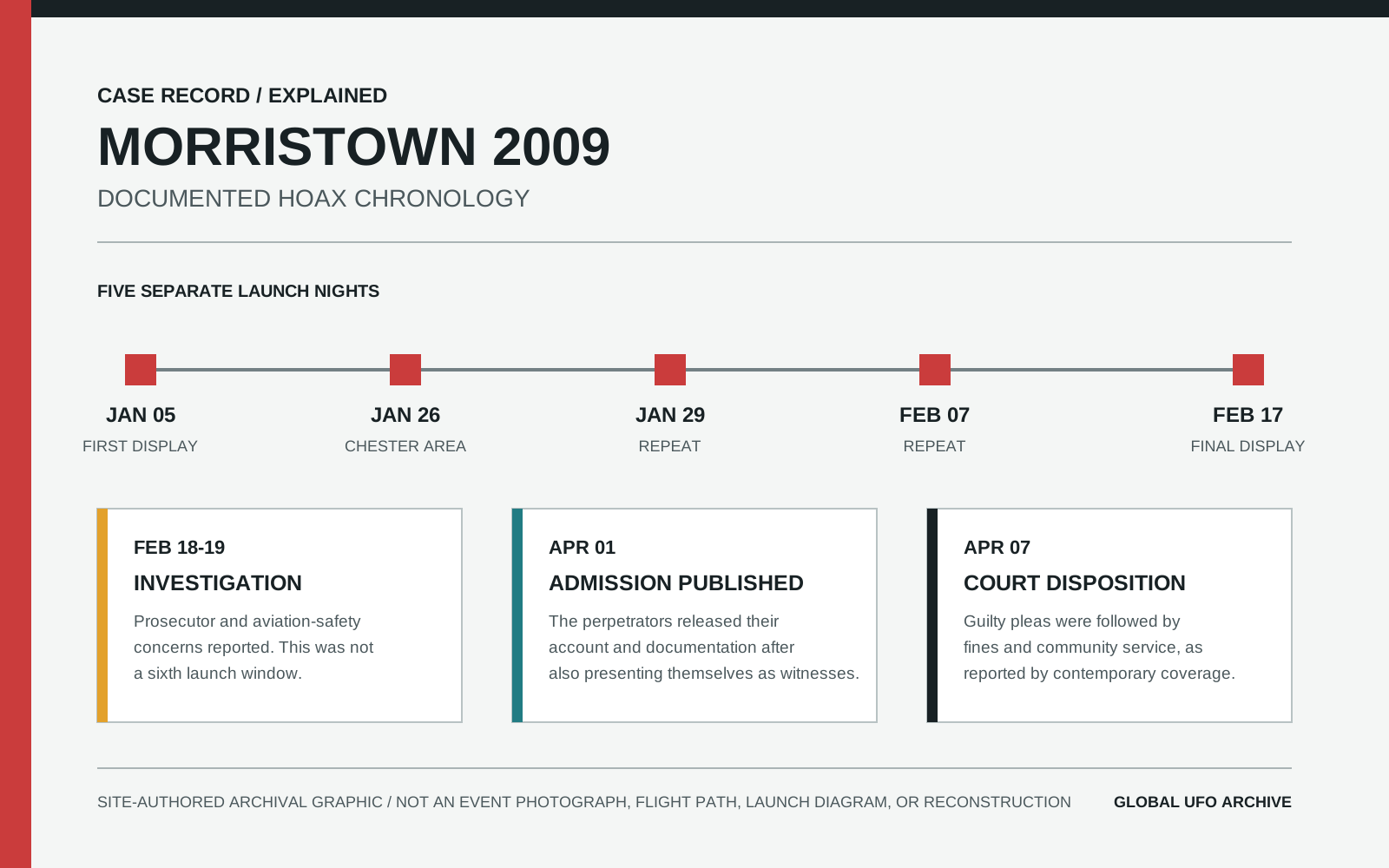
The event commonly called the Morristown UFO hoax was a sequence, not a single night. The best-supported chronology contains five launch dates: 5, 26 and 29 January, followed by 7 and 17 February 2009. Contemporary and later accounts place the displays in Morris County, principally around Hanover and Morristown, with the 26 January event associated with the Chester area. February 18-19 marks the public investigation and reporting after the final display, not a sixth launch. That distinction prevents the case window from being inflated by treating official response dates as additional sightings.
On 5 January, five steady-looking red lights drew attention from residents, motorists and the Hurley family, whose account included pilot Paul Hurley's judgment that the lights were not ordinary aircraft. News crews recorded descriptions of formation, drift and changing spacing. Those observations need not be dismissed: the lights were physically present. What the witnesses lacked was distance, scale and a disclosed source. A small nearby light can appear large, high or fast when the background offers few reference points, so an honest description of motion does not independently identify a craft.
The perpetrators did more than release visible lights. Their account and contemporary coverage say they recorded preparations and launches, contacted news outlets after displays and entered the story as apparent witnesses. Repeating the event let them observe how each round of television, radio, online and UFO-investigator attention influenced the next. That media history matters because it was an actively seeded information environment, not a set of independent reports arising without contact from the source of the deception.
Some investigators reached the correct physical interpretation from appearance. In a local report after the admission, MUFON investigators pointed to flicker, wind-consistent drift and lights going out one by one as flare indicators. Police were also reported to have suspected flares suspended from balloons after the first night. Yet the surviving public record does not include a time-stamped pre-admission MUFON report, police incident file, raw video analysis or measured wind reconstruction. The correct early suspicion is significant, but later recollection should not be upgraded into documentation that has not been found.
On 1 April, Rudy and Russo published a detailed admission through eSkeptic. It is a primary source and also a self-interested one: they selected the material, described their motives and framed the outcome as a lesson about eyewitnesses and UFO investigators. Its central factual claim is nevertheless strongly corroborated. Preparation and launch footage predates the revelation, the five public event dates align with outside reporting, the pair publicly accepted responsibility, and the later plea and sentence are independently reported.
The public-safety response is part of the case, but it must be stated with source boundaries. Contemporary local coverage says the final display generated numerous calls, slowed or stopped traffic along Route 80 and led the Morris County Prosecutor's Office to examine possible fire and aviation hazards. Reports say the office contacted the FAA and other state agencies and that federal aviation officials were concerned about objects near arrival traffic for Newark. No original FAA advisory, air-traffic log or prosecutor release was found in the accessible public record, so this archive does not claim a collision, airspace closure, radar detection or specific federal violation.
After the admission, the Morris County prosecutor announced disorderly-conduct complaints. Reports of the 7 April disposition say both men pleaded guilty, paid $250 each and were ordered to perform 50 hours of community service. The legal outcome confirms responsibility for the public disturbance; it is not a technical FAA finding about every flight risk described in the press. As an archival comparison case, Morristown shows how real lights, poor scale cues, repeated publicity and source manipulation can create a durable UFO story. It does not justify treating unrelated UAP reports as hoaxes without case-specific evidence.
Timeline
- Rudy and Russo stage the first display in the Hanover-Morristown area. Five red lights are seen by residents and motorists; 911 calls and local television coverage follow.
- Police are reported to suspect road flares suspended from balloons, and Morristown Airport is contacted. No public police incident file, tower log or radar record has been located.
- A second display is associated in the surviving chronology with the Chester area. It is one of four repetitions after the first night.
- A third red-light display is staged. Continuing coverage gives later reports a pre-existing UFO narrative and a larger media audience.
- The fourth display repeats the same broad visual effect. Public reporting still treats the cause as contested.
- The fifth and final display uses a larger cluster. Calls increase and vehicles slow or stop along Route 80; reports differ on the maximum number of lights visible at once.
- Local reports describe a Morris County prosecutor inquiry and aviation-safety concern involving the FAA and arrival traffic for Newark. These are response dates, not additional launch dates.
- Rudy and Russo publish their admission and selected preparation and launch documentation through eSkeptic. Newsweek reports the disclosure the same day.
- The Morris County prosecutor announces disorderly-conduct complaints, citing public resources and possible fire and aviation hazards.
- Both men plead guilty. Contemporary and later reports state that each receives a $250 fine and 50 hours of community service.
Questions about the Morristown hoax
What happened in the Morristown UFO hoax?
Joe Rudy and Chris Russo staged five red-light displays in Morris County between 5 January and 17 February 2009 using road flares carried by helium balloons. They documented the activity and admitted it publicly on 1 April.
How do we know the lights were a hoax?
The two perpetrators gave a detailed joint admission, released preparation and launch footage, matched the public five-date chronology, accepted responsibility and later pleaded guilty. Independent reports confirm the public events, charges and sentence.
Were the witnesses lying?
Not necessarily. Witnesses saw real lights but did not know their distance, scale or cause. The perpetrators also contacted media and appeared as witnesses, contaminating the information available to sincere observers and investigators.
What did the FAA establish?
Contemporary journalism reports FAA concern and contact about possible risk near arrival traffic for Newark. No original FAA advisory, incident file, radar record or enforcement finding was located, so exact proximity and any federal violation remain unverified.
What penalties did Rudy and Russo receive?
Reports say both pleaded guilty to disorderly conduct on 7 April 2009. Each was fined $250 and ordered to complete 50 hours of community service. The original court docket was not located in this review.
Does Morristown show that other UAP reports are hoaxes?
No. It demonstrates one documented mechanism and how source manipulation can amplify ambiguous lights. Other reports require their own chronology, records, physical analysis and corroboration; analogy cannot replace case-specific evidence.
Sources
- [1] ArchiveThe Great UFO Hoax of 2009eSkeptic / Skeptics Society archive
- [2] ArchiveProsecutor investigates red lights, citing possible danger to aircraftDaily Record (archived excerpt)
- [3] Archive2 reveal UFO hoax, but prosecutor for Morris not smilingThe Star-Ledger / NJ.com (Internet Archive)
- [4] News reportPair charged in UFO hoaxABC11 / Associated Press
- [5] News reportNJ Men Fined $250 for UFO HoaxLive Science
- [6] News reportProbers not fooled by Morristown UFO hoaxNew Jersey Hills / Morris NewsBee
- [7] News reportMorristown UFO Hoax: Meet The Duo Behind The 2009 ExperimentMorristown Patch
The displayed image is a site-authored chronology, not a photograph of the lights, a launch diagram, flight path or visual reconstruction. A licensed January 5 witness photo was identified through Wikimedia Commons metadata but was not copied after the host rate-limited retrieval. The legacy VICE thumbnail is excluded because its active reuse rights and provenance are insufficient.