United Kingdom / 1980 / DISPUTED
1980 Rendlesham Forest Incident
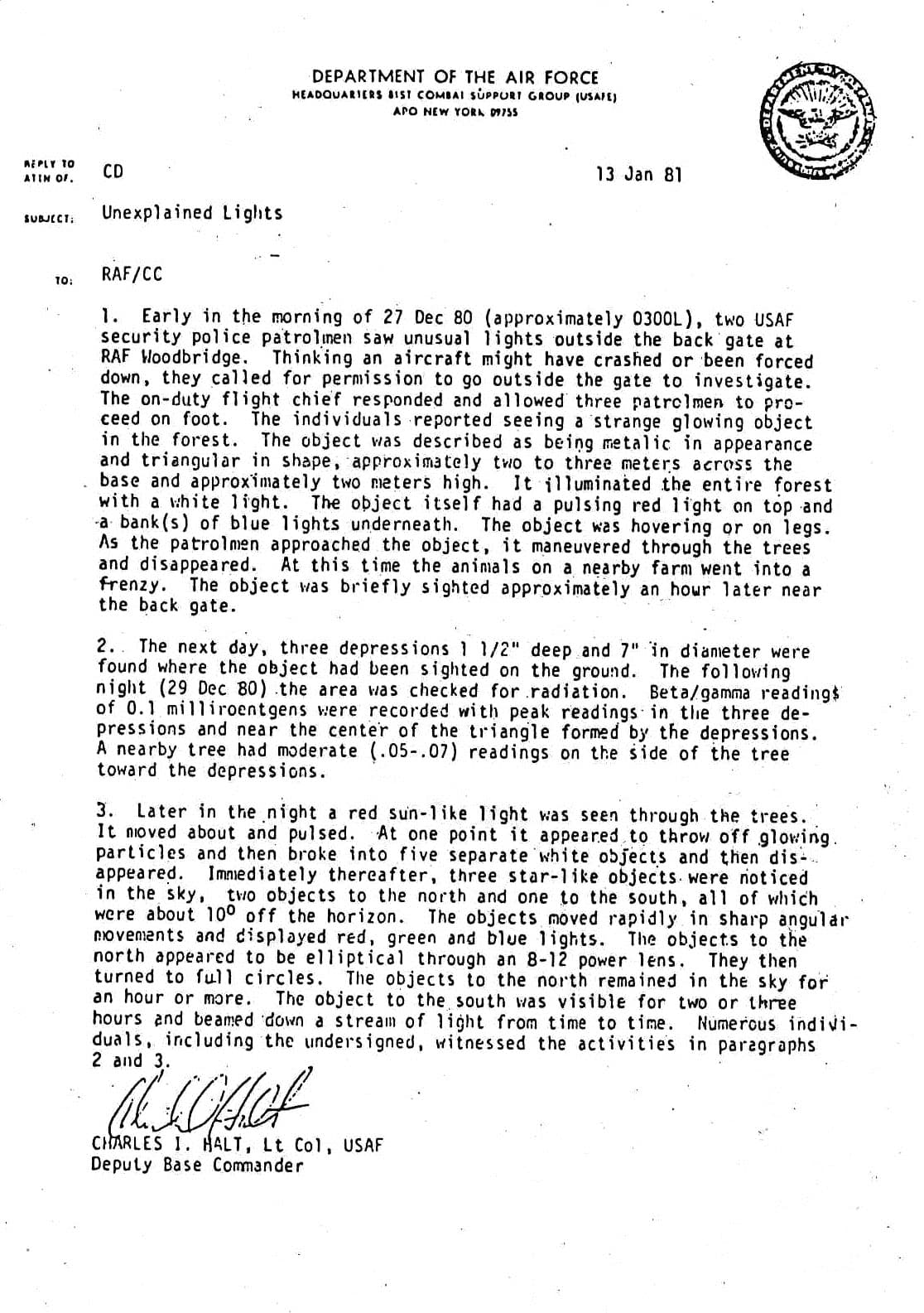
In late December 1980, U.S. Air Force security personnel stationed at RAF Woodbridge and RAF Bentwaters reported unusual lights in Rendlesham Forest, Suffolk. Lieutenant Colonel Charles Halt later recorded a second investigation and sent the British Ministry of Defence a one-page memorandum titled “Unexplained Lights.” The memo and audio are genuine archival records, but the dates conflict with the reconstructed chronology, the reported radiation readings are not conclusive, and no public radar record or authenticated event photograph identifies a craft. The case remains disputed; the archive does not support an extraterrestrial conclusion.
This case is disputed. The archive preserves the claims while separating evidence from interpretation.
- Documentation
- High documentation
- Primary location
- Rendlesham Forest, Suffolk
- Source base
- 9 linked records
- Research use
- Comparison case
What the public record supports
- Confirmed setting
- U.S. Air Force personnel investigated unusual lights near RAF Woodbridge on two nights in late December 1980.[1][2]
- Primary records
- The archive contains Halt's signed one-page memorandum and an intermittent field recording from the second investigation.[2][3][4]
- Date conflict
- The memo dates both nights one day later than the chronology usually reconstructed from witness and operational records.[1][2][9]
Location context
Case dossier
Case scope: In late December 1980, U.S. Air Force security personnel stationed at RAF Woodbridge and RAF Bentwaters reported unusual lights in Rendlesham Forest, Suffolk. Lieutenant Colonel Charles Halt later recorded a second investigation and sent the British Ministry of Defence a one-page memorandum titled “Unexplained Lights.” The memo and audio are genuine archival records, but the dates conflict with the reconstructed chronology, the reported radiation readings are not conclusive, and no public radar record or authenticated event photograph identifies a craft. The case remains disputed; the archive does not support an extraterrestrial conclusion.
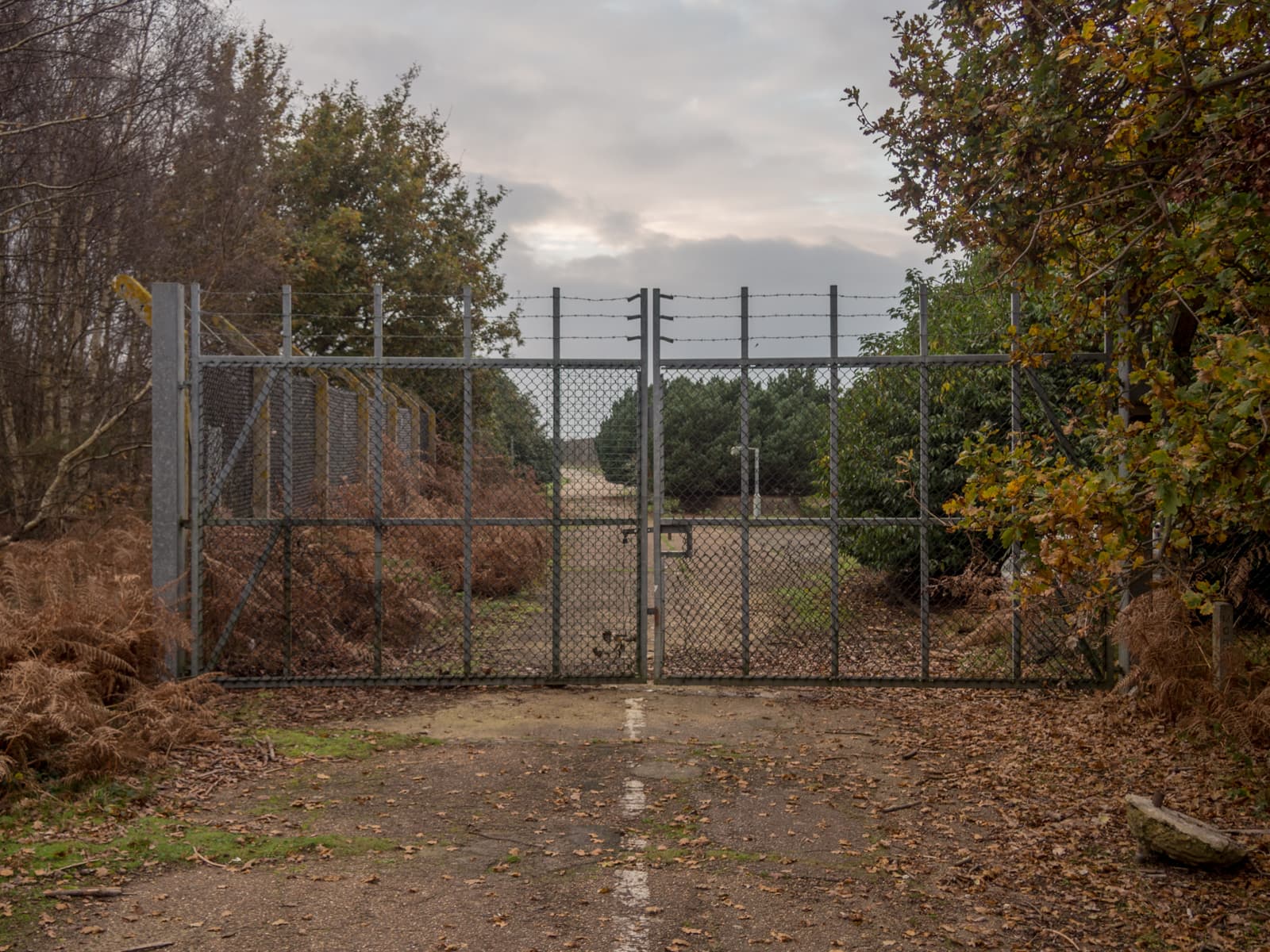
Chronology: The incident developed beside two Cold War airfields used by the United States Air Force: RAF Woodbridge and nearby RAF Bentwaters. In the early hours after Christmas 1980, security personnel at Woodbridge saw lights beyond the east gate and entered Rendlesham Forest because they initially considered the possibility of a crashed aircraft. The National Archives summarizes the episode as servicemen investigating unusual lights on two nights. That setting and the existence of named military witnesses are well documented; the identity and distance of the lights are not.
Evidence record: The strongest documentary evidence is the 13 January 1981 Halt memorandum. It proves that a senior U.S. Air Force officer formally reported the episode through an official channel. Because it was retrospective, brief and internally inconsistent on dates, it cannot by itself verify every later witness detail or reconstruct exact timing.
The Halt tape is closer to contemporaneous evidence. It preserves the investigators' comments, Geiger-counter readings and changing descriptions of lights, but the recorder was repeatedly stopped. Without synchronized video, surveyed positions, instrument calibration and complete timing, the audio documents experience and procedure more strongly than object identity or performance.
The depressions, tree marks and radiation readings have limited evidentiary weight. Public records do not establish a protected scene, independent sampling or a baseline survey capable of excluding ordinary causes. The archive therefore records that personnel reported and measured features at the site, while rejecting the stronger claim that the data prove a landed craft.
Official record: The National Archives catalogues the core Ministry of Defence material under files including DEFE 24/1948/1 and DEFE 24/1512. Its research guide says the original report and follow-up papers are present, while much of the surrounding material concerns public discussion. The ministry's “no defence significance” position addressed national-security relevance; it did not certify an extraterrestrial event or produce a complete scientific investigation.
A 2015 written answer in the House of Lords is important for the radar claim. The government said the Ministry of Defence could not confirm Halt's account that radar operators tracked an unknown object because the relevant files contained no radar reports or recordings. This does not prove that no operator saw a contact; it means the public official record cannot independently verify that part of the story.
Possible explanations: Ian Ridpath's reconstruction combines several ordinary stimuli rather than forcing one cause onto the whole sequence: a bright fireball for the initial alarm, the Orford Ness lighthouse for a recurring light near the horizon, and bright stars for later coloured points. The proposal is consistent with important directions and timing but remains a reconstruction built from incomplete records, not a controlled replay of every witness perspective.
The most careful assessment is that military personnel conducted and documented real investigations of lights whose full identity is not recoverable from the surviving public file. The memo and tape are authentic, but authenticity of records is not proof of an extraordinary craft. Conventional explanations cover substantial portions of the event, while date conflicts, absent raw measurements and later narrative growth prevent a definitive reconstruction.
Archive assessment: The earliest patrol is usually reconstructed as occurring in the early hours of 26 December. Airmen John Burroughs and Jim Penniston, with Ed Cabansag, went into the forest and reported lights among the trees. Later recollections included a close triangular object and, in Penniston's account, physical contact. Those later details must be separated from the earliest available records. Halt's memorandum instead dates the first report to about 0300 on 27 December, creating a one-day discrepancy that the surviving public file does not resolve.
After daylight, personnel reported three shallow depressions and marks on nearby trees. Suffolk police visited after the first call and did not record an aircraft wreck. Halt later wrote that radiation readings were taken around the depressions, with a higher reading near the centre. The public material does not provide a controlled survey, calibrated background comparison or laboratory chain that could establish when the marks formed or what caused them. Ground traces are therefore documented claims, not proof of a landing.
A second investigation, generally placed in the early hours of 28 December, was led by Deputy Base Commander Lieutenant Colonel Charles Halt. Halt carried a microcassette recorder and intermittently narrated the team's movement, instrument readings and sightings of coloured lights. The surviving recording is unusually valuable because it preserves parts of the field investigation as they occurred. It also contains gaps whenever the recorder was switched off and does not supply synchronized photographs, range measurements or radar data.
On 13 January 1981, Halt signed the memorandum “Unexplained Lights” for the Royal Air Force liaison chain. The memo records the patrol reports, depressions, radiation readings and later lights, making it the central official document. It was written more than two weeks after the observations and compresses events into a short chronology. The date mismatch and the memo's retrospective nature are evidentiary limits, but they do not make the document a fabrication.
The British Ministry of Defence treated the material as a question of air-defence significance. The National Archives states that the original one-page report is the only record it holds of the event itself; the surrounding files largely contain later press and public correspondence. The ministry's published position was that nothing reported suggested a threat to national security or required further defence investigation. That administrative conclusion does not identify every light, and it is not an endorsement of later extraordinary claims.
Public retellings expanded after the story reached the press in 1983 and after Ministry of Defence files were released from 2001 onward. Later books, interviews and television programmes introduced more elaborate narratives, including Penniston's binary-code account. Because those elements do not appear in the Halt memo or other earliest public records, they cannot be backdated as contemporaneous evidence. Repetition by later media may document the growth of the legend without independently confirming the event.
A composite conventional reconstruction remains plausible: a bright meteor may have prompted the first alarm, the Orford Ness lighthouse and bright stars may have contributed to later moving or flashing lights, and stress, darkness and uncertain distance may have shaped perception. This reconstruction explains important parts of the record but cannot be proven frame by frame from the incomplete archive. Rendlesham belongs in the archive because it has named witnesses, an official memo and a field recording, while also showing how missing measurements, date conflicts and later embellishment limit a famous military UFO case.
Later ITN news report
This 2009 On Demand News/ITN report covers the release of British UFO files and Rendlesham's public history. It is retrospective journalism, not footage recorded during the 1980 observations.
Related video
Timeline
- Security personnel enter Rendlesham Forest after seeing lights beyond RAF Woodbridge's east gate; Halt's later memo dates this first report one day later.
- John Burroughs, Jim Penniston and Ed Cabansag report lights among the trees; later accounts add disputed close-contact details.
- Suffolk police attend after the first report and do not record an aircraft wreck.
- Charles Halt leads a second forest investigation and makes the intermittent field recording; his memo dates this phase to 29 December.
- Halt signs the one-page memorandum “Unexplained Lights” for the British defence liaison chain.
- The story enters wider public discussion through press reporting and parliamentary attention.
- The Ministry of Defence begins releasing Rendlesham-related files, expanding access beyond the Halt memo.
- The National Archives opens DEFE 24/1948/1, containing the Halt memo and later correspondence.
- A parliamentary answer says Ministry of Defence files contain no radar reports or recordings that confirm Halt's later radar account.
- Forestry England maintains a Rendlesham UFO Trail as cultural and location interpretation, not as an official finding about the lights.
Frequently asked questions
What happened in the Rendlesham Forest incident?
U.S. Air Force personnel investigated lights near RAF Woodbridge on two nights in late December 1980. The second investigation produced Halt's field recording and later memorandum.
Is the Halt memorandum authentic?
Yes. It is an official U.S. Air Force work preserved in British defence files. Its authenticity does not verify every later claim, and its dates conflict with the usual reconstructed chronology.
Was there an original photo or video of the object?
No authenticated event image is public. The case has a document scan, field audio, later interviews and retrospective news coverage, not verified footage of the reported object.
What does the Halt tape prove?
It records parts of the second investigation, including comments, light descriptions and instrument readings. It does not provide synchronized imagery, exact ranges or radar tracks needed to identify an object.
Did radar confirm an unknown craft?
The public Ministry of Defence files contain no radar reports or recordings that confirm the later radar account, according to a 2015 parliamentary answer.
What are the leading conventional explanations?
A composite explanation includes a bright meteor, the Orford Ness lighthouse, bright stars and perception under darkness and stress. It explains substantial parts but cannot be proved for every reported moment.
Did the incident prove an extraterrestrial visit?
No. The records confirm an investigation and unresolved observations. They do not identify a craft, demonstrate extraordinary performance or establish an extraterrestrial origin.
Sources
- [1] ArchiveUFO reports: Rendlesham Forest recordsThe National Archives (UK)
- [2] ArchiveThe National Archives UFO research guideThe National Archives (UK)
- [3] Official fileHalt memorandum: Unexplained LightsU.S. Air Force work / Wikimedia Commons
- [4] ArchiveHalt field recording from Rendlesham ForestCharles Halt field recording / Wikimedia Commons
- [5] Official fileHouse of Lords written answer on the Rendlesham radar claimUK Parliament
- [6] ResearchRendlesham Forest: the first nightIan Ridpath
- [7] Official fileRendlesham Forest UFO TrailForestry England
- [8] News reportUFO files: Finally the truth about Rendlesham Forest?On Demand News / ITN
- [9] ArchiveAugust 2009 UFO file highlights guideThe National Archives (UK)
The main image is the 13 January 1981 Halt memorandum, an official documentary record rather than a photograph of the reported lights. No authenticated event photograph or video is public.