
Evidence / Updated 2026-08-02 / 11 min read
Common UFO Misidentifications: Drones, Satellites, Planets and Camera Effects
Most reports begin with honest uncertainty. Time, direction, motion, weather, flight paths, satellite passes and original files are the strongest first checks.
Reviewed and maintained byGlobal UFO Archive Editorial DeskEditorial policy
Quick answer
Common UFO misidentifications include aircraft lights, drones, balloons, Starlink and other satellites, Venus, bright stars, meteors, rocket reentries and camera artifacts. A match should use the reported time, direction and motion together with flight, weather and orbital records, not appearance alone.
Key points
- Misidentification does not mean the witness lied. It means the observation was interpreted under limited information.
- The strongest first checks are time, location, direction, weather, flight paths, satellite passes, and original media files.
- A case becomes more interesting when ordinary explanations have been checked and documented, not when they are ignored.
- Identification works best as elimination by observable behavior, not as a visual guess from a cropped image.
- An explained report remains useful because it shows which missing observations would have prevented the misidentification.
Sky objects often look strange
Drones, aircraft, balloons, satellites, re-entering debris, meteors, planets, and bright stars can all produce reports that feel unusual to a witness. Distance removes scale, darkness removes context, and phone cameras often amplify motion blur, focus breathing, digital zoom, and compression artifacts.
A practical checklist
Start with the basic reconstruction: exact time, exact location, viewing direction, elevation angle, duration, weather, sound, motion, and whether the object changed brightness or color. Then compare the report with aircraft tracking, satellite visibility, astronomical objects, local drone activity, events, launches, and known military or emergency operations where publicly available.
If the case depends on video, preserve the original file. A reposted clip without metadata is much weaker than the first file from the camera. Analysts need frame rate, exposure, focal length, stabilization behavior, file creation time, and unedited audio when available.
Why skeptical review improves the archive
Skeptical review is not the opposite of curiosity. It is what makes curiosity useful. When ordinary explanations are documented, the remaining cases become clearer, search users trust the site more, and future updates can explain why an assessment changed.
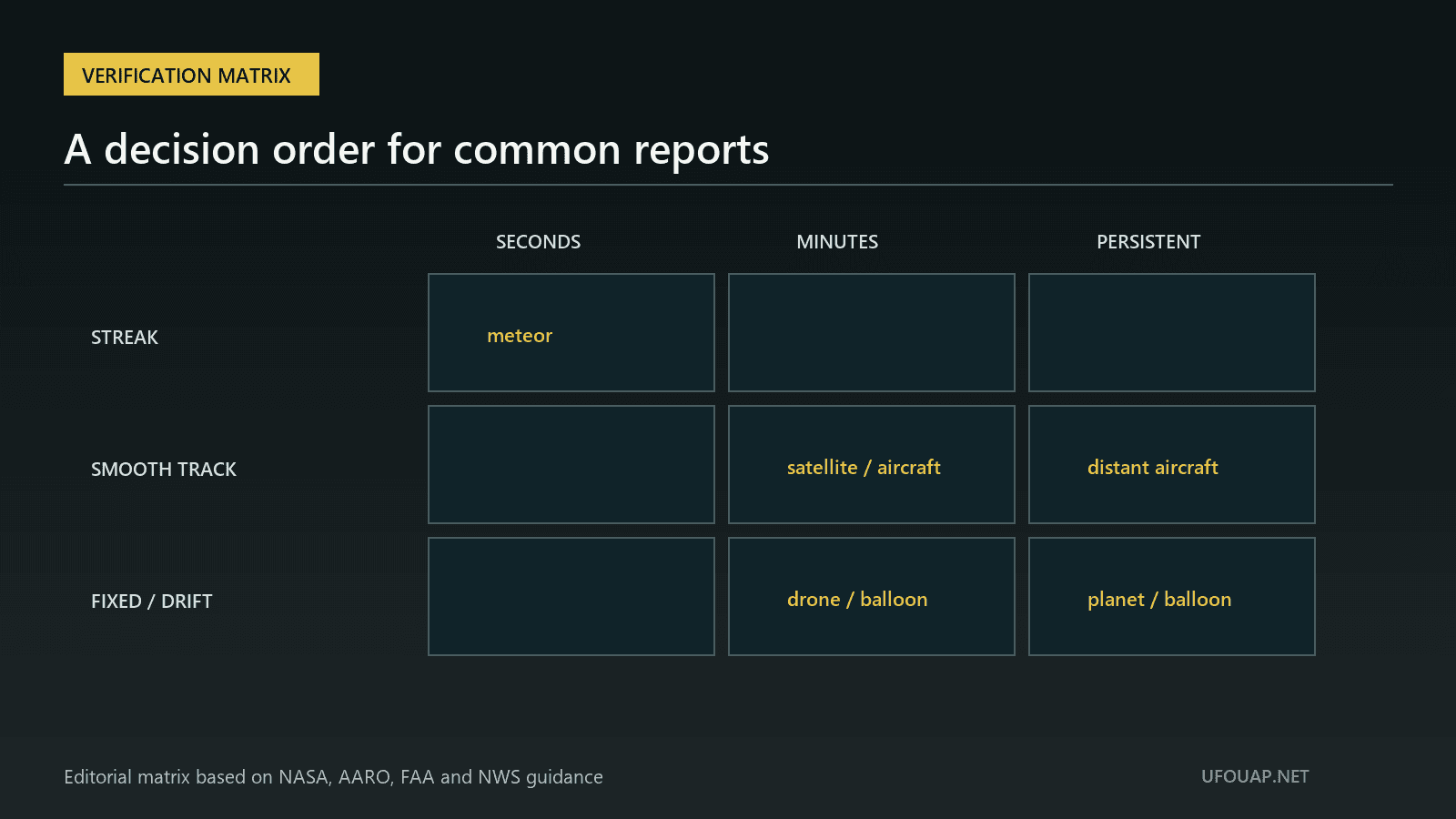
Use a decision order, not a list of look-alikes
Start with duration and motion. A seconds-long streak suggests a meteor; a minutes-long formation may point to satellites or aircraft; a persistent fixed light calls for an astronomy check. Next test direction, elevation, wind, sound, flashing pattern and whether the object crosses stars or terrain. Only then compare shape. This order reduces a common error: letting a dramatic zoomed frame dominate evidence that the light followed a predictable celestial, orbital or aviation path.
What remains after common causes are checked
Failure to identify a report is not the same as evidence of an exotic object. It may mean the time is approximate, direction was not recorded, the video lacks an original file, a flight was not publicly tracked, or the sensor geometry is unknown. A responsible unresolved classification states the missing information and the conventional categories already tested. That makes the record useful for later comparison without claiming more than the evidence supports.
FAQ
Are most UFO sightings misidentifications?
Many reports can be explained after reconstruction, but the exact percentage depends on the reporting system and data quality.
What is the most common first mistake?
Judging speed, size, and distance without reliable reference points. A distant aircraft or satellite can appear close, fast, or silent.
What is the most common cause of a UFO report?
There is no single cause for every dataset. Bright planets, aircraft, balloons, satellites, drones, meteors and camera effects recur often, and their shares change by place, period and reporting system.
Sources
- All-domain Anomaly Resolution OfficeAARO official resources and common causeswww.aaro.mil
- AAROOfficial UAP Imagerywww.aaro.mil
- FAADrone Sightings Near Airportswww.faa.gov
- NASA ScienceIdentifying UFOs and UAPsscience.nasa.gov
- National Weather ServiceWeather balloon factswww.weather.gov