
Evidence / Updated 2026-09-27 / 3 min read
How to verify a UFO sighting with flight, satellite and weather data
A repeatable workflow preserves the original record, reconstructs time and direction, and tests aircraft, orbital, astronomical and weather candidates before calling a report unresolved.
Reviewed and maintained byGlobal UFO Archive Editorial DeskEditorial policy
Quick answer
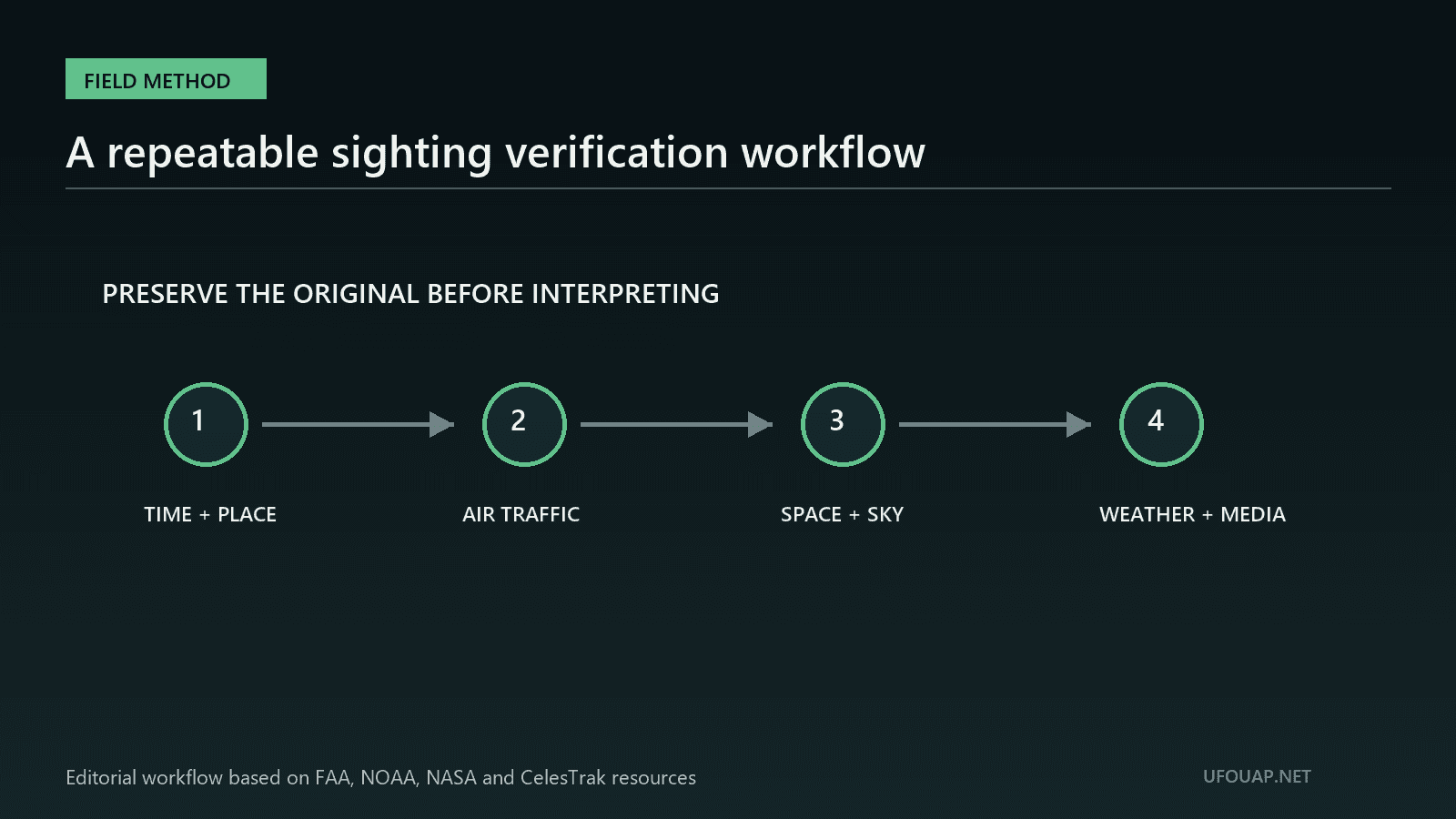
Begin with the original file and an exact timeline, not a guess about the object. Record location, time zone, direction, elevation, duration and camera details. Then test aircraft and airport routes, satellites and launches, planets and fireballs, weather balloons, clouds and local events. Keep a log of which source and data time were checked. A candidate is credible only when it matches several independent features; no database match means unresolved, not automatically anomalous.
Key points
- Preserve originals before screenshots, edits or platform compression remove evidence.
- Convert every observation into time, place, direction and duration before searching candidates.
- Use independent matches and document uncertainty instead of treating one app as definitive.
Build the observation record
Save the original photo or video, note the device and keep surrounding frames and audio. Write local time with time zone, coordinates or a precise location, viewing direction, elevation, duration and observer movement. Photograph the horizon in daylight if useful. Separate what was directly seen from later interpretation. This record lets another analyst reproduce the checks rather than rely on memory.
Check aircraft and orbital traffic
Compare airport approaches, FAA context and reputable flight history with the observation. ADS-B is valuable but public coverage is incomplete. For orbital objects, use the observation-time elements from a catalog such as CelesTrak and note the pass direction, elevation and shadow entry. Check recent launches and reentries. A visual resemblance without timing and path agreement is not a match.
Check sky and weather conditions
Compare the bearing with planets, bright stars, the Moon, meteor-shower windows and NASA fireball records. Use NOAA past-weather tools for cloud cover, visibility, wind and storms; local balloon activity may follow wind. Consider lenticular clouds, light pillars, reflections and lightning only when conditions support them. Weather history is evidence, not a generic list of possibilities.
Report confidence and remaining unknowns
Record each candidate as supported, contradicted or not testable and link the source used. A conclusion should explain why timing, direction, behavior and media agree. If essential data are absent, say which measurements would change the assessment. Identified, probable and unresolved are different confidence states. Unresolved means the record cannot support a firm attribution; it is not a shortcut to an extraordinary claim.
Related checks and records
FAQ
What is the first thing to save after a UFO sighting?
Save the original unedited media with metadata, then record exact time, location, direction and duration before memory or online discussion changes the account.
Does a failed match in flight and satellite apps prove a UAP?
No. Coverage, catalog freshness, classified objects and incomplete observations create gaps. It only means those checks did not identify the report.
Official sources used
- Federal Aviation AdministrationADS-B In and Outwww.faa.gov
- NOAA National Centers for Environmental InformationPast Weatherwww.ncei.noaa.gov
- CelesTrakCelesTrakcelestrak.org
- NASA CNEOSFireballs and Bolidescneos.jpl.nasa.gov