
Culture / Updated 2026-10-25 / 3 min read
Crop Circles and UFOs: Human Makers and Evidence Limits
A crop formation can be real while its maker remains unverified. Compare documented circle-making with the much stronger claim that a pattern records a UFO visit.
Reviewed and maintained byGlobal UFO Archive Editorial DeskEditorial policy
Quick answer
There is documented human production of elaborate crop circles. A field photograph establishes the appearance of a pattern, not who made it or whether anything flew overhead. An unattributed formation remains unattributed; it does not become extraterrestrial evidence because its design is intricate or its discovery seemed sudden.
Key points
- Formation, authorship and aerial-event claims require different evidence.
- Human-making demonstrations do not identify every formation ever photographed.
A formation is not evidence of its maker
- 01
Formation: record location, crop and observation window.
- 02
Traces: document stems, access and witness accounts.
- 03
Provenance: preserve first images and their history.
- 04
Claim: test authorship separately from a UFO association.
What the human-making record establishes
Smithsonian’s 2009 account by Rob Irving and Peter Brookesmith discusses circle-making from within that practice, including Doug Bower and Dave Chorley. Daniel Stables’s BBC field reporting, dated 23 August 2021, independently interviews people in the Wiltshire crop-circle community. It describes Bower and Chorley’s 1991 authorship claims and demonstrations using ordinary measuring and flattening tools.
These sources establish human construction as a demonstrated explanation, not merely an imagined alternative. They do not supply an authorship certificate for every field image. A participant can document a method; a reporter can document interviews and demonstrations. Repeating the same confession in two publications does not create a second witness to an unobserved formation.
How to investigate one formation
Our field-record checklist starts with the exact location, crop, dated photographs and the landholder’s account. Separate the last documented view of the undisturbed field from the first discovery. “Found at dawn” is a discovery time, not a measured construction duration. Use matching landmarks in wide views before relying on an aerial crop or a close-up of a bent stem.
Treat laboratory claims as separate documents requiring sample locations, collection dates, custody, methods and comparison samples. Plant-damage photographs do not on their own identify radiation, an energy source or a maker. Authorship claims are stronger with plans, dated records and matching details. These are our verification questions, not a claim that the cited articles performed controlled tests of every reported anomaly.
Keep folklore, photographs and aerial reports distinct
The BBC article records makers, farmers, visitors and believers with conflicting interpretations. Those interviews document culture and personal claims; a reported light or equipment failure is not a verified causal link to a formation. A circle photograph and a nearby UFO narrative need matching place, time and independent records before they can be treated as one event.
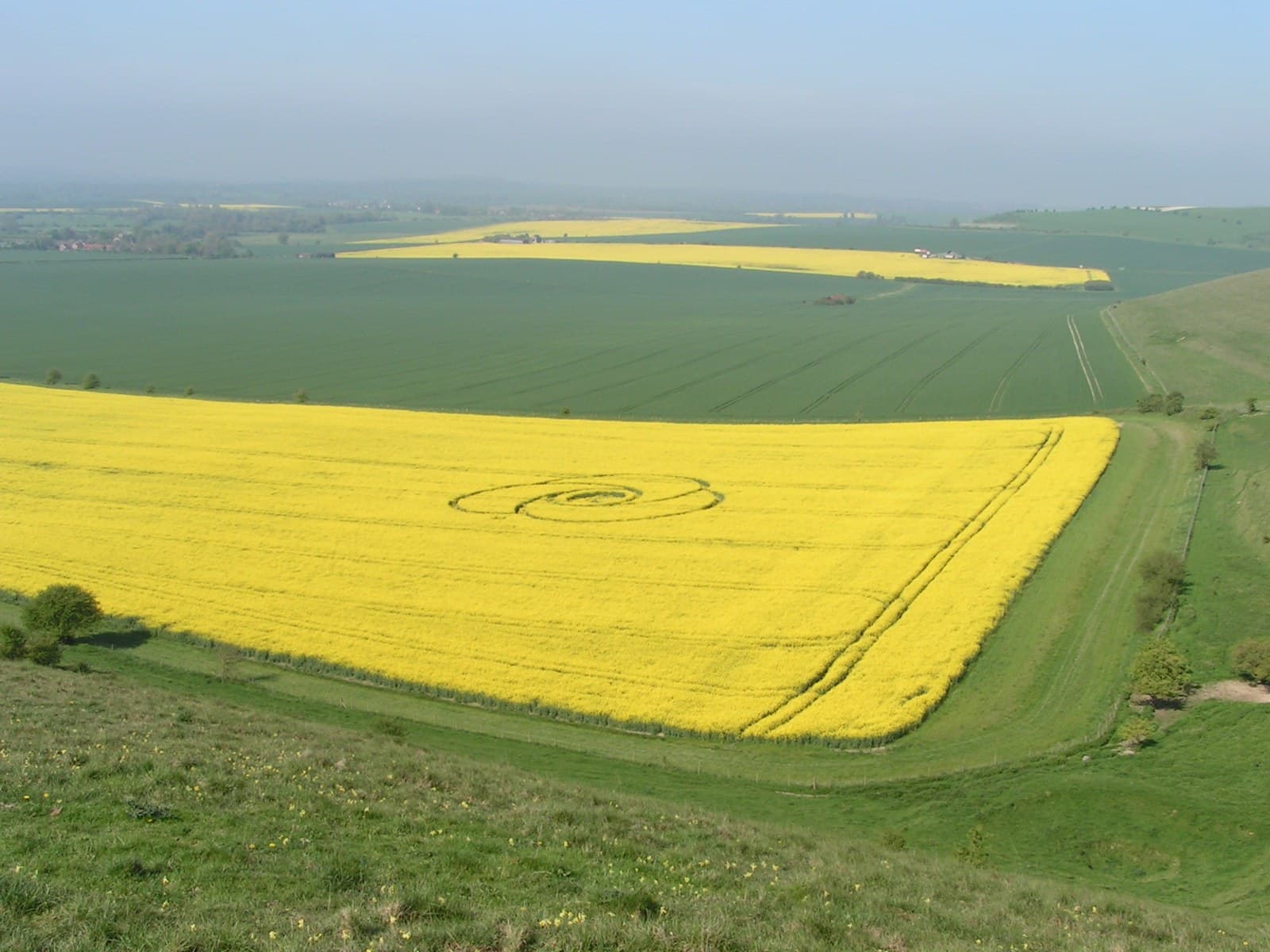
The Milk Hill photograph here is an appearance example credited to Brian Nelson under CC BY-SA 2.0. Its source entry does not identify the maker or establish a UFO connection; resemblance alone cannot assign it to another famous formation. This guide therefore provides cultural and evidentiary context, while specific aerial encounters remain in their own dossiers.
Related checks and records
FAQ
Are crop circles evidence of aliens?
A pattern alone does not establish extraterrestrial origin. Human construction is documented; unknown authorship is not positive evidence of aliens.
Did two men make every crop circle?
Their claims and demonstrations establish examples of human production, not a complete authorship inventory of every formation.
Does overnight discovery measure construction time?
No. It records when a person noticed it. Establishing a time window requires a documented earlier view of the same field.
Sources
- Smithsonian Magazine / Rob Irving and Peter BrookesmithCrop Circles: The Art of the Hoax (15 December 2009)www.smithsonianmag.com
- BBC Travel / Daniel StablesEngland’s crop circle controversy (23 August 2021)www.bbc.com
- Brian Nelson / Geograph / Wikimedia CommonsCrop circle below Milk Hill: photograph and licencecommons.wikimedia.org