
Reporting / Updated 2026-08-02 / 10 min read
How to Report a UFO Sighting: Where to Submit a UAP Report
Record time, location, direction, duration, weather, witnesses and original files, then check aircraft, satellites, planets, balloons and drones before reporting.
Reviewed and maintained byGlobal UFO Archive Editorial DeskEditorial policy
Quick answer
Preserve the original file and record the exact time, place, direction, duration, weather, witnesses, and camera details before posting. Aviation hazards belong with the relevant safety authority. AARO's secure reporting route is limited to eligible current or former U.S. government personnel, while civilians may use established public reporting databases after checking their privacy and verification policies.
Key points
- Record facts before interpretation: time, location, direction, duration, movement, sound, weather, and witnesses.
- Keep original photos and videos. Do not crop, filter, stabilize, or overwrite the first file.
- If there is immediate danger, report it to local emergency services or law enforcement first, not to a UFO website.
- Record first, interpret later: exact time, location, direction, duration and the original file are more valuable than a confident label.
- Safety and operational reporting come before public posting when the sighting affects an aircraft, airport, military facility or emergency response.
What to write down immediately
Write the report while the memory is fresh. Record the exact local time, date, location, viewing direction, elevation above the horizon, duration, movement pattern, apparent brightness, color, sound, weather, and whether other people saw the same thing. A rough sketch can help if it shows the horizon, buildings, stars, or aircraft paths used as reference points.
How to preserve media
If you recorded video or photos, keep the original files exactly as created by the device. Do not send only a social-media repost. Copy the original to a safe folder, note the device model, and preserve any separate audio or witness messages that establish time and context.
For analysis, the boring details matter: frame rate, exposure, focal length, stabilization, zoom level, file creation time, GPS metadata, and whether the camera was behind glass. These details often decide whether a light is extraordinary or simply misread.
Where to report
If the event involves immediate danger, suspected illegal drone operation, interference with aircraft, fire, injury, or a security threat, contact local emergency services or law enforcement first. In the United States, the FAA directs dangerous or criminal drone activity to local law enforcement first responders before aviation follow-up.
For archival reporting, submit structured information rather than conclusions. A good report says, 'I saw a silent amber light moving northwest for 90 seconds from this location at this time,' not only, 'I saw a UFO.'
Build a field record that can be checked
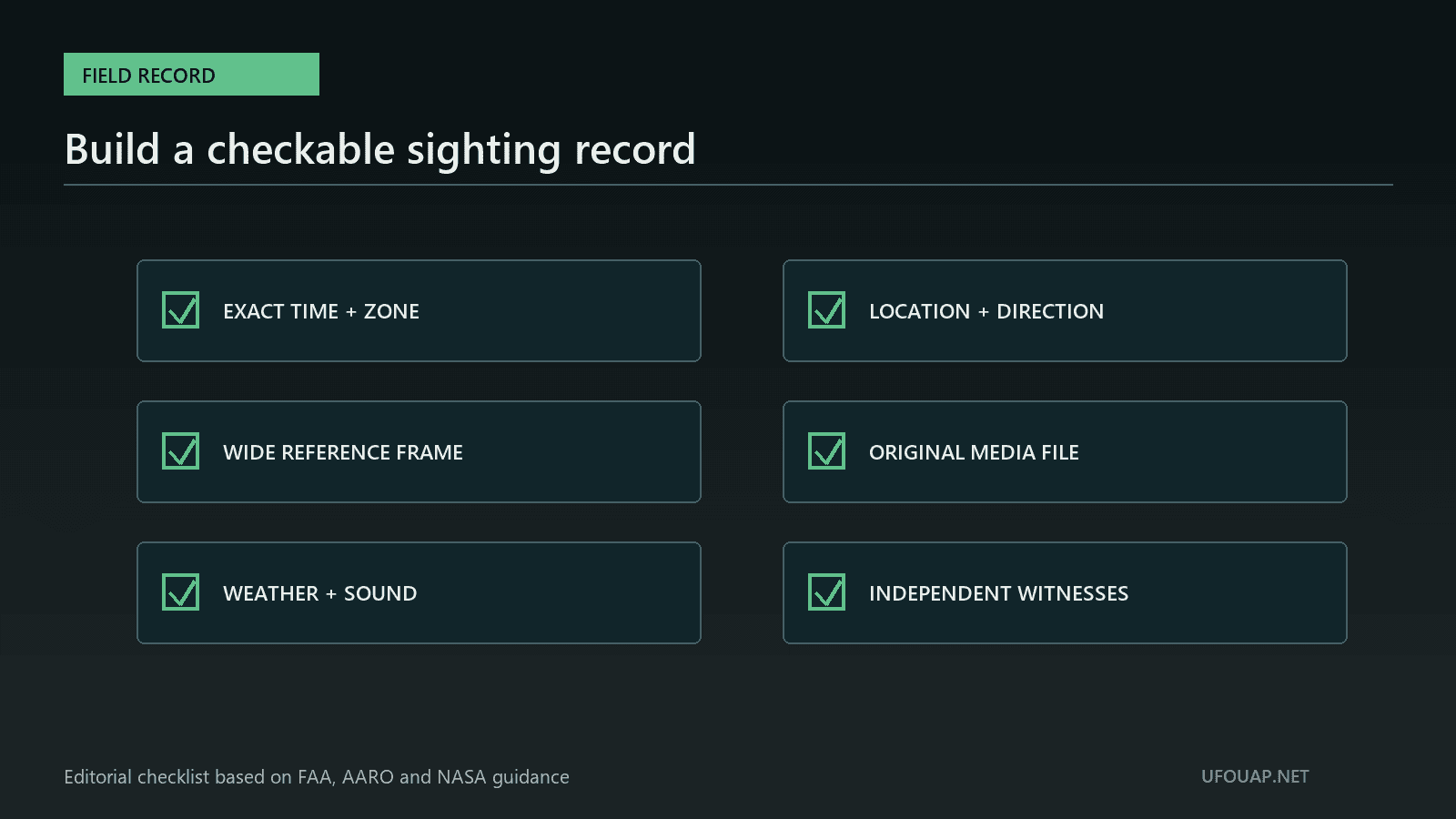
Write down the start and end time with time zone, precise observing location, compass direction, approximate elevation, weather, sound and how the object moved relative to buildings, stars or terrain. Describe each light separately before naming a shape. If safe, capture a wide unzoomed view, then a closer view, and keep the original file unchanged. Note the device, lens, zoom, exposure mode and any editing or platform compression. Ask other witnesses to record their accounts independently so later discussion does not standardize their memories.
Choose the correct reporting channel
Aviation hazards should be reported through the relevant air traffic or safety channel, not delayed for social media. U.S. military personnel follow their command reporting procedures, while AARO provides a secure mechanism for eligible current or former government personnel with direct knowledge of relevant programs. Civilian archive organizations can preserve non-emergency reports, but their forms and verification standards differ. Before submitting, read the privacy terms, decide whether your name may be published, and keep a copy of exactly what you sent. A report should distinguish direct observation from later inference and identify any media that is secondhand.
FAQ
Should I edit my UFO video before submitting it?
No. Keep the original file. You can make a copy for public sharing, but the unedited file is more valuable for analysis.
What if I only have a short clip?
Submit it with context: where you stood, which direction you faced, what happened before and after, and whether anyone else recorded the same event.
How do I report a UFO sighting properly?
Record the time, place, direction, duration, weather, camera model and original file. Also note any aircraft, satellites, planets, drones, balloons or local events that might explain the sighting.
Should I post a UFO video before reporting it?
Preserve the original first. Public platforms may recompress media and strip metadata. If safety is involved, use the operational reporting channel immediately; a public copy can wait.
Official sources used
- Federal Aviation AdministrationReport a drone sightingwww.faa.gov
- FAAHandling Sightings and Reportswww.faa.gov
- All-domain Anomaly Resolution OfficeAARO reporting informationwww.aaro.mil
- NASA ScienceIdentifying UFOs and UAPsscience.nasa.gov