
United Kingdom / 1980 / DISPUTED
The Halt Memorandum and Rendlesham Record
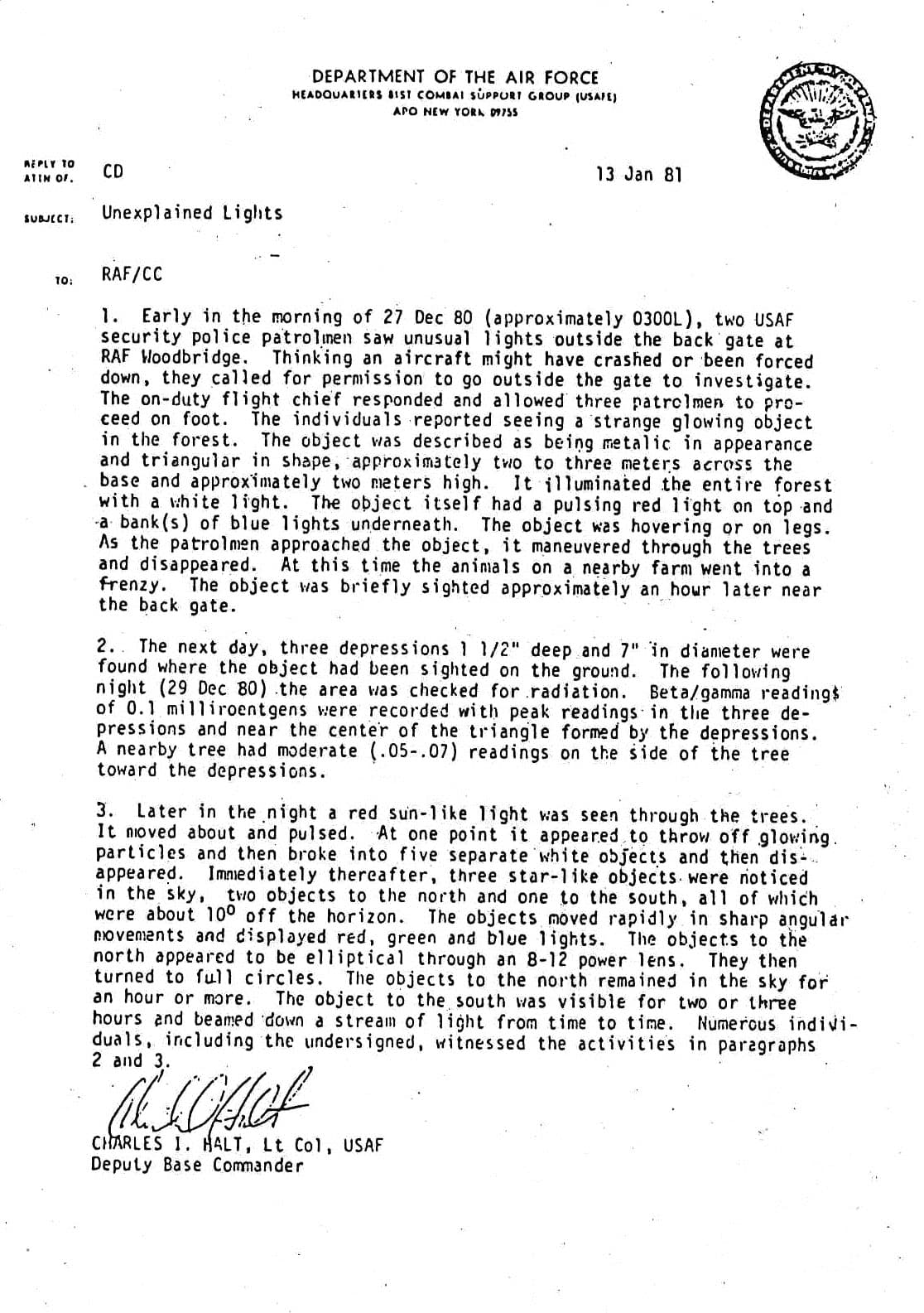
Lieutenant Colonel Charles Halt's one-page memorandum, signed on 13 January 1981, is a genuine official record of reports made after the Rendlesham Forest observations. It documents patrol accounts, marks on the ground, radiation readings and lights seen during a later investigation; it does not identify a craft or endorse an extraordinary origin. Halt's field recording preserves part of that later investigation, but differences in dates, wording and later recollections limit how closely the memo, tape and testimony can be combined. This page is a supporting document guide; the full event belongs to the main Rendlesham Forest case file.
This case is disputed. The archive preserves the claims while separating evidence from interpretation.
- Documentation
- High documentation
- Primary location
- RAF Woodbridge and Rendlesham Forest, Suffolk
- Source base
- 6 linked records
- Research use
- Comparison case
What the Halt record establishes
- Document status
- The 13 January 1981 memorandum is a genuine official report, not an official identification of a craft.[1][3]
- Date conflict
- Its two event dates are one day later than the chronology normally reconstructed from other records.[3][4]
- Audio boundary
- The tape is near-contemporaneous but intermittent and has no synchronized image, range or radar data.[4][5]
Case dossier
This supporting file has a deliberately narrow scope. The main Rendlesham Forest dossier covers the reported nights, witnesses, ground marks and competing astronomical or lighthouse explanations. Here the question is what the Halt memorandum and related archive material actually establish. The secure point is administrative: a U.S. Air Force lieutenant colonel sent a short report through the RAF liaison chain, and the British Ministry of Defence retained it. Custody proves that the report was received and preserved, not that every observation in it was independently verified.
The memorandum is dated 13 January 1981 and carries the subject “Unexplained Lights.” It summarizes two reported episodes: an initial security-police patrol and a later party led by Halt. It mentions three depressions, damage to nearby trees, measurements on a radiation meter and several coloured lights. The wording is a compressed after-action account written more than two weeks after the observations. It records what personnel reported and what Halt said his group observed; the title “Unexplained” is a description of unresolved reports, not a finding about their physical source.
The dates are an important internal limit. The memorandum places the first report at about 0300 on 27 December and the later investigation on the night of 29 December. The chronology normally reconstructed from duty patterns, witnesses and the field recording places those episodes in the early hours of 26 and 28 December. The available local record does not contain a signed correction or a complete duty log that resolves the one-day shifts. The discrepancy does not make the memo a forgery, but it prevents treating it as a precise contemporaneous log.
Halt's microcassette recording is closer in time to the later field investigation. It preserves movement through the forest, attempts to take meter readings and spoken descriptions of lights. That immediacy makes it valuable for checking later retellings, but the recorder was not continuous and the audio supplies no synchronized image, surveyed bearing, calibrated distance or radar track. Ian Ridpath's local analysis aligns parts of the spoken sequence with the Orford Ness lighthouse and bright stars. That is an independent skeptical reconstruction, not an official ruling, and incomplete bearings prevent a frame-perfect demonstration.
Later testimony cannot simply be read back into the January memorandum. More elaborate accounts of a structured object, beams directed at sensitive areas, radar confirmation or other details may reflect sincere memory, interpretation or narrative development, but they are not all present at the same level in the early documents. A 2015 UK parliamentary answer says the released Ministry of Defence files contain no radar reports or tapes confirming the later radar account. That answer defines a public-record gap; it cannot prove that no operator ever said anything, and the gap must not be filled by assumption.
The National Archives release guide identifies DEFE 24/1948 as the Rendlesham file and notes that much of the correspondence dates from 1983 to 1995. This matters because an official file can contain both event-era material and later public letters, parliamentary interest or retrospective claims. The archive supports the history of reporting and government handling. It does not transform every enclosed statement into an official finding. The careful conclusion is that the memorandum and tape are important primary records with real chronological and measurement limits; they document an unresolved observation sequence but do not authenticate a landed craft, hostile capability or non-human source.
Timeline
- The first security patrol is normally placed in the early hours; the later memorandum gives 27 December.
- Halt's party investigates in the forest and records parts of the activity; the memorandum gives the night of 29 December.
- Halt signs the one-page memorandum “Unexplained Lights” for the RAF liaison chain.
- Much of the later material catalogued in DEFE 24/1948 consists of correspondence generated after the event.
- The National Archives releases a guide identifying the Rendlesham file and distinguishing the memo from later correspondence.
- A UK parliamentary answer states that released MoD files hold no radar reports or tapes confirming the later radar account.
Halt memorandum questions
What is the Halt memorandum?
It is a one-page U.S. Air Force memorandum signed by Charles Halt on 13 January 1981 summarizing reports connected with Rendlesham Forest.
Does the memorandum confirm an alien craft?
No. It records reported lights, marks and measurements but gives no identification of a craft or extraordinary source.
Why do the dates differ?
The memo dates both episodes one day later than the commonly reconstructed chronology. No signed correction or complete local duty log in the reviewed material resolves the discrepancy.
What does the Halt tape prove?
It proves that Halt recorded parts of a field investigation and described lights and instrument readings. Without continuous recording or synchronized sensor data, it does not identify the lights.
Is there radar confirmation in the public file?
A 2015 parliamentary answer says released MoD files contain no radar report or tape confirming the later account. This is a public-record gap, not proof that no conversation occurred.
Sources
- [1] Official fileUFO reports: Rendlesham correspondenceThe National Archives (UK)
- [2] Official fileThe UFO Files: UK National Archives research guideThe National Archives (UK)
- [3] ArchiveHalt memorandum: “Unexplained Lights”United States Air Force / Wikimedia Commons
- [4] ArchiveHalt field recordingCharles Halt recording / Wikimedia Commons
- [5] ResearchRendlesham Forest UFO: the Halt tapeIan Ridpath
- [6] Official fileRendlesham radar records: written parliamentary answer HL1550UK Parliament
The displayed image is a scan of the 13 January 1981 memorandum. It is official documentary evidence that a report was filed, not an event photograph, a picture of the lights or proof of a landed object.