
Norway / 1984 / UNRESOLVED
Hessdalen Lights
The Hessdalen lights are recurring reports from a Norwegian valley, not one encounter with a demonstrated common cause. The 1984 field campaign collected visual, photographic and radar records, but their quality and correlation varied. Later research disputed some optical interpretations and investigated possible geophysical mechanisms. The public record supports a genuine programme of observation and unresolved individual reports, not proof of extraterrestrial craft or a single established plasma explanation.
This case remains unresolved in the public record, with credibility grade B.
- Documentation
- High documentation
- Primary location
- Hessdalen valley
- Source base
- 7 linked records
- Research use
- Comparison case
What the records establish
- Scope
- Recurring valley observations; the dated entry marks the 1984 campaign, not one common object.[1]
- 53 of 188
- Reports meeting the investigators' F5 threshold, not 53 verified extraordinary craft.[1]
- Optical disagreement
- A later headlight identification was disputed; it does not settle every report.[2]
- Geophysical hypothesis
- The 2024 study maps conductive geology and proposes, rather than proves, a light-generation mechanism.[3]
Case dossier
A valley, not a single object: Erling Strand's final technical report describes increased activity from December 1981 in Hessdalen, southeast of Trondheim. Witnesses reported white or yellow lights, sometimes groups of lights, with apparent hovering or movement. Those descriptions do not establish a shared distance, size or physical object. Different sightings must remain separate observations. The date attached to this dossier, 21 January 1984, marks the start of the principal field campaign, not the first-ever light report.
What the 1984 campaign counted: Project Hessdalen, established in June 1983, operated in the valley from 21 January to 26 February 1984. Strand's report, signed 5 January 1985, lists 188 reports, of which 53 received an F score of at least five. F described the investigators' assessment of unusualness; G rated documentation. These subjective scales were not probabilities of alien origin. Uneven staffing and interrupted instrument coverage also mean that the totals cannot be treated as a controlled estimate of how often unusual phenomena occurred.
Radar and spectra need separate qualifications: The original report records 36 radar observations, with only three described as probably also seen visually. It does not provide 36 securely matched optical-radar tracks. Four spectral images emerged from seven films; the strongest spectra came from a borderline F5 light for which a snowmobile headlamp remained possible. Strand explicitly cautioned against concluding that the unknown lights had a continuous spectrum. Missing reference photographs, camera problems and incomplete watch periods are documented limitations, not details to remove from a success story.
Why the car-headlight dispute matters: In his 2006 paper, Matteo Leone challenged optical conclusions from the later EMBLA campaigns. He reported resolving a recurring August 2002 light into vehicle headlights through a telescope, and examined road geometry, brightness estimates and film response. Massimo Teodorani disputed the identification and argued that Leone had not photographed the telescope view and had not explained other observations. This is a specific disagreement about identification and measurement. It neither proves every Hessdalen light is a car nor establishes that the disputed spectrum represents a new physical phenomenon.
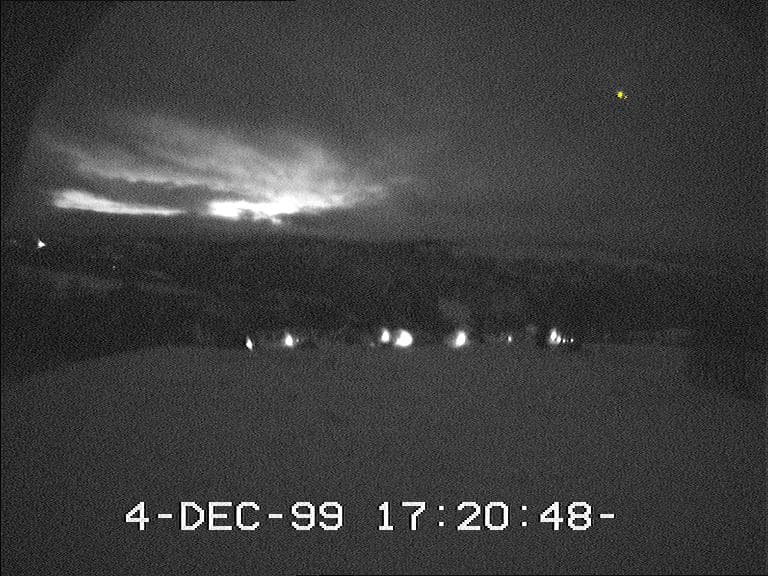
The 1999 recording is a separate record: The project's automatic station archive links a 4 December 1999 video and a frame-by-frame account. That report gives a 13-second recording starting at 16:20:29 and explains that the screen clock was one hour fast because it still showed summer time. Its description of a smaller light moving toward a larger one is an image interpretation, not a measured collision or merger of physical craft. The station still reproduced here belongs to that day's archive; its later timestamp should not be confused with the short sequence's starting time.
What the 2024 geology study adds: Vargemezis and colleagues published a very-low-frequency electromagnetic survey in the Journal of Applied Geophysics. The work mapped conductive structures in the valley and proposed that geology, mineral deposits, water and electrical processes could help generate transient lights. Its mechanism is explicitly provisional. Mapping conductive ground does not identify a photographed light or demonstrate the necessary atmospheric discharge at the moment of a sighting. The authors call for more simultaneous physical measurements and longer-term analysis; the paper is not a final solution to every historical report.
Research support is not official identification: The early programme was a civilian field investigation with technical assistance and later academic participation. Equipment, institutional affiliations and publication in a journal establish an investigative context; they do not turn every witness report into an official finding. The 2024 author list includes Project Hessdalen participants, so it is not a wholly independent replication of the original project. Leone's critical analysis supplies a different assessment, but also needs its stated limitations retained. Read competing interpretations against the observations each actually addresses.
A careful conclusion and the archive's value: Vehicle lights, aircraft, astronomical sources and atmospheric effects need testing for individual reports; proposed plasma or geoelectric mechanisms need event-specific measurements. Neither a conventional explanation for one observation nor a remaining unidentified light settles the whole collection. Hessdalen belongs in the archive because dated reports, instruments, criticism and later measurements allow readers to inspect how an identification is argued. Grade B describes that documentation, not the chance that an extraterrestrial explanation is correct. The map marks the valley approximately, not a verified object trajectory.
Original station archive: December 1999 video
The station image and December 1999 video are observation records, not identifications. They are separate from the 1984 campaign. The project hosts the video; no copy or unverified YouTube reupload is republished here.
Compare light reports and measurement limits
- What a radar return can establish
- Norway's 2009 spiral: a separate, explained event
- Greifswald: testing a flare explanation
- Compare flight, satellite and weather records
- Lake Michigan 1994: did radar and witnesses see the same targets?
Compare the two contemporary newspaper accounts before treating reported radar echoes as corroboration of visual lights.
- Montreal 1990: lights, photographs and optical explanations
Distinguish police witnesses from measured range and compare the competing explanations for Bonaventure's lights.
Timeline
- Strand dates the increased reporting to December 1981.
- Project Hessdalen is established.
- The principal winter field campaign collects visual and instrument records.
- Strand signs the final report on the 1984 campaign.
- Automatic station monitoring begins.
- The station records a short sequence later published with a clock correction.
- Leone's critique and Teodorani's response debate EMBLA optical evidence.
- The geophysical paper is published online with a provisional mechanism.
Questions about Hessdalen
Have the Hessdalen lights been explained?
Some observations have conventional interpretations and others remain uncertain. No single cause has been demonstrated for the entire historical collection.
Did radar confirm all the lights?
No. The 1984 report lists 36 radar observations and only three probable visual counterparts. Those are not 36 fully correlated tracks.
Is the displayed image from 1984?
No. It is an automatic-station still dated 4 December 1999. The archive also provides a separate short video and explains the one-hour camera-clock error.
Does scientific research prove an alien origin?
No. Instruments and publications document observations and hypotheses. An unexplained signal and a research affiliation are not evidence identifying an extraterrestrial source.
Sources
- [1] Research1984 field report, signed 5 January 1985Project Hessdalen / Erling Strand
- [2] ResearchLeone's 2006 critique and opening of Teodorani's replyJournal of Scientific Exploration / Internet Archive
- [3] ResearchVLF geophysical survey and provisional mechanism (2024)Journal of Applied Geophysics / Vargemezis et al.
- [4] ResearchProject Hessdalen: project historyProject Hessdalen
- [5] Archive1999 station archive and December videoProject Hessdalen
- [6] ArchiveReport 991204: sequence and clock correctionProject Hessdalen
- [7] ArchiveMedia collection and reuse conditionsProject Hessdalen
The station image and December 1999 video are observation records, not identifications. They are separate from the 1984 campaign. The project hosts the video; no copy or unverified YouTube reupload is republished here.