
Norway / 2009 / EXPLAINED
2009 Norwegian Spiral Anomaly
The Norwegian spiral was a real, widely recorded atmospheric display seen across northern Norway on the morning of 9 December 2009. Witnesses photographed and filmed a turquoise trail ending in a large, nearly symmetrical white spiral that expanded for several minutes. Norwegian space and auroral specialists quickly recognized the pattern as a malfunctioning rocket. On 10 December, Russia acknowledged that a Bulava submarine-launched ballistic-missile test from the White Sea had failed after its first two stages operated normally and the third stage became unstable. A later peer-reviewed analysis explained how a rotating rocket could distribute exhaust products into a spiral illuminated by the Sun. The event is therefore classified as explained. The precise engineering sequence is less fully documented because the reviewed public record does not include complete telemetry or the investigating commission's report.
This archive treats the case as explained or substantially resolved by conventional evidence.
- Documentation
- High documentation
- Primary location
- Northern Norway, including Troms and Finnmark
- Source base
- 9 linked records
- Research use
- Comparison case
What the record supports
- Confirmed event
- A turquoise trail and expanding white spiral were photographed and filmed across northern Norway on 9 December 2009.[1][3]
- Official identification
- Russia acknowledged that a Bulava test launched from Dmitry Donskoy failed when its third stage became unstable.[2][4]
- Physical explanation
- A rotating rocket and sunlit exhaust products account for the spiral geometry and grey-turquoise colour separation.[5][6]
Case dossier
At about 07: 49 local time on 9 December 2009, observers across northern Norway saw an unusual display in the dawn sky. Aftenposten published a photograph made at Spildra in Kvænangen, while Space.com recorded an observer in Harstad who placed the display between about 07:50 and 08:00. Reports came from a broad area rather than one viewing point, giving the event a strong documentary base as a visible phenomenon.
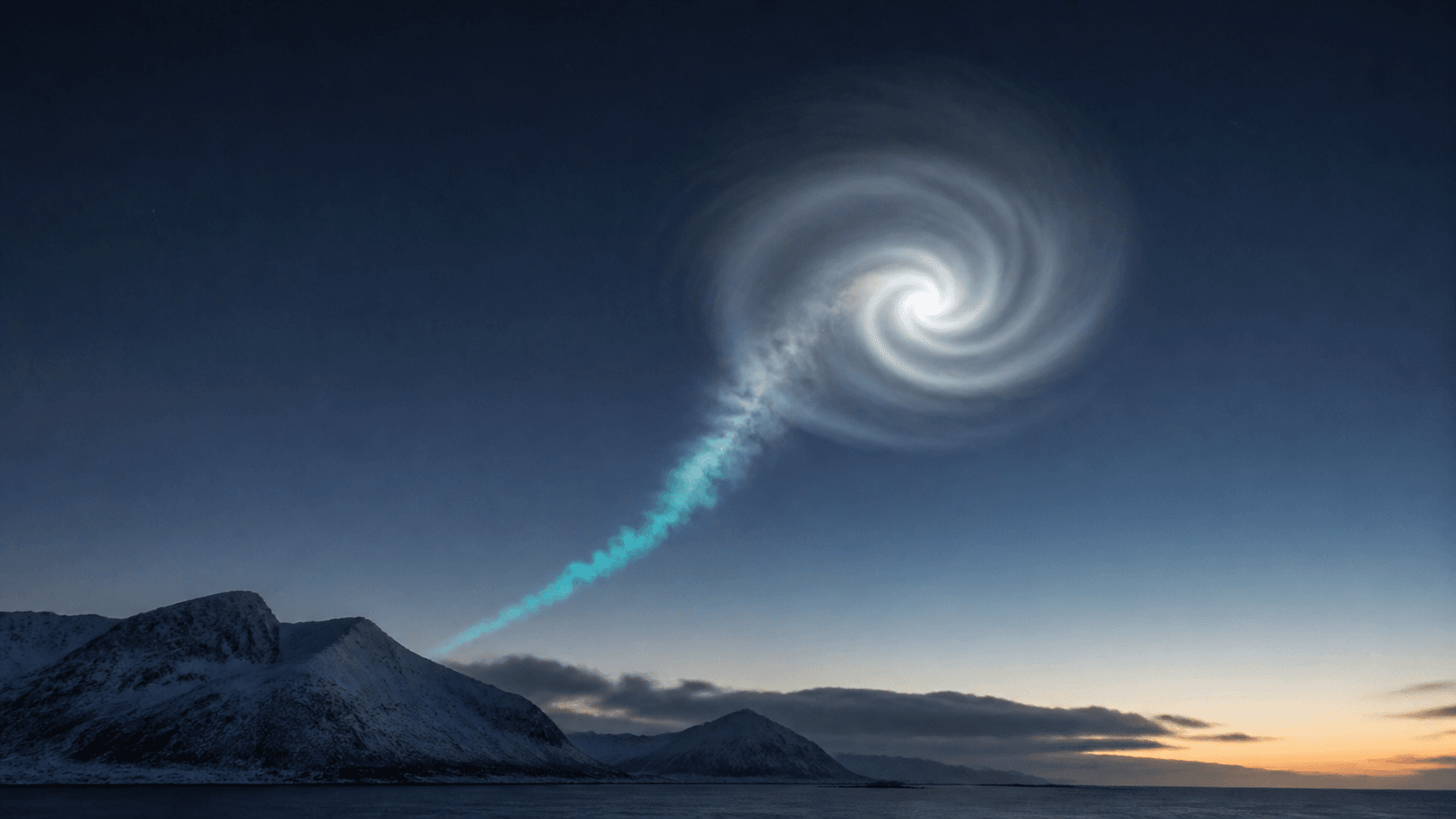
Descriptions and surviving media show a blue-green or turquoise trail rising toward a bright centre, with a pale grey-white spiral expanding around it. The pattern remained visible for several minutes and then faded. Its regular geometry looked extraordinary, but the photographs and videos primarily establish shape, colour and duration; without calibrated range or altitude data, they do not measure the object's size or flight performance.
Norwegian specialists proposed a rocket explanation within hours. Paal Brekke of the Norwegian Space Centre told Space.com that the videos looked like an out-of-control rocket or missile. Truls Lynne Hansen of the auroral observatory in Tromsø told Aftenposten that sunlight illuminating leaked fuel or exhaust at high altitude could produce the display. Those assessments preceded Russia's public acknowledgment and were based on the observed motion and launch geometry.
The official picture initially lagged behind the observations. A Russian Northern Fleet spokesperson said there was no knowledge of a launch, and Russian authorities did not confirm the test on the first day. That early non-confirmation encouraged speculation because photographs were already circulating while the responsible activity remained undisclosed.
On 10 December, a Russian Defence Ministry statement quoted by Kommersant identified the failed test. The Bulava missile had been launched from the strategic submarine Dmitry Donskoy in the White Sea. According to the statement, the first two stages operated normally, but a technical failure made the third-stage engine unstable. Telemetry was to be examined and a state commission was investigating.
The physics was later described in the journal Geophysica. A rotating, malfunctioning rocket can expel combustion products along a changing direction, drawing a spiral as the material expands. The paper distinguishes a larger light-grey spiral of dispersed particles from a smaller turquoise cloud produced by molecular scattering. At dawn, the high-altitude plume could remain sunlit while observers below were still in darkness, increasing its contrast.
The case belongs in a UFO/UAP archive because it demonstrates how a genuinely unfamiliar and visually dramatic event can be solved by converging evidence. Independent observations establish the display; expert assessments identify a rocket signature; an official statement supplies the launch and failure; and optical research explains the geometry. It is also a warning that delayed disclosure can create an information gap in which extraordinary interpretations flourish.
Related video
Related checks and records
- Hessdalen: what recurring lights and instruments can establish
Compare the 1984 measurements, the headlight dispute and later geophysical hypotheses without assuming a single cause.
Timeline
- A Bulava test missile is launched from the submarine Dmitry Donskoy in the White Sea.
- A photograph at Spildra records the blue trail and expanding spiral; observations are reported across northern Norway.
- Witnesses describe a display lasting several minutes before the spiral fades.
- Norwegian space and auroral specialists publicly identify the pattern as likely rocket exhaust from a failed launch.
- Russian officials do not initially confirm the test, and a Northern Fleet spokesperson says there is no knowledge of a launch.
- Russia acknowledges a failed Bulava test: the first two stages worked normally and the third-stage engine became unstable.
- Contemporary international reports connect the official acknowledgment with the spiral seen in Norway.
- A Geophysica paper models the grey and turquoise components as sunlight scattered by rocket exhaust products.
- Sodankylä Geophysical Observatory revisits the event as a diagnostic example of rocket-exhaust optical phenomena.
Norwegian spiral questions
What caused the 2009 Norwegian spiral?
The converging evidence identifies exhaust from a failed Russian Bulava missile test. Russia acknowledged a third-stage failure the next day, and later optical research explains the observed spiral.
Was the Norwegian spiral a UFO?
It was unidentified to many witnesses at first, but it is no longer unresolved. The missile-test explanation is supported by timing, official acknowledgment and physical modelling.
Why did the spiral look so symmetrical?
A spinning rocket can release exhaust in a steadily changing direction. As the plume expands in thin upper-atmosphere air, that repeated motion can project a regular spiral.
Why was the trail blue or turquoise?
The scientific analysis attributes the colours to sunlight scattering through different exhaust products and particle sizes at high altitude while the ground remained dark.
Are the photographs and videos genuine?
Multiple independent recordings document the same display, so the visible event is well supported. That does not make every repost or caption reliable; this page links to contemporary reporting and a preserved third-party upload instead of downloading copyrighted frames.
What remains unknown?
The broad source is well identified, but the complete telemetry, final commission report and exact frame-by-frame failure sequence are not available in the public sources reviewed.
Sources
- [1] News reportRussian rocket explosion visible across northern NorwayAftenposten
- [2] News reportBulava missile test fails at the third stageKommersant / Russian Defence Ministry statement
- [3] News reportBizarre sky spiral caused by failed missileSpace.com
- [4] News reportRussian missile failure visible in NorwayRFE/RL / Reuters
- [5] ResearchOptical phenomena due to rocket exhaust products in the atmosphereGeophysica
- [6] ResearchNorway spiral revisitedSodankylä Geophysical Observatory
- [7] ResearchNorwegian spirals and rocket-plume videosThe Planetary Society
- [8] ArchiveEISCAT at Work - Norway 09.12.2009YouTube / sdirru
- [9] ResearchNorway cloud spiral: simulation of a possible explanationYouTube / Doug Ellison
The local hero is an original editorial reconstruction made for this archive. It illustrates the documented geometry but is not an event photograph, missile image or evidence. The Related video section embeds a third-party recording preserved on YouTube and an explanatory simulation; neither thumbnail is downloaded or presented as archive-owned media.