
United Kingdom / 1965 / DISPUTED
Warminster Thing
The strongest conclusion is historical rather than extraterrestrial. On Christmas morning 1964, residents including Marjorie Bye reported a disturbing sound around Warminster, Wiltshire; Arthur Shuttlewood published the story in the Warminster Journal in January 1965. Later reports shifted from sounds to lights and differently described aerial shapes. A crowded public meeting in August and Gordon Faulkner’s much-reproduced photograph in the national press helped turn a collection of reports into “the Warminster Thing.” Shuttlewood then became its chief recorder, promoter and witness, publishing books and leading skywatches. That dual role preserved testimony but also concentrated the narrative through one influential interpreter. BBC footage from 1973 documents the later culture of watchers and interviews Shuttlewood; it is not film of the 1964–65 reports. The public record contains testimony, clippings, photographs of uncertain evidential value and later broadcasts, but no surviving sound recording, radar data, verified physical trace or official case conclusion. Nearby military training, aircraft, flares, astronomical objects, unusual acoustics, pranks and expectation effects can plausibly explain parts of the story, though no single demonstrated explanation covers every report. The archive therefore retains C / disputed and treats “the Thing” as a media-amplified local wave, not a proved craft.
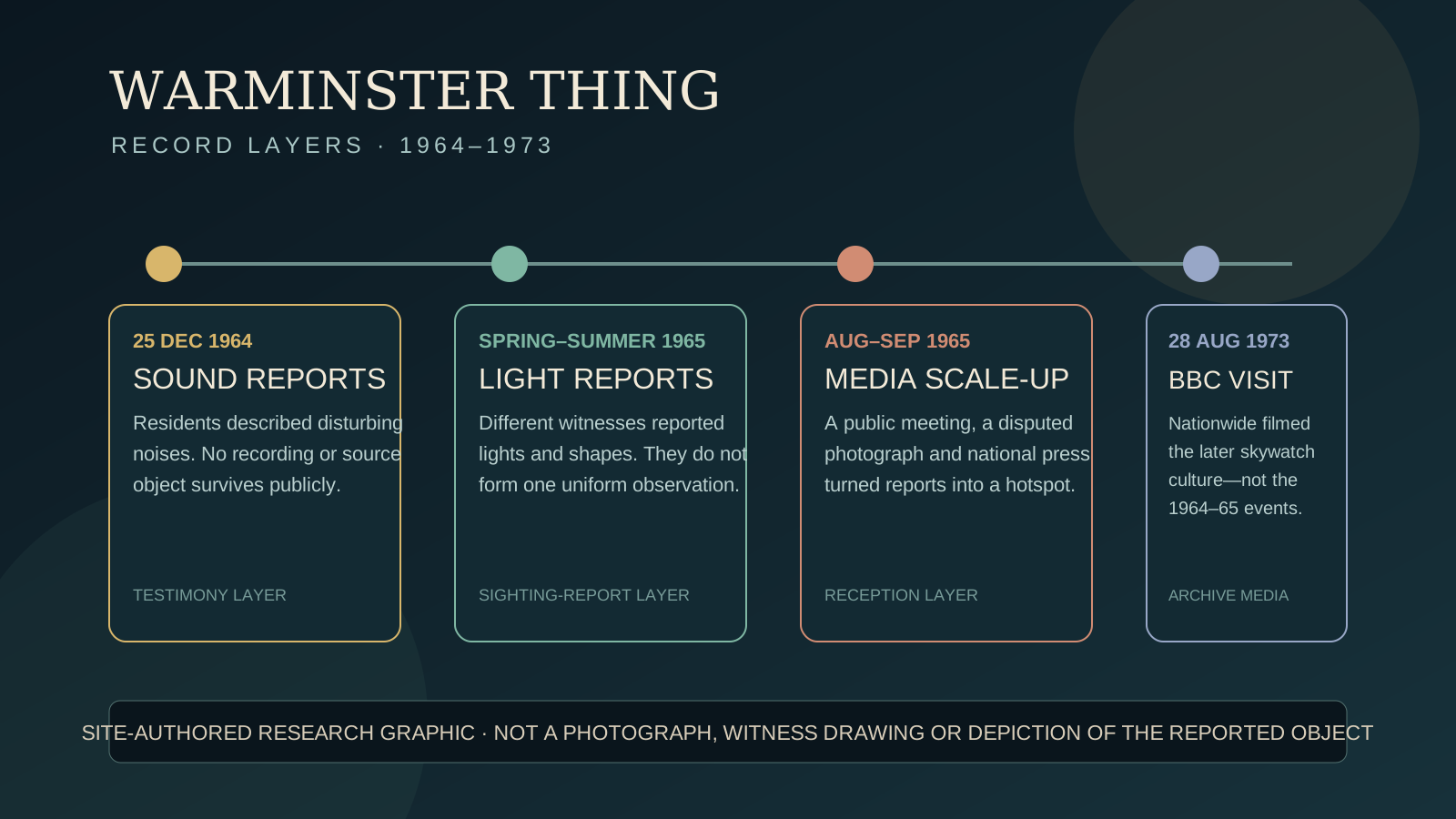
This case is disputed. The archive preserves the claims while separating evidence from interpretation.
- Documentation
- High documentation
- Primary location
- Warminster, Wiltshire, England
- Source base
- 5 linked records
- Research use
- Comparison case
What the record supports
- Confirmed core
- Residents reported sounds in late 1964; reports of varied lights and shapes followed in 1965.[1][2]
- Not one object
- “The Thing” grouped different dates, witnesses, sounds and visual descriptions under one media label.[1][2]
- Media boundary
- The 1973 BBC clip shows a later skywatch culture. It is not footage of the 1964–65 events.[4]
- Official limit
- No Warminster-specific official finding was located; pre-1967 UK UFO file destruction leaves an archival gap, not proof of confirmation.[5]
Case dossier
The chronology begins before the case’s conventional 1965 label. On 25 December 1964, Marjorie Bye said that while walking to an early church service she heard a powerful, disturbing noise near Bell Hill. Other residents later reported unusual clattering, humming or vibration. These are reports of sound effects: no contemporaneous audio recording or identified source object is publicly available. The first durable trace is journalistic—Shuttlewood’s Warminster Journal article of 7 January 1965—not an instrument record.
During spring and summer 1965, the public story changed category. Residents and visitors reported coloured lights, star-like points, cigar forms and other shapes over or near Warminster. Those descriptions should not be collapsed into one object: dates, observers, directions and forms differed. Some reports may have involved ordinary aircraft, celestial objects or activity around Salisbury Plain; others remain too poorly documented for a case-level identification. “The Thing” became a container for multiple reports rather than a consistent visual target.
The August 1965 public meeting is better understood as a civic and media milestone than as an evidential hearing. Local reporting says more than 200 people attended, while still larger numbers came to the town and nearby hills hoping to see something. A crowd can document public concern and curiosity; it does not convert every story repeated there into independent testimony. Organised skywatching also changed the observing environment by placing many expectant viewers under busy night skies.
Gordon Faulkner’s photograph became a decisive publicity object after Shuttlewood passed it to the Daily Mirror, which printed it in September 1965. The image records an indistinct shape, but the public chain available here does not provide the original negative, complete camera and processing data, or an independent reconstruction of scale and distance. It can support the history of how the story reached a national audience. It cannot, on its own, authenticate the shape as a craft or tie it to the earlier sound reports.
Arthur Shuttlewood is inseparable from the archive. As a local journalist he collected accounts that might otherwise have vanished. He later reported his own sightings, wrote books, spoke at UFO meetings and helped sustain Warminster as a destination for watchers. This makes him both a valuable source and a participant with a developing interpretation. Counts and extraordinary claims derived mainly from his later books or lectures require attribution; they are not equivalent to independently preserved first statements.
Television extended the story beyond the 1965 peak. BBC West examined Warminster in 1966, and the surviving BBC Archive clip from Nationwide was originally broadcast on 28 August 1973. In that later segment, a reporter accompanies Shuttlewood and Rex Dutta during a skywatch. Its evidential value is reception history: it shows the people, practices and claims that kept Warminster prominent. It is not contemporaneous film of Marjorie Bye’s sound, Faulkner’s photographed object or a verified anomalous craft.
The observing landscape also became part of the archive. Warminster is a market and garrison town beside Salisbury Plain, while nearby high ground offered broad views and practical meeting places for visitors. By the time of the 1973 broadcast, going to a named hill with binoculars, cameras and experienced watchers was itself a repeatable social practice. That setting improved the chance that ordinary aircraft, satellites, stars, meteors and distant military activity would be noticed, but it did not guarantee that observers could identify them in darkness. It also encouraged comparison: one person’s uncertain point of light could be discussed immediately with a group already familiar with the Thing narrative. These conditions are important evidence about how later reports were generated and remembered. They are not grounds for dismissing every observation, and they do not establish that the landscape produced a physical anomaly. The archive can confirm the place, the watching practice and its media visibility more securely than it can identify any light seen from the hills.
Warminster matters because it shows how a UFO hotspot is made from reporting as well as observation. A local sound story prompted more correspondence; visual reports broadened the category; a meeting, photograph and national coverage attracted observers; later observers generated further reports and media. This feedback loop does not prove that every witness was mistaken or insincere. It does mean that the archive must evaluate each report separately and treat the shared label as cultural history, not evidence of one persistent vehicle.
Related video
Timeline
- Marjorie Bye and other residents report disturbing sounds around Warminster; no recording or source object survives publicly.
- The Warminster Journal publishes Shuttlewood’s account, creating the first durable public anchor for the sound story.
- Reports now include coloured lights and cigar-like forms; differing observations broaden “the Thing” beyond sound.
- A packed public meeting in Warminster marks civic concern and media growth, not an official evidential finding.
- The Daily Mirror publishes Gordon Faulkner’s photograph, bringing national attention without resolving its provenance or scale.
- Shuttlewood publishes The Warminster Mystery, helping fix his interpretation of the reports in later UFO literature.
- BBC Nationwide broadcasts a later Warminster skywatch with Shuttlewood and Rex Dutta; the footage is retrospective context, not event film.
Frequently asked questions
What was the Warminster Thing?
A label for a sequence of sound reports, varied lights, photographs, newspaper coverage and skywatches around Warminster, especially in 1964–65—not one consistently described object.
When did the Warminster Thing begin?
The usual starting point is Christmas morning, 25 December 1964, when Marjorie Bye and others reported disturbing sounds. The story was published locally on 7 January 1965.
Was the strange sound ever recorded?
No surviving contemporaneous recording, spectrum or measured pressure record was located. The sound layer rests on witness descriptions and newspaper reporting.
Does Gordon Faulkner’s photograph prove a UFO?
No. It was crucial to national publicity, but the accessible chain lacks the original negative, complete technical data and independent scale reconstruction needed to identify the blurred shape.
Did the Ministry of Defence solve the case?
No Warminster-specific official conclusion was located. The archive gap before 1967 prevents a complete file audit, but missing files are not evidence of an extraordinary finding.
Is the 1973 BBC video event evidence?
No. It is valuable archive coverage of a later skywatch with Shuttlewood and Rex Dutta. It does not show the 1964 sound, Faulkner’s 1965 target or a verified anomalous craft.
Sources
- [1] News reportBBC retrospective on Warminster’s sound reports, sightings and legacyBBC News
- [2] News reportWarminster Journal local-history anniversary accountWarminster Journal
- [3] News reportLater review of media growth and conventional hypothesesWarminster Journal
- [4] News reportBBC Nationwide archive skywatch, originally broadcast 28 August 1973BBC Archive
- [5] Official fileThe National Archives guide to UK UFO recordsThe National Archives
The main image is a site-authored record-layer graphic, not event evidence. The BBC/YouTube thumbnail is not reused because commercial republication rights are unclear. The 1973 BBC clip is linked only as later archive reporting and must not be described as original footage of the Thing.