
United States / 1957 / DISPUTED
Kirtland AFB UFO sighting
Between about 22:45 and 23:05 MST on 4 November 1957, Civil Aeronautics Administration controllers R. M. Kaser and E. G. Brink reported a dark, vertically oriented object with a white light moving low across Kirtland Air Force Base, then climbing into cloud. A radar account followed, but no raw radar plot, recording, photograph or identified aircraft survives in the reviewed public sources. The Air Force and the Condon Report favored a powerful private aircraft that approached the wrong runway and departed; James E. McDonald later argued that this did not fit the controllers’ description or reported geometry. The event is documented but its cause remains disputed. Unidentified does not mean extraterrestrial.
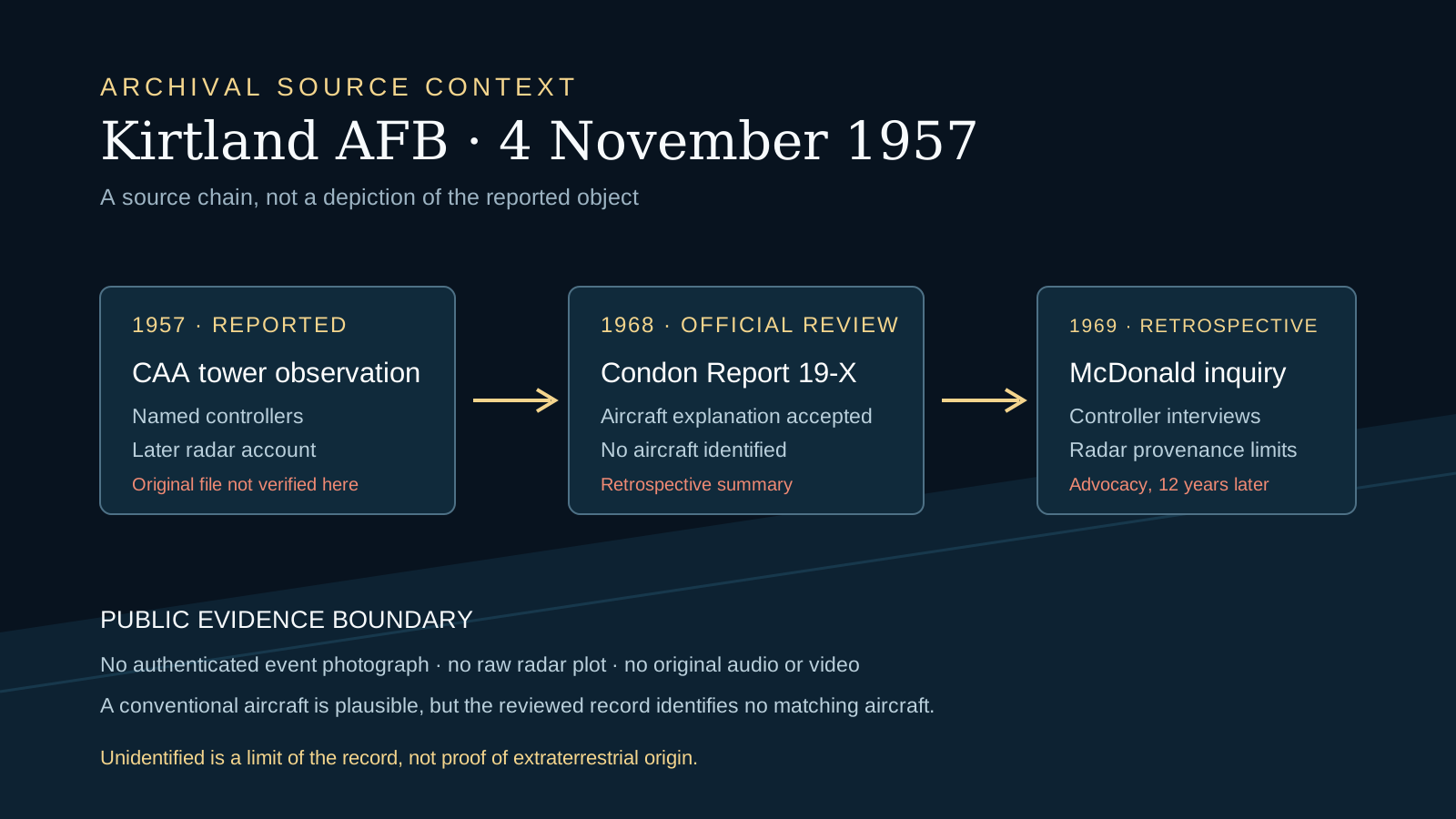
This case is disputed. The archive preserves the claims while separating evidence from interpretation.
- Documentation
- High documentation
- Primary location
- Kirtland Air Force Base, Albuquerque, New Mexico
- Source base
- 3 linked records
- Research use
- Comparison case
What the record supports
- Confirmed record
- The 1968 Condon Report includes a Kirtland entry dated 4 November 1957, timed 22:45–23:05 local.[1]
- Witness report
- Kaser and Brink reportedly described a low, vertical or egg-like object with a white light; dimensions were estimates.[2]
- Radar boundary
- No raw radar trace or 1957 operator statement is available; the detailed route is secondhand.[2]
Case dossier
The strongest official public discussion is item 19-X in the 1968 Condon Report. It places the report at Kirtland AFB from 22:45 to 23:05 local time, in light rain with scattered cloud and a high overcast. It says CAA tower observers saw a dark object with a white light underneath cross the field, maneuver as if approaching the east-west runway, turn at low altitude and climb into cloud. That text is an official retrospective summary, not the controllers’ original signed statements.
McDonald said he examined the 21-page Blue Book file and in 1969 interviewed the named controllers, Kaser and Brink, five times by telephone. His synthesis places the object in a steep descent near the east end of Runway 26, crossing paved and unpaved areas toward the tower at a few tens of feet. Through 7-power binoculars, they reportedly described no wings, tail or fuselage, but a roughly 15-to-20-foot vertical or egg-like form with a white light at its base. These dimensions and geometry are witness estimates transmitted through McDonald, not calibrated measurements.
The official handling is known mainly through McDonald’s account of the file. He describes a 6 November teletype, interviews conducted on 8 November by Captain Patrick O. Shere of Ent AFB, and a 13 November Air Intelligence follow-up that characterized the controllers as experienced and reliable. He also reports that the 8 November form found no match to Blue Book identification criteria, while Shere’s closing opinion proposed a confused unidentified aircraft. Until the underlying case pages are verified in a stable public repository, those details must remain attributed to McDonald’s archival reading.
Radar is the case’s weakest famous element. The controllers reportedly called CAA Radar Approach Control only after the object climbed into cloud. Kaser later recalled a CPN-18 surveillance set, and a later tower chief confirmed that equipment type, but McDonald found no 1957 radar operator to interview. The claimed eastward and southward track, several-minute orbit, return to Kirtland and trail position behind an outbound Air Force C-46 come from later controller recollections and an imprecise teletype summary. No raw scope photography, plot, operator statement or synchronized timeline is available here.
The Air Force explanation, repeated approvingly by the Condon Report, was a small but powerful private aircraft flying without a flight plan. On this view, its pilot confused the airfield, attempted the wrong landing area, recognized a brightly lit restricted zone, reversed and departed. The Condon text says the radar return was normal for an aircraft and the reported track was within such an aircraft’s capabilities. This hypothesis explains an approach-like path, a runway reversal and an ordinary radar return, but the reviewed record identifies no aircraft, pilot, flight plan violation or matching movement log.
The accounts contain material conflicts. Condon’s phrase that the object crossed the field at about 1,500 feet sits uneasily beside McDonald’s low-level reconstruction. The reported hover lasts about 20 seconds in Kaser’s later memory, nearer one minute in Brink’s, and longer in McDonald’s reading of the contemporary interview. Condon says buildings blocked the reversal; McDonald says both controllers denied that and his site inquiry found no suitable obstruction. Blue Book’s quoted 45,000-feet-per-minute climb figure appears to be a conversion from an estimated Mach number, not an instrument reading, and should not be treated as precise.
McDonald’s 1969 paper is essential because it names witnesses, exposes the radar source chain and records discrepancies; it is also advocacy written twelve years later. He said neither controller had been contacted by the Condon project and that their 1969 memories broadly matched Shere’s 1957 interview, with differences in distance and duration. No independent recording of McDonald’s calls is supplied. The defensible conclusion is therefore narrow: trained controllers made a documented unusual report; an aircraft is a plausible but unverified explanation; the radar story is secondhand and incomplete; and no evidence in this record establishes an extraterrestrial or supernatural cause.
Timeline
- Kaser and Brink reportedly observe the low-moving object; a radar report follows after it enters cloud.
- An Air Force teletype summarized the report; its radar wording was later described as imprecise.
- Captain Patrick O. Shere reportedly interviewed the controllers and proposed a possible confused aircraft.
- A reported Air Intelligence follow-up characterized the controllers as experienced and reliable.
- The Condon Report publishes a short summary and accepts the Air Force aircraft explanation.
- McDonald interviews Kaser and Brink and presents a detailed critique to the AAAS.
Kirtland AFB case questions
What happened at Kirtland AFB in 1957?
Two CAA controllers reported an unusual low object and later relayed a radar account. The public record does not identify the object.
Did radar independently confirm it?
Not from the material now available: no raw trace, operator statement or synchronized radar record has been located.
Was it an aircraft?
That is the official conventional hypothesis and it explains parts of the path, but no specific aircraft or pilot was identified.
Why do descriptions conflict?
The Condon summary, McDonald’s file reading and 1969 memories differ on altitude, obstruction and hover duration; no raw record resolves them.
Does unexplained mean extraterrestrial?
No. The evidence supports an unresolved identity, not an extraterrestrial or supernatural origin.
Sources
- [1] Official fileCondon Report: Kirtland AFB item 19-XUniversity of Colorado study / NCAS transcription
- [2] ResearchScience in Default: Kirtland AFB caseJames E. McDonald / Princeton archive
- [3] Official fileNational Archives: Project Blue Book recordsU.S. National Archives
Site-authored source map separating the 1957 reported observation, the 1968 official summary and McDonald’s 1969 retrospective. It is not an event image, radar plot or reconstruction of the object. No authenticated event photograph, raw radar image or original event video was located.