
Skywatching / Updated 2026-07-16 / 3 min read
Aircraft lights mistaken for UFOs: a night identification guide
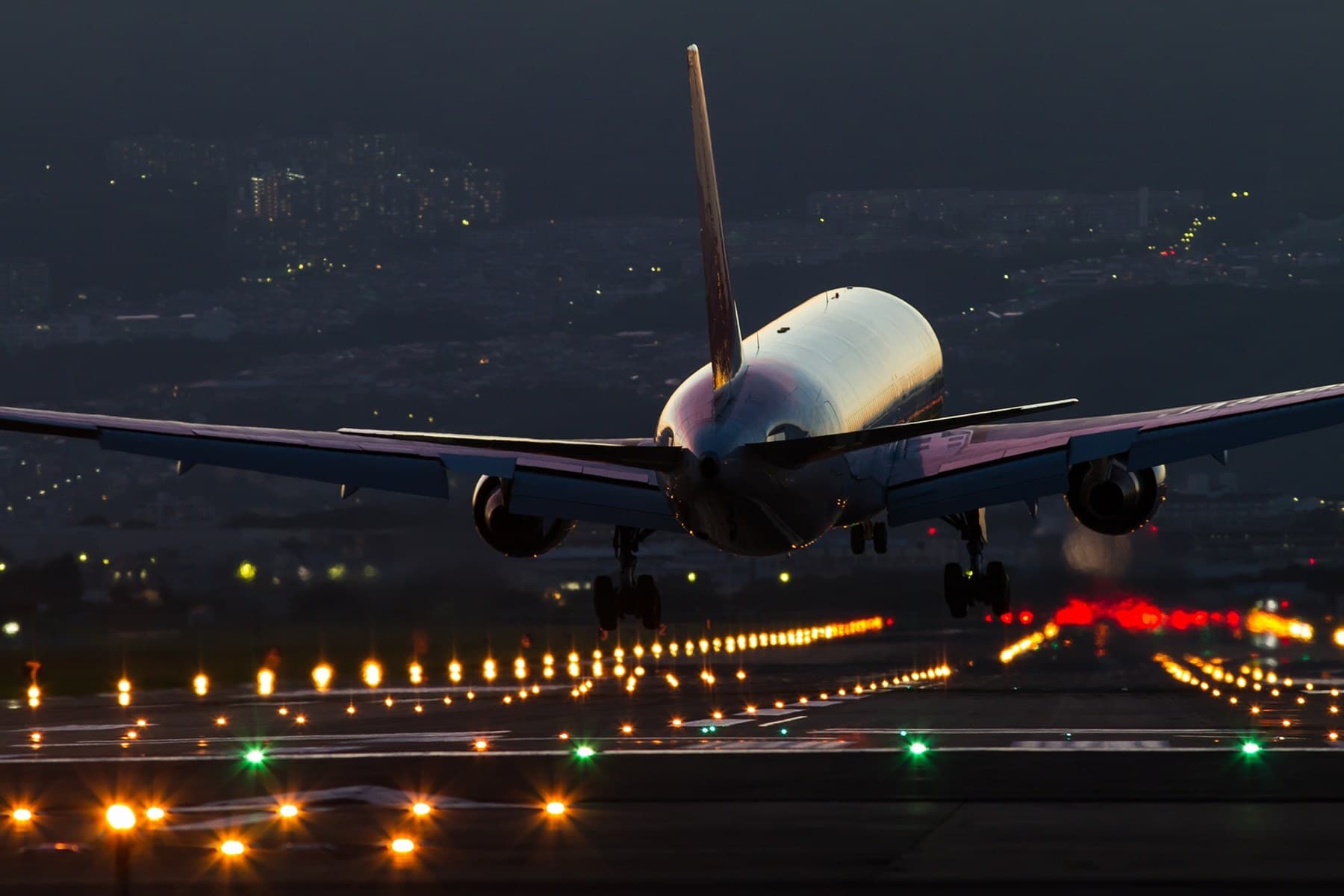
An aircraft approaching nearly head-on can look stationary while its landing light grows brighter. Position, strobe and beacon patterns provide further checks.
Reviewed and maintained byGlobal UFO Archive Editorial DeskEditorial policy
Quick answer
A bright night light that appears stationary and slowly intensifies may be an aircraft approaching almost directly toward the observer. As its angle changes, red and green position lights, white strobes or a flashing beacon may become visible. Check the duration, direction, nearby airport approaches, sound delay and available flight tracking. A missing public tracker result is not decisive because coverage and broadcast requirements are incomplete.
Key points
- A head-on approach can produce little sideways motion, making a moving aircraft appear to hover.
- Lighting patterns become more informative as the viewing angle changes, but distance, haze and exposure may hide individual lamps.
- Flight tracking is a useful cross-check, not a complete catalog of every aircraft in the sky.
Why an approaching aircraft can look stationary
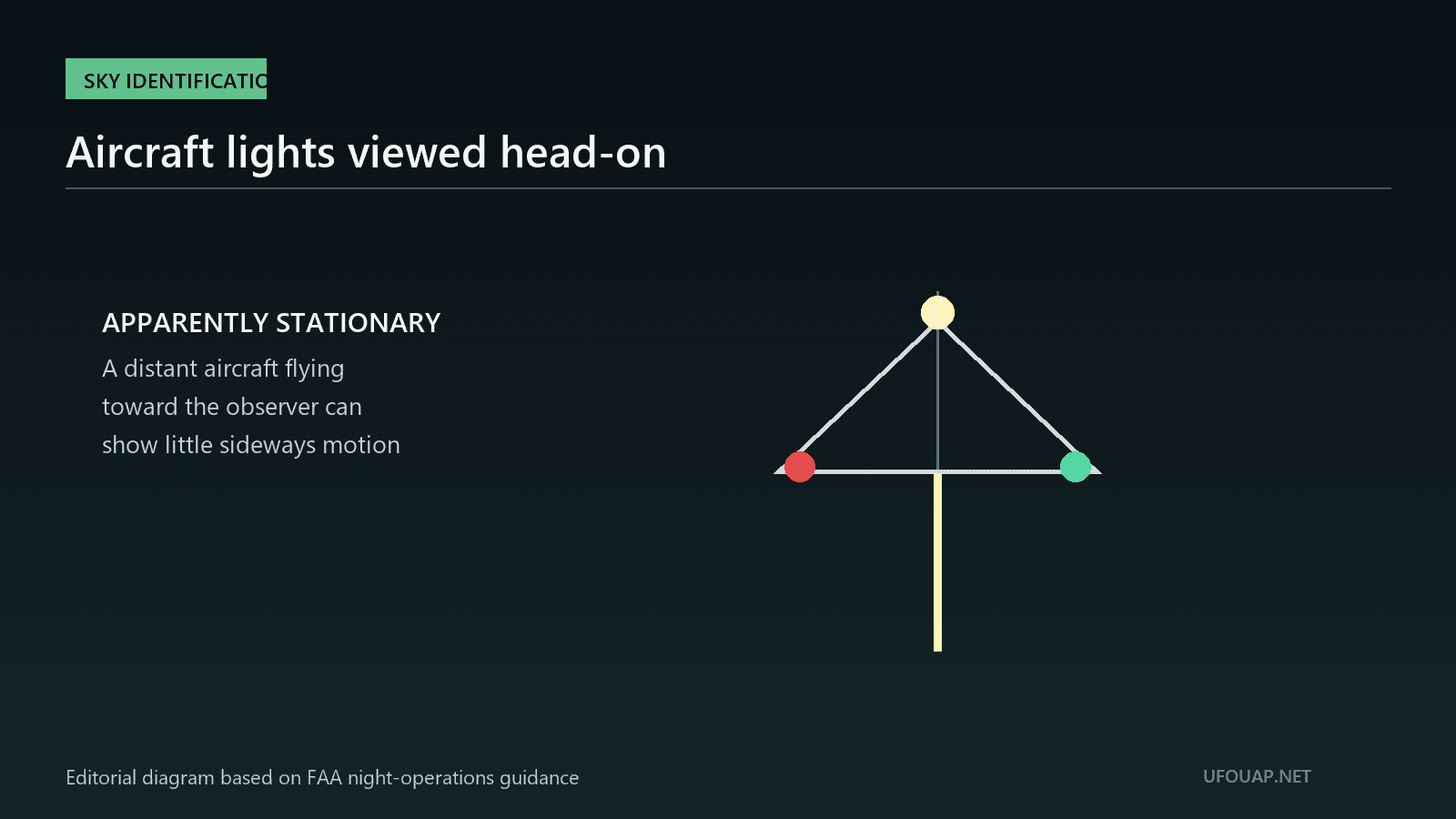
Human vision detects sideways angular motion more easily than motion directly toward or away from the observer. A distant aircraft near the line of sight can therefore remain in almost the same part of the sky while its landing light grows. Without a distance cue, the light may seem to hover and then suddenly move when the aircraft turns or passes. Haze can enlarge the glow and delay recognition of the airframe.
What the lighting pattern can reveal
Aircraft commonly carry position lights, anti-collision lights and landing or taxi lights. From a favorable angle, red on the aircraft's left side, green on its right and white toward the rear help indicate orientation; strobes and beacons add repeating flashes. At long range, several lamps may merge into one bright point, and phone exposure may erase their rhythm. Analysts should inspect an uncompressed sequence rather than one frame.
How to verify the flight path
Record exact time, direction, elevation and duration, then check airport runway alignments and official or reputable flight-tracking data. Listen for sound, allowing for delay over distance. Compare the light with stars and terrain to measure bearing change. ADS-B can support an identification, but receiver gaps, blocked records, military operations and aircraft not represented in a public interface mean that no displayed flight is not proof of an empty sky.
Other effects that change the appearance
Cloud layers can hide and reveal lights, creating apparent blinking unrelated to the aircraft's programmed pattern. Atmospheric turbulence can make a distant point shimmer or change color. Autofocus, digital stabilization and zoom can make the light swell, jump or take the shape of the camera aperture. These recording effects should be separated from the aircraft-light hypothesis, even when both occur in the same clip.
Careful assessment
An aircraft explanation is strong when the light follows an airport corridor, gradually changes bearing, reveals regulated lighting or matches a tracked flight. It is weaker when several fixed cameras record motion inconsistent with a plausible flight path. The conclusion should state the evidence level: identified aircraft, probable aircraft, or unresolved because tracking and original media are incomplete. Failure to identify a flight is not evidence of extraordinary origin.
FAQ
Why can an aircraft landing light look brighter without moving?
On a near head-on approach, distance decreases while sideways angle changes very little. The landing light can therefore intensify before obvious lateral motion appears.
Does no aircraft on a tracking app rule out a plane?
No. Public services depend on broadcasts, receiver coverage and display policies. Some flights or records may be absent, delayed or filtered.
Official sources used
- Federal Aviation AdministrationNight Operations, Airplane Flying Handbookwww.faa.gov
- Federal Aviation AdministrationAirplane Flying Handbook, Chapter 11www.faa.gov
- Electronic Code of Federal RegulationsAircraft Lights, 14 CFR 91.209www.ecfr.gov