
United States / 1967 / DISPUTED
Malmstrom missile UFO reports
The Malmstrom case combines two different records. A contemporary 341st Strategic Missile Wing history documents all ten Echo Flight launch facilities losing strategic alert at 08:45 MST on 16 March 1967. Engineers investigated, reproduced the relevant No-Go indications with injected electrical pulses, and later added pulse protection, but the released history never identifies the initiating disturbance. The same history says rumors of UFOs near Echo at the time were disproven by a mobile security team and that local radar reported no unusual activity. A separate Project Blue Book file records unidentified-object reports around Belt and Great Falls on 24-25 March, yet its July follow-up says the wing knew of no equipment malfunctions during those sightings. Robert Salas's public account emerged decades later, changed from November Flight on 16 March to Oscar Flight on 24 March, and alleges guard sightings followed by another ten-missile shutdown. No public contemporary Oscar operations log, signed guard statement, radar record, photograph, or technical report has been located. The Echo failure is well documented; a UFO causing Echo or Oscar is not. The case remains B-grade and disputed.
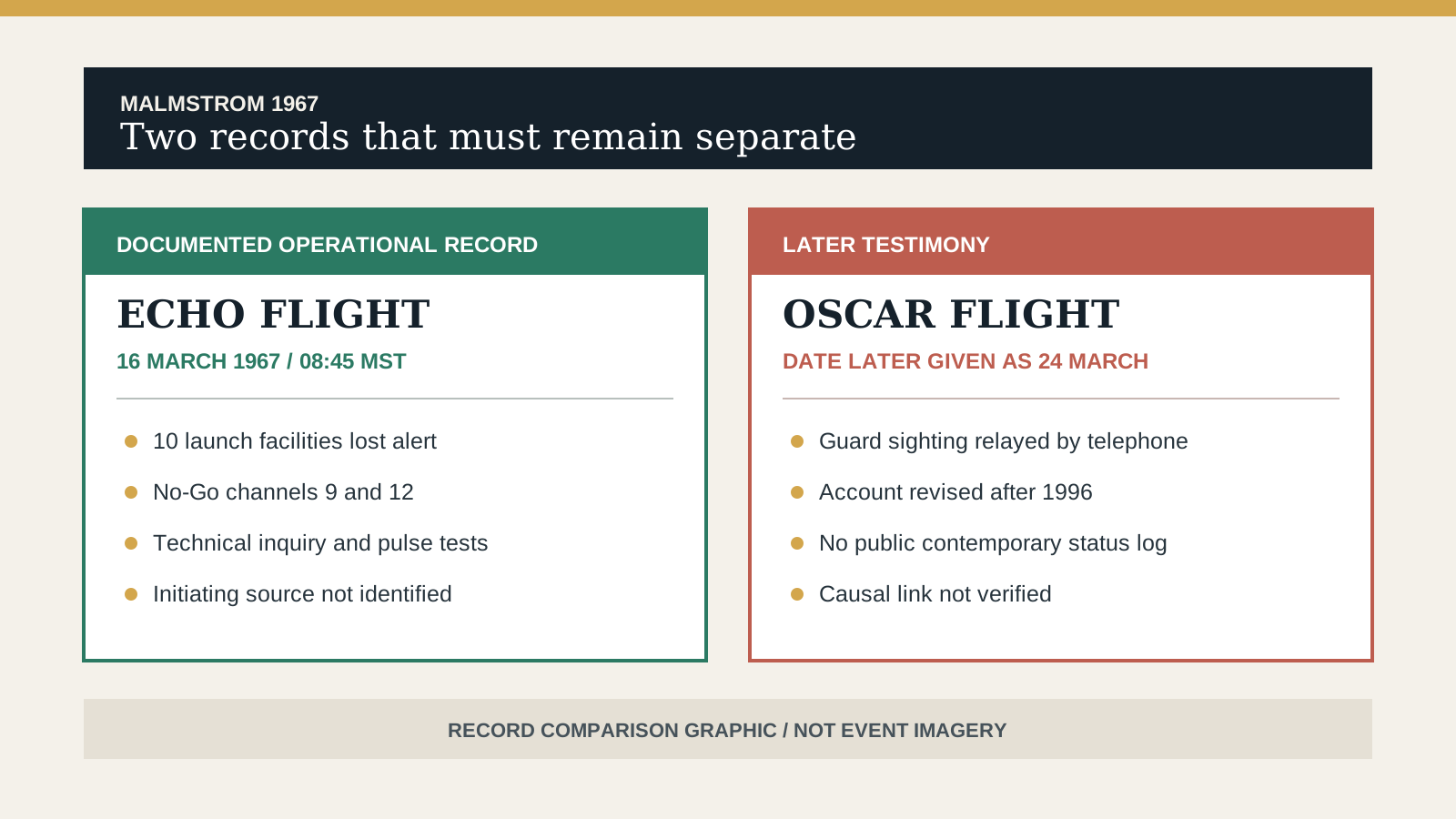
This case is disputed. The archive preserves the claims while separating evidence from interpretation.
- Documentation
- High documentation
- Primary location
- Malmstrom missile field, north-central Montana
- Source base
- 8 linked records
- Research use
- Comparison case
What the Malmstrom record establishes
- Documented date
- Echo Flight lost strategic alert at 08:45 MST on 16 March 1967. The Belt UFO reports were 24-25 March; they are not the same dated event.[1][2]
- Echo record
- All ten launch facilities showed No-Go channels 9 and 12 within an estimated 10-40 seconds and were restored without replacement of launch-facility equipment.[1]
- Technical finding
- Short injected pulses reproduced the channel combination, and later orders added pulse protection. The released record does not identify the source of the original disturbance.[1]
- Belt file
- Blue Book left the 24-25 March Belt visual report Unidentified but recorded no photograph, physical evidence or landing trace; the wing reported no known equipment abnormality during that period.[2]
Case dossier
The cleanest reading begins by separating two events that later retellings often merge. Echo Flight has a dated operational record: ten Minuteman I launch facilities lost strategic alert on 16 March 1967. The alleged Oscar Flight episode, in which guards reportedly saw a glowing red object before missiles failed, is known from testimony made public decades later. Public files do not demonstrate that an observed object caused either shutdown, and they do not contain a contemporary record of a second ten-missile failure at Oscar.
Malmstrom's 341st Strategic Missile Wing operated a dispersed Minuteman force across north-central Montana. The official Air Force fact sheet says the wing had three missile squadrons, fifteen flights and 150 missiles by July 1963; a flight normally comprised one launch-control center and ten remote launch facilities. That structure matters because 'Echo' and 'Oscar' designate different flights, not alternate names for one site.
The January-March 1967 wing history fixes the Echo event at 08:45 MST on 16 March. All Echo launch facilities showed No-Go channels 9 and 12 and lost strategic alert nearly simultaneously; no other Wing I-configured flight did so at that time. The recorded sequence across the sites was estimated at roughly 10 to 40 seconds. Every missile was returned to alert without replacing launch-facility equipment, although two sites had unrelated maintenance issues noted during recovery.
A wing and contractor task group examined power, communications, logic-coupler and guidance-control paths. Its initial report could not determine a logical initiating cause. It called a common externally generated signal capable of reaching all ten sites a very remote possibility, language that refers to an electrical input outside the affected assemblies, not to an aircraft. Later Boeing tests produced the same channel 9 and 12 indications by injecting a short noise pulse into the logic circuitry. Field power-switching tests did not recreate the shutdown, and no public record identifies what supplied the original disturbance. Subsequent technical orders added pulse suppression and line protection.
The same contemporary history directly addresses the UFO claim around Echo. It says rumors of unidentified flying objects near the flight during the fault were disproven after a mobile strike team, which had checked the nearby November Flight facilities that morning, reported no unusual activity or sightings. The 801st Radar Squadron likewise reported no unusual radar or atmospheric interference. This is the unit's recorded assessment, not proof that every possible observer was questioned, but it sharply limits claims that the official Echo investigation documented a nearby craft.
A different official file concerns the night of 24-25 March. Project Blue Book recorded numerous reports around Great Falls and an alleged landing near Belt. Its Belt card remained classified 'Unidentified,' while also recording no photographs, no physical evidence and negative ground and air searches for a landing site. On 3 July, Malmstrom's 341st Combat Support Group told Blue Book that it had no knowledge of equipment malfunctions or abnormalities during the period of those sightings. The Belt report is therefore genuine UFO documentation, but it does not establish a missile shutdown.
Salas's chronology developed in public. A 1996 article by Salas and Jim Klotz placed him at November Flight on the morning of 16 March and described four or five missiles failing after guards reported a red glowing saucer. In a March 2011 account for his Air Force Academy class, Salas instead placed himself underground at Oscar Flight on the evening of 24 March, said all ten missiles failed, and explained that locating commander Fred Meiwald in 1996 led him to distinguish Oscar from Echo. Salas did not claim to see the object himself. His account records a sincerely asserted memory, but the changed site, date, time and missile count, plus the absence of a public contemporary Oscar record or guard statement, prevent it from being treated as an operational measurement.
Later nuclear-facility narratives frequently join the documented Echo shutdown, the separate Belt sightings and the revised Oscar testimony into one causal story. AARO's 2024 historical report noted that it interviewed former Air Force personnel who made missile-site allegations, but Volume I did not resolve the Malmstrom claim. A 2025 Wall Street Journal investigation reported that reviewers were considering a secret electromagnetic test as a terrestrial explanation; no supporting 1967 test record or completed public finding accompanied that report. The strongest conclusion remains narrow: Echo suffered a serious, technically investigated common-mode failure of unknown initiating source, while the claimed UFO connection is disputed and unverified.
Timeline
- At 08:45, all ten Echo Flight launch facilities lost strategic alert and displayed No-Go channels 9 and 12 nearly simultaneously. No other Wing I flight was recorded as losing alert at that time.
- The site-to-site sequence was estimated at 10-40 seconds. All ten missiles were restored to alert without replacement of launch-facility equipment; separate maintenance observations at E-2 and E-8 were recorded.
- Investigators questioned a mobile strike team that had checked November Flight facilities that morning. The wing history says the team reported no unusual activity or sightings, and the 801st Radar Squadron reported no unusual radar or atmospheric interference.
- The wing learned that Strategic Air Command had called in a technical task group including Air Force and contractor specialists to investigate the Echo failure.
- Malmstrom agencies received numerous UFO reports around Great Falls and Belt. Project Blue Book investigated an alleged landing near Belt, found no landing evidence, photographs or physical traces, and retained the case as Unidentified.
- A commercial-power switching test at Echo did not reproduce the shutdown, reducing support for ordinary grid switching as the common cause.
- Boeing laboratory tests repeatedly produced channel 9 and 12 No-Go indications by injecting a short electrical pulse into logic-coupler circuitry. Other field tests did not identify the source of the original event.
- The 341st Combat Support Group told Project Blue Book that it knew of no equipment malfunctions or abnormalities during the period of the 24-25 March UFO reports.
- Further inspections found no arcing, burning, tampering or major equipment defect. Engineering changes and 1968 technical orders added pulse suppression and line protection against electrical-discharge effects.
- A Salas-Klotz article placed Salas at November Flight on 16 March and described four or five missile failures after a guard's reported red object. This is the earliest located public version used in this review.
- Salas's Air Force Academy class history instead placed him at Oscar Flight on the evening of 24 March, alleged ten failures, and said his 1996 contact with Fred Meiwald corrected his earlier Echo/November identification.
- AARO released Historical Record Report Volume I. It discussed interviews with former Air Force missile personnel but did not publish a resolution of the Malmstrom allegations.
Questions about the Malmstrom reports
What happened at Echo Flight on 16 March 1967?
All ten remote launch facilities lost strategic alert nearly simultaneously, showing No-Go channels 9 and 12. They returned to alert without equipment replacement, and a multi-agency technical inquiry followed.
Did a UFO shut down the Echo missiles?
The released record does not establish that. The wing history says UFO rumors around Echo were disproven by the security check and local radar response. It records a technical failure whose initiating disturbance remained unidentified.
Are Echo Flight and Oscar Flight the same incident?
No. They were different missile flights. Echo has a contemporary 16 March record. The alleged Oscar event is placed on 24 March in Salas's later account and lacks a public contemporary operational file.
What did the technical investigation find?
Engineers could reproduce channels 9 and 12 by injecting a brief noise pulse and later added pulse protection. Field tests rejected several proposed paths, but the public history did not identify the real 16 March trigger.
Why did Project Blue Book call the Belt report Unidentified?
Blue Book did not identify the reported visual object. That classification did not mean the landing claim was confirmed: searches found no site, photograph or physical evidence, and the file records no associated equipment malfunction.
Did Robert Salas see the reported object?
No. Salas said he was in the underground launch-control capsule and received telephone reports from a topside guard. His account is therefore second-hand for the object and first-hand only for what he recalls inside the capsule.
Does the reported secret electromagnetic test solve the case?
No public finding does so. The Wall Street Journal reported in 2025 that reviewers were considering that explanation, but no supporting 1967 test record or completed AARO case resolution was released with the report. It remains an attributed hypothesis.
Sources
- [1] ArchiveReleased 341st Strategic Missile Wing histories and Echo Flight investigationU.S. Air Force records / The Black Vault FOIA archive
- [2] ArchiveProject Blue Book Belt, Montana case fileU.S. Air Force record / NICAP scan archive
- [3] Official fileOfficial 341st Missile Wing fact sheetU.S. Air Force
- [4] Official fileNARA guide to Project Blue Book recordsU.S. National Archives and Records Administration
- [5] ResearchSalas-Klotz 1996 Malmstrom accountRobert Salas and Jim Klotz / NICAP archive
- [6] ArchiveRobert Salas's March 2011 Oscar Flight accountU.S. Air Force Academy Class of 1964 alumni archive
- [7] Official fileAARO Historical Record Report, Volume IU.S. Department of Defense / AARO
- [8] News reportWall Street Journal report on a proposed Malmstrom test explanationThe Wall Street Journal
The displayed image is a site-produced comparison of record categories. It is not an event photograph, missile-status display, document facsimile, radar plot, or depiction of a reported object. No authenticated event image or original video was found; later programs and user-created clips are not treated as primary evidence.