
Australia / 1966 / DISPUTED
Tully saucer nest
The Tully record begins with one witness, not a mass sighting. At about 9:00 a.m. on 19 January 1966, 28-year-old farm worker George Pedley said a loud hiss drew his attention to a dull grey, disc-like object roughly 25 yards away above Horseshoe Lagoon at Euramo, south of Tully. He reported it rising from treetop height, rotating and departing southwest within seconds. Later he found a near-circular area of reeds flattened to the water in curved lines. Sergeant A. V. Moylan inspected the site the next morning, and the RAAF collected the police questionnaire, plant sample and press material. The file supports a real report and a real vegetation disturbance; it does not establish that a machine made either observation.
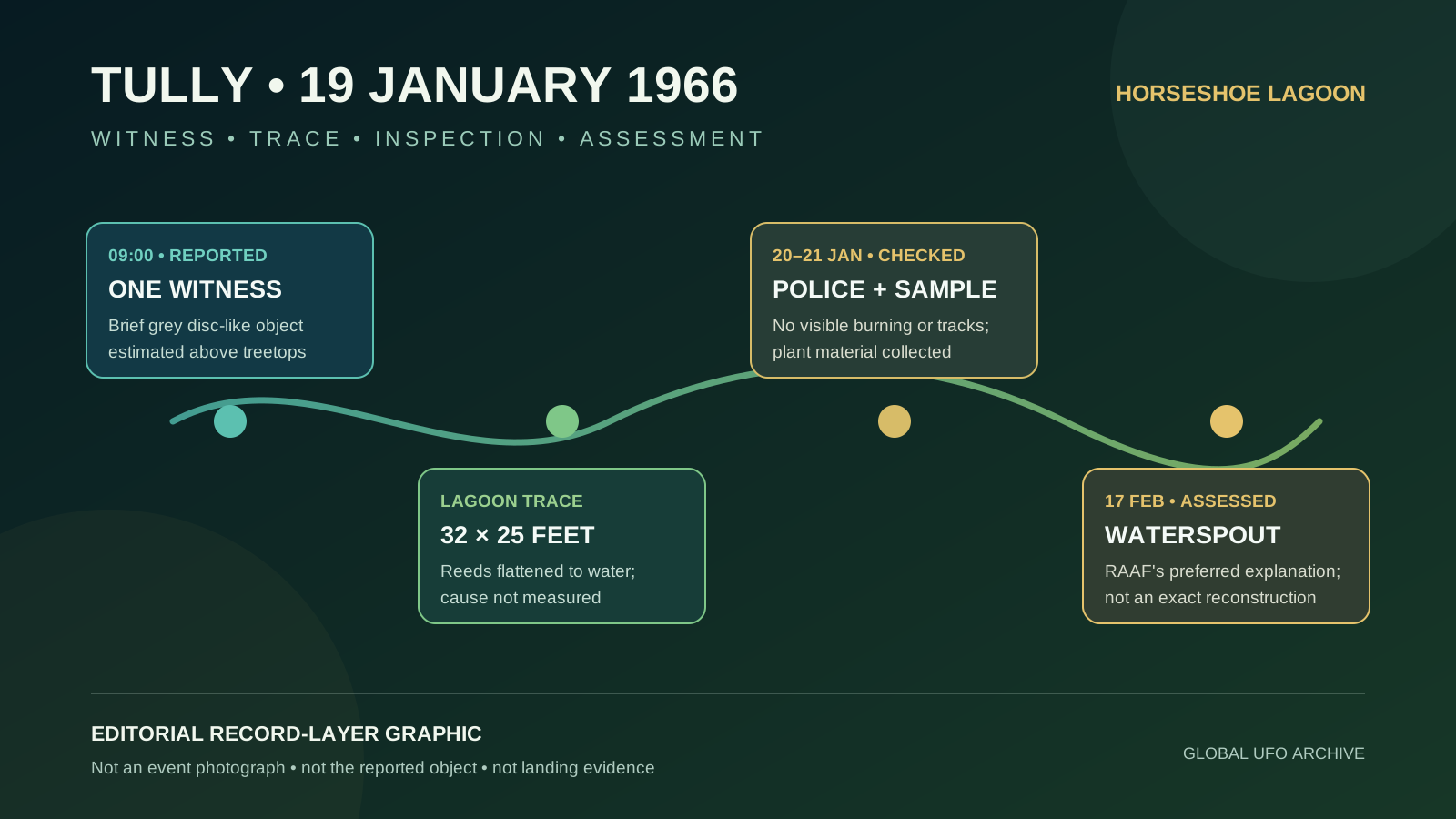
This case is disputed. The archive preserves the claims while separating evidence from interpretation.
- Documentation
- High documentation
- Primary location
- Horseshoe Lagoon, Euramo, Queensland
- Source base
- 5 linked records
- Research use
- Comparison case
What the 1966 record establishes
- Confirmed record
- Police and RAAF files document Pedley's report, a site inspection and a plant sample.[1]
- Witness boundary
- Pedley was the only known witness to the brief object; size, speed and identity were estimates.[1]
- Physical trace
- Moylan recorded a near-circular patch of smoothly flattened reeds without visible burning or access tracks.[1]
- Official assessment
- RAAF command favored small isolated waterspouts; the file contains no measured vortex or exact reconstruction.[1]
Case dossier
Pedley's earliest surviving account is the police-completed RAAF form, not the richer versions printed decades later. It records clear sky and hot sunshine, a sighting lasting only a few seconds, no optical aid, and no trail, exhaust or light. The object was an estimate made against nearby treetops. The form says it rose vertically to about 60 feet, then followed a straight southwest climbing path at about 45 degrees. Those details preserve what Pedley told police; they are testimony, not independent measurements.
The chronology is unusually well fixed. Pedley reported the incident to Tully police at 7:30 p.m. on 19 January. At 7:00 a.m. on 20 January he took Moylan to the depression. Moylan contacted RAAF Base Townsville; Flight Lieutenant Wallace sent sighting forms and requested a grass sample. Moylan took that sample at 3:30 p.m. on 21 January and returned the completed paperwork on 26 January. A RAAF minute says no service or civil aircraft were operating in the area at the reported time.
The physical trace was documented but its description changed with time. The official form gives a near-circular depression about 32 by 25 feet, with swamp grass flattened to the surface of roughly four feet of water in curved lines. Moylan recorded no combustion smell, visible scorching, broken trees or tracks into or out of the patch. Pedley said the reeds were green when first seen and brown on his afternoon return. Contemporary clippings in the RAAF file describe the plants as smoothly flattened and later browned, while photographs and later investigators sometimes used different dimensions or swirl directions. The corrected official form reads clockwise; that correction explains much later confusion.
Moylan first considered a small helicopter because Pedley described a take-off, but he also noted a safer cleared landing area nearby and later learned of similar swamp marks attributed locally to a whirlwind. Operational Command then wrote that small isolated waterspouts caused the depressions. This was an assessment, not a demonstrated reconstruction: no weather instrument recorded a vortex at Horseshoe Lagoon, and the file does not show a controlled test reproducing the exact mat. The lack of matching aircraft weakens the helicopter idea without proving a waterspout.
Plant testing answered narrower questions. A University of Queensland botanist reported that the reeds appeared to have died from submersion in a low area flooded by recent rains, with no evidence of parasitic infestation or burning; he explicitly said more wind, current and site information was needed for a complete answer. Separate radioactivity tests publicized through the civilian bureau were negative. These findings make radiation and scorching poor descriptions of the sample. They do not determine what flattened the reeds or whether Pedley's visual report and the plant mat had one cause.
Deliberate manufacture must be kept as a possibility rather than a verdict. People can flatten or weave reeds, and the site quickly attracted crowds, so later marks had poor custody. Yet the police visit came the next morning and Moylan recorded no entry tracks, animal marks or obvious scorching at the main patch. The public file contains no confession, tool evidence or identified maker for the 19 January formation. Human action is therefore mechanically possible but positively evidenced less well than in later British crop-circle hoaxes.
Tully later became entangled with crop-circle culture, but the categories are not identical. The 1966 trace was a floating mat in lagoon reeds tied to one brief aerial claim; the elaborate field patterns popularized in Britain in the 1980s used standing crops and acquired their own hoax, meteorological and cultural history. ABC's 2024 retrospective reports that Doug Bower and Dave Chorley cited Tully when describing their British circle-making. That later influence is reception history, not evidence that their methods were used at Horseshoe Lagoon—or that a saucer was.
Timeline
- Pedley reported a brief disc-like object above Horseshoe Lagoon and later a near-circular mat of flattened reeds.
- Pedley reported the event to Tully police.
- Sergeant Moylan inspected the lagoon site with Pedley and contacted RAAF Base Townsville.
- Moylan collected a grass sample requested by the RAAF.
- Moylan returned the completed sighting form; press reports also described negative radioactivity tests and a cautious botanical opinion.
- RAAF Operational Command forwarded the investigation and assessed the swamp depressions as small isolated waterspouts.
- British circle-makers Doug Bower and Dave Chorley publicly linked Tully to their later crop-circle activity, changing the case's cultural afterlife without resolving 1966.
Tully saucer nest questions
When did the Tully saucer nest incident happen?
Pedley dated his sighting to about 9:00 a.m. on Wednesday, 19 January 1966. He reported it that evening; police visited on 20 January.
Where was Horseshoe Lagoon?
It was on Albert Pennisi's farm at Euramo, south of Tully in far north Queensland, Australia.
What did George Pedley report seeing?
He said a dull grey disc-like object rose near the treetops, appeared to rotate and departed southwest within seconds. No other person is documented as seeing that object with him.
What did police find at the lagoon?
Moylan recorded a near-circular 32-by-25-foot depression of reeds flattened to the water in curves, with no visible burning, broken trees or access tracks; he later collected a sample.
What was the RAAF explanation?
Operational Command assessed the depressions as small isolated waterspouts. This was a probable natural interpretation, not a measured observation or controlled reconstruction at the lagoon.
Was Tully the first crop circle?
That label is misleading. Tully involved lagoon reeds and one aerial claim in 1966; the later British crop-circle culture involved patterns in standing crops, including many admitted human constructions. Tully influenced that culture but does not prove a common cause.
Sources
- [1] Official fileRAAF file containing the Pedley questionnaire and Tully investigationRoyal Australian Air Force / National Archives of Australia
- [2] ArchiveState Library of Queensland guide to the 1966 newslettersState Library of Queensland
- [3] News reportABC News retrospective on Tully, the archive and crop-circle legacyABC News Australia
- [4] ResearchUFO Research Queensland case reportUFO Research Queensland
- [5] ResearchProject 1947 review of the official file and later debateProject 1947
The hero is a site-authored record-layer graphic, not an event image. Surviving 1966 photographs and document reproductions are linked through sources but not copied because commercial republication rights are unclear.