
Canada / 1967 / INSUFFICIENT DATA
1967 Duhamel UFO landing marks
In August 1967, farmer Edgar Schielke found four large, incomplete rings of flattened or discoloured grass in a pasture near Duhamel, Alberta. No one saw the marks form or reported a craft at the site. A Defence Research Establishment Suffield scientist inspected them six days after the first discovery and documented their dimensions, compressed grass and normal background radiation. Memorandum 49/67 considered rolling machinery, deliberate construction and an unknown vehicle, but confirmed none. Its often-repeated 135-ton figure was a conditional pressure calculation, not a measured craft weight. The evidence supports an unusual, officially examined ground-trace case whose cause remains insufficiently determined.
This case has insufficient public data for a strong conclusion.
- Documentation
- High documentation
- Primary location
- Duhamel, Alberta
- Source base
- 6 linked records
- Research use
- Comparison case
What Memo 49/67 supports
- Confirmed record
- A Canadian defence scientist measured four large, incomplete pasture rings on 11 August 1967.[1][3]
- Witness boundary
- Schielke discovered the marks; no one in the official record saw them form or saw a craft at the site.[1]
- Physical findings
- Grass and fresh dung were compressed, but there was no burning, exhaust pattern, broad disturbance or abnormal radiation.[1]
- Sample limit
- The public memo contains no controlled soil-chemistry comparison or complete chain of custody for material removed before inspection.[1][4]
- 135-ton correction
- The 135-ton figure was a hypothetical pressure calculation, not a measured vehicle mass or proof of a landing.[1]
Documented ring dimensions
Case dossier
Heavy rain fell near Duhamel on Friday, 4 August 1967. The next morning, while bringing cows from a pasture, Schielke noticed the first roughly 30-foot ring. He said he had not crossed that part of the field during the previous week, did not believe in UFOs and first wondered whether unusual lightning had made it. He was the discoverer of a mark, not a witness to an object, landing or construction process.
The report spread indirectly. A neighbour told Ray Sanders, a local teacher interested in UFO reports. During the next day or two, Sanders and other visitors located three additional rings, and material was removed for a private UFO group in Edmonton. The Camrose Canadian photographed the field on 8 August and published an image the following day. By the official visit, many people and vehicles had crossed both pastures. That traffic and the early removal of material weakened the site's later evidential control.
A 9 August telex asked Canadian Forces Base Namao to assign Captain Walker to the case. Defence Research Establishment Suffield was not contacted until the morning of 11 August, when scientist G. H. S. Jones was instructed to inspect the site. He flew to Camrose in an RCAF Otter and visited the pasture with Walker, an Army photographer and a newspaper representative. Jones's memorandum cautioned that his local background summary was brief and should not be read as an endorsement of every witness or claim.
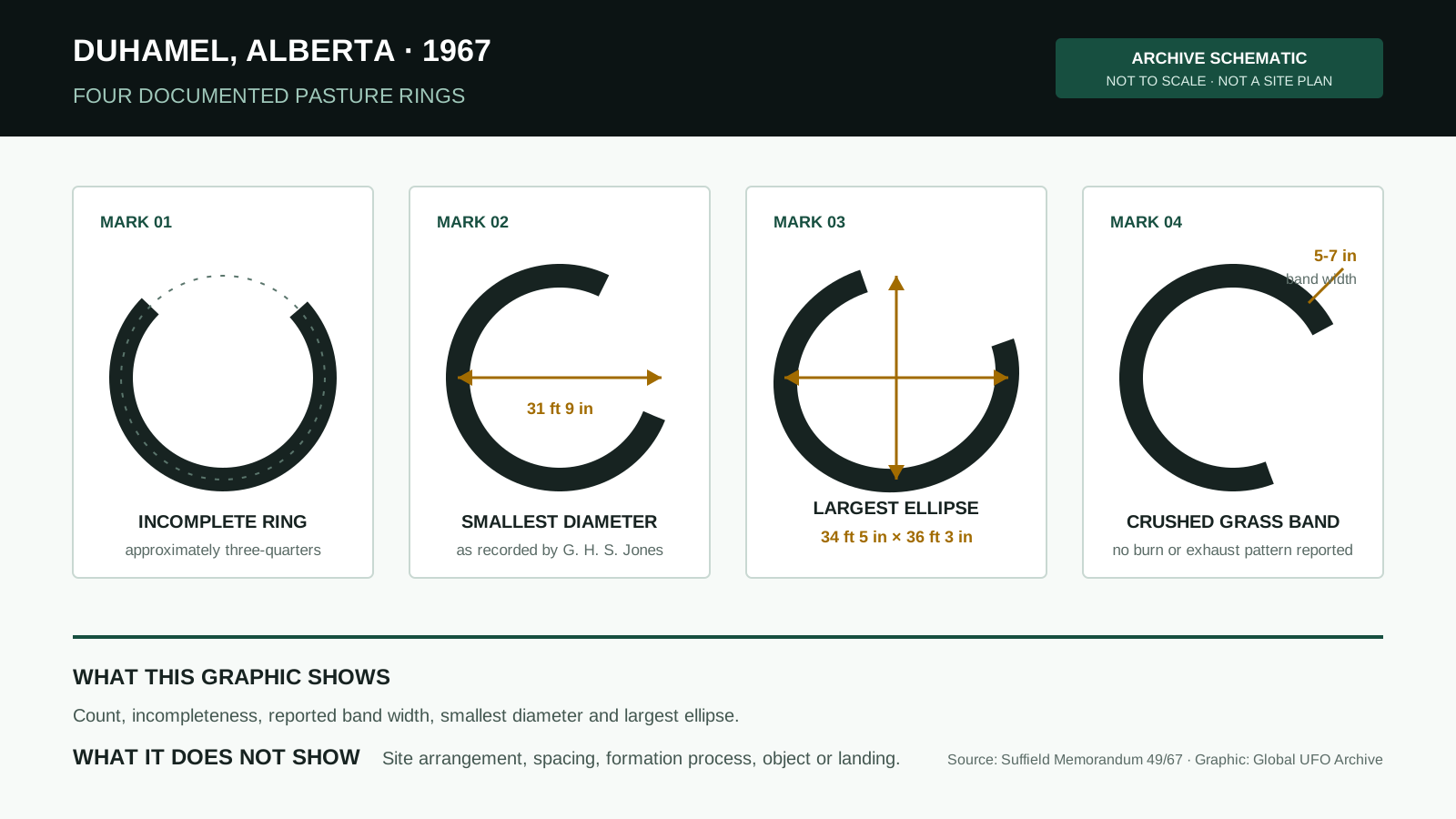
Jones documented four marks, not the six or seven rings sometimes claimed in later retellings. Three were approximately circular; the largest was slightly elliptical. The smallest measured 31 feet 9 inches across, while the ellipse measured about 34 feet 5 inches by 36 feet 3 inches. Each band was roughly 5 to 7 inches wide and only about three-quarters complete. The published memorandum did not establish a precise site layout that would justify reconstructing their spacing or orientation.
Within the bands, pasture grass was crushed or discoloured. Jones saw fresh cow dung compressed into one track and described a possible repeating pattern, about three inches long, that earlier visitors said had been clearer before traffic degraded it. He found no exhaust-blast pattern, scorching, displaced loose material or effects extending inside or outside the rings. The marks also appeared distinct from the obvious car and truck tracks made by visitors, but those observations did not uniquely identify the tool or force that produced them.
Radiation readings ranged from roughly 50 to the low 200s counts per minute and were treated as ordinary background. Jones removed very small clumps of vegetation, but the public memorandum does not present a controlled soil-chemistry study, comparative laboratory results or a complete chain of custody for material taken before the official inspection. Therefore, phrases such as 'soil tests found an anomaly' overstate the surviving record. The documented negative radiation result is firmer than any later claim about special sample composition.
The memorandum examined mechanical contact and deliberate construction without resolving either. Jones estimated that a rolling wheel would need at least one-half to three-quarters of a ton of load to leave the observed compression while following a precise circle. One ring had a central indentation; the others did not. He also calculated that a hypothetical circular support pressing at an assumed 50 pounds per square inch could imply about 270,000 pounds, or 135 tons. That number depends entirely on assumed pressure and area: it was not a scale reading, vehicle identification or confirmation that a craft landed.
Jones concluded that a hoax could neither be confirmed nor denied, that rolling contact remained possible, and that the marks were unusual in his experience. Later summaries introduced distortions: the Condon Report referred to six rings, while some popular accounts raised the number to seven and converted the conditional 135-ton calculation into a craft claim. Library and Archives Canada preserves the primary memorandum and related Camrose records. Read against that source, the cautious conclusion is limited: four durable rings were measured, but no direct witness, diagnostic test or identified mechanism connects them to an extraordinary vehicle.
Timeline
- Heavy rain falls on the Duhamel pasture.
- Edgar Schielke discovers the first large ring while moving cattle; he does not witness its formation.
- Three additional marks are identified; visitors enter the field and material is removed before official control.
- The Camrose Canadian photographs the pasture.
- The newspaper publishes a photograph, and a military telex requests an investigator from CFB Namao.
- G. H. S. Jones inspects and measures four marks for Defence Research Establishment Suffield.
- The published Condon Report later describes six rings, illustrating a retelling error against the four in Memo 49/67.
- Library and Archives Canada's current guide continues to place the Duhamel records within Canada's digitized federal UFO collection.
Duhamel landing-marks questions
How many Duhamel landing marks were documented?
Memo 49/67 documents four marks. Later references to six or seven rings conflict with the primary inspection record.
Did anyone see a UFO make the rings?
No. Schielke found the first ring after rain, and the others were located later. The official record contains no formation witness or craft observation at the field.
Were radiation or soil anomalies found?
Radiation was treated as normal background. The public memo does not provide a controlled soil-chemistry comparison or a complete chain of custody supporting an exotic sample claim.
Does the report say a craft weighed 135 tons?
No. Jones calculated a hypothetical load using an assumed contact pressure. It was not a weight measurement and did not identify a craft.
Could machinery or a hoax have made the marks?
They remain plausible. The memo considered rolling contact and deliberate construction but neither reproduced the marks nor identified equipment. Plausibility is not proof of a specific method.
Why is Duhamel kept in the UFO archive?
It is a well-preserved official physical-trace investigation with clear negative findings and unresolved causation. It teaches the difference between an unexplained mark and evidence that an extraordinary craft landed.
Sources
- [1] Official fileOnsite inspection of reputed UFO landing marks at Duhamel, AlbertaDefence Research Establishment Suffield / Library and Archives Canada
- [2] Official fileCanada's historical UFO records research guideLibrary and Archives Canada
- [3] ArchiveArchived Camrose, Alberta UFO database resultsLibrary and Archives Canada
- [4] ResearchA History of Canada's UFO Investigation, 1950-1995Trent University Digital Collections
- [5] ResearchScientific Study of Unidentified Flying Objects: Duhamel retellingUniversity of Colorado / U.S. Air Force Office of Scientific Research
- [6] ArchiveTranscript mirror of Suffield Memorandum 49/67The Experiencer Support Association
The displayed graphic is an archive-authored explanatory schematic derived from the dimensions in Memo 49/67. It is not a survey plan, site photograph, reconstruction of the rings' spacing, or evidence of a craft. The legacy report-page image is not recommended for display because commercial republication rights were not verified.