
Poland / 1978 / DISPUTED
Emilcin abduction
The public record establishes that 71-year-old farmer Jan Wolski told an extraordinary story in Emilcin, eastern Poland, in May 1978 and that UFO enthusiasts recorded it later that month. Wolski said two short figures rode on his wagon, led him into a hovering white vehicle and examined him. No authenticated event photograph, film, instrument record, biological sample or securely documented physical trace is public. A child’s supposed corroboration and claims about police, medical and lie-detector findings became part of later advocacy, but the surviving material does not make them independent confirmation. A 1978 television film preserves an early retelling; later books, disputes and the 2005 monument preserve the case’s cultural life. The careful finding is C / DISPUTED: a promptly circulated witness report, not verified evidence of abduction or non-human visitors.
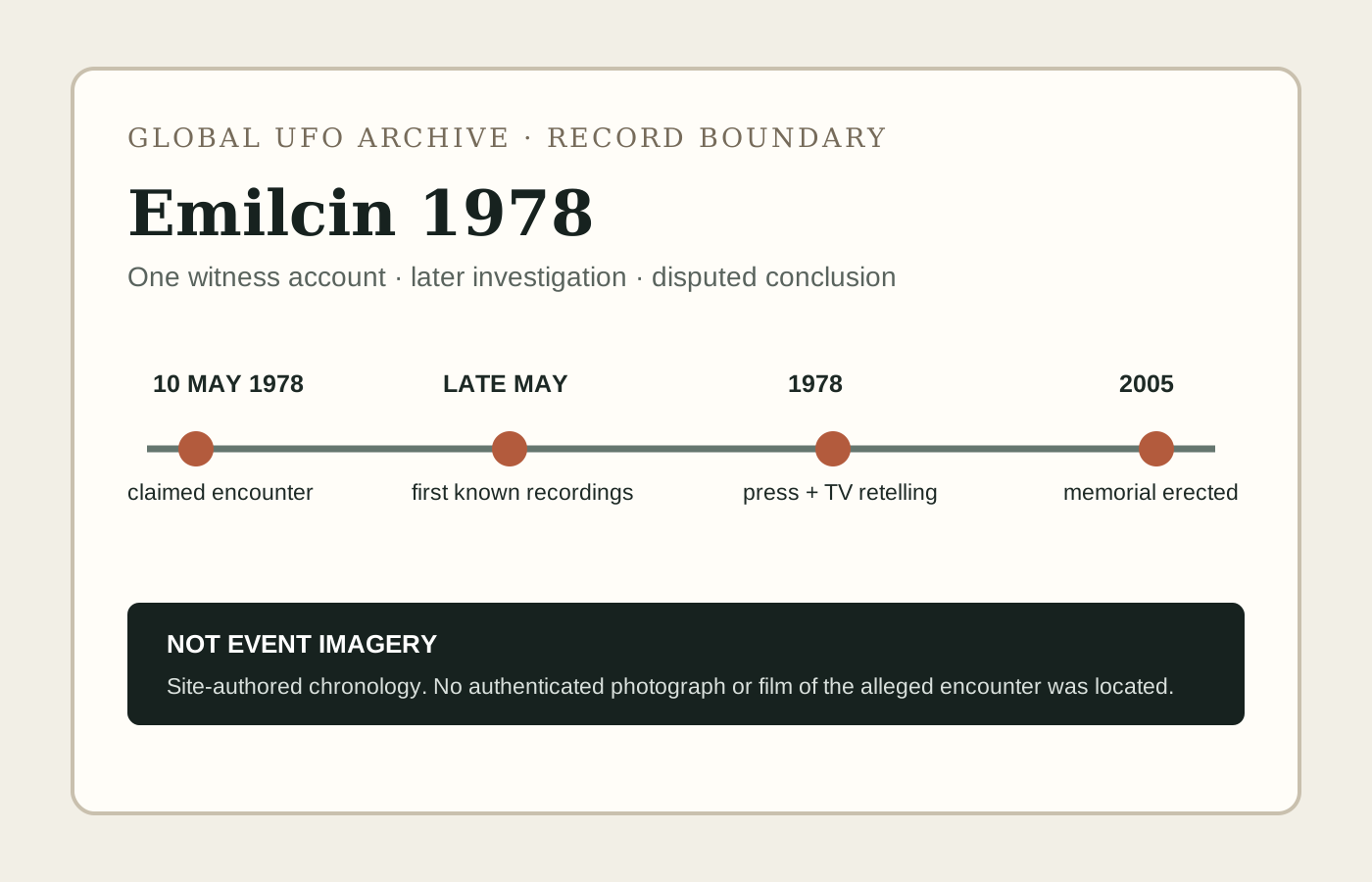
This case is disputed. The archive preserves the claims while separating evidence from interpretation.
- Documentation
- High documentation
- Primary location
- Emilcin, Lublin Voivodeship
- Source base
- 7 linked records
- Research use
- Comparison case
What the record establishes
Case dossier
The reported journey
Wolski placed the encounter early on 10 May 1978 while driving a horse-drawn wagon near Emilcin. He said two short, dark-suited figures joined the wagon and spoke in high, unintelligible voices. At a clearing he described a white, bus-sized object hovering above the ground. These are details of his testimony, not independently observed facts. [2] · [3]
Why the familiar name needs care
Wolski said a platform carried him inside voluntarily, where he undressed and was touched with two plate-like instruments before leaving. Calling the case an ‘abduction’ therefore reflects later UFO classification more than his own account of coercion. The archive preserves the familiar name while avoiding the claim that captivity occurred. [2] · [3]
The first investigation
The reporting lag was weeks, not decades, but it still matters. Bartosz Rdułtowski’s archive-based chronology says Lublin enthusiast Witold Wawrzonek learned of the case on 25 May and made the first known recordings on the following days; Zbigniew Blania then arrived at month’s end. This is an early investigative trail, but it was created by interested UFO researchers rather than police or a neutral scientific team. [1] · [2]
A film made after the report
A newspaper story followed in early June, and TVP’s short documentary Odwiedziny, czyli u progu tajemnicy was broadcast later in 1978. The film is valuable because viewers can hear Wolski during the event year, but it is already a produced retelling with interviews and drawings. Its images of Wolski, the beings and the craft are documentation or illustration, not footage of 10 May. [2] · [3]
The broadcaster’s archive recording
Polskie Radio identifies a separate event-year record: Małgorzata Sawicka’s report Łąka na skraju wszechświata, listed on its archive page as a 1978 recording lasting 23 minutes 38 seconds. The page also offers an 18-minute 17-second report from 2004 about preparations for the monument. These are different recordings made for different purposes. The first preserves Wolski telling his story after the alleged encounter; the second documents remembrance decades later. Neither is a microphone recording of the claimed meeting. The archive labels establish provenance, but do not supply an exact recording day or authenticate the reported vehicle. [3]
Limits of the supporting claims
The alleged supporting evidence is weaker than the story’s reputation suggests. Later accounts mention marks in wet ground, family members arriving after the object had gone, a child who supposedly saw a bus-like craft, police visits, medical evaluation and a polygraph. Publicly accessible reporting does not provide a contemporaneous police file, original trace measurements, laboratory results or a full validated polygraph record. Rdułtowski’s later review also argues that the child account was shaped during questioning. [1] · [2] · [3]
The later dispute
The case later became a contest between advocacy and debunking. Blania’s 1996 book defended the incident. Rdułtowski’s 2013 study, based partly on acquired investigator archives, criticized leading questions and proposed that Wawrzonek may have implanted a false memory through hypnosis as a prank. That is a hypothesis, not a demonstrated solution: no public primary record establishes that such a session with Wolski occurred. The honest conclusion is unresolved cause, not confirmed aliens and not a proven hoax. [1] · [2] · [7]
What the critical author actually claimed
In a June 21, 2014 response on his own blog, Rdułtowski distinguished his criticism of Blania’s investigation from his proposed reconstruction of what happened. He continued to call the latter a hypothesis. He also said he had started by investigating a possible secret-service operation but found no supporting evidence. He objected to a newspaper reprint’s headline presenting that idea as a finding, saying he had not authorized the changed title. This first-person clarification is useful for reading sensational headlines: it documents the author’s stated position, not an intelligence-service confession, a police determination or proof that hypnosis occurred. [7]
Commemoration is a separate record
A monument erected by Fundacja Nautilus in 2005, anniversary gatherings, comics and later television coverage made Emilcin a durable Polish cultural landmark. Municipal tourism material confirms the monument and repeats the local story. These sources are strong evidence for commemoration and weak evidence for the event itself. The monument’s inscription is a claim made 27 years later, not a finding by a public authority. [4] PDF p. 8 · [2] · [6]
Related checks and records
Timeline
- Date Wolski assigned to his encounter near Emilcin.
- Late May: Wawrzonek makes the first known recordings; Blania begins his investigation.
- Early June: the first identified newspaper coverage brings the story to a wider public.
- TVP broadcasts Odwiedziny, czyli u progu tajemnicy, preserving an event-year interview and illustrations.
- Blania-Bolnar publishes Zdarzenie w Emilcinie, a later investigator’s defense of the case.
- Fundacja Nautilus erects the Emilcin UFO monument, 27 years after the report.
- Rdułtowski publishes an archive-based critique and a hypnosis-hoax hypothesis, neither a conclusive solution.
Questions about the Emilcin report
Did the Emilcin abduction happen?
Wolski reported an experience; no public evidence independently verifies an abduction or non-human visitors.
When was Wolski first recorded?
The archive chronology places the first known recordings in late May 1978, roughly two weeks after the claimed event.
Is the 1978 documentary original event footage?
No. It is an event-year interview and illustrated retelling made after the alleged encounter.
Did a child independently confirm the craft?
A child account was promoted as corroboration, but later archive review says it was shaped by questioning; it should not be treated as clean independent confirmation.
Was the case proved to be a hypnosis hoax?
No. Rdułtowski proposed that explanation from later archive research, but no public primary record proves Wolski underwent the alleged memory-implanting session.
What does the Emilcin monument prove?
It proves commemoration since 2005 and the story’s cultural importance, not that a craft landed in 1978.
Sources
- [1] ResearchEmilcin 1978: Archives and WitnessesBartosz Rdułtowski / Wydawnictwo Technol
- [2] ResearchA Tale Out Of This WorldCulture.pl / Adam Mickiewicz Institute
- [3] News reportWhat did Jan Wolski report in Emilcin?Polskie Radio 24
- [4] Official fileEmilcin in the municipal visitor guideGmina Opole Lubelskie
- [5] ArchiveZdarzenie w Emilcinie: catalog recordKsiążnica Pruszkowska SOWA
- [6] ArchiveLicensed photograph of the Emilcin UFO memorialWikimedia Commons
- [7] ResearchRdułtowski on his hypothesis and a changed headlineBartosz Rdułtowski
The hero is a site-authored archive cover, not event evidence. No authenticated image or original film of the alleged encounter was located.