
Skywatching / Updated 2026-07-16 / 4 min read
Meteor or UFO? How to identify fireballs and bolides
Bright meteors can produce sudden flashes, colored trails and fragmentation that look extraordinary on video. NASA terminology and event data provide a practical first check.
Reviewed and maintained byGlobal UFO Archive Editorial DeskEditorial policy
Quick answer
A bright object that crosses a large part of the sky in seconds, leaves a continuous luminous trail, sheds fragments or ends in a flash is often consistent with a meteor or fireball. The identification becomes stronger when the time and direction match NASA fireball data, a meteor-shower window or independent reports along the same ground track. A dramatic appearance alone does not make the event anomalous.
Key points
- NASA uses meteor for the visible atmospheric path of a meteoroid; an unusually bright meteor is called a fireball, and an exploding fireball may be called a bolide.
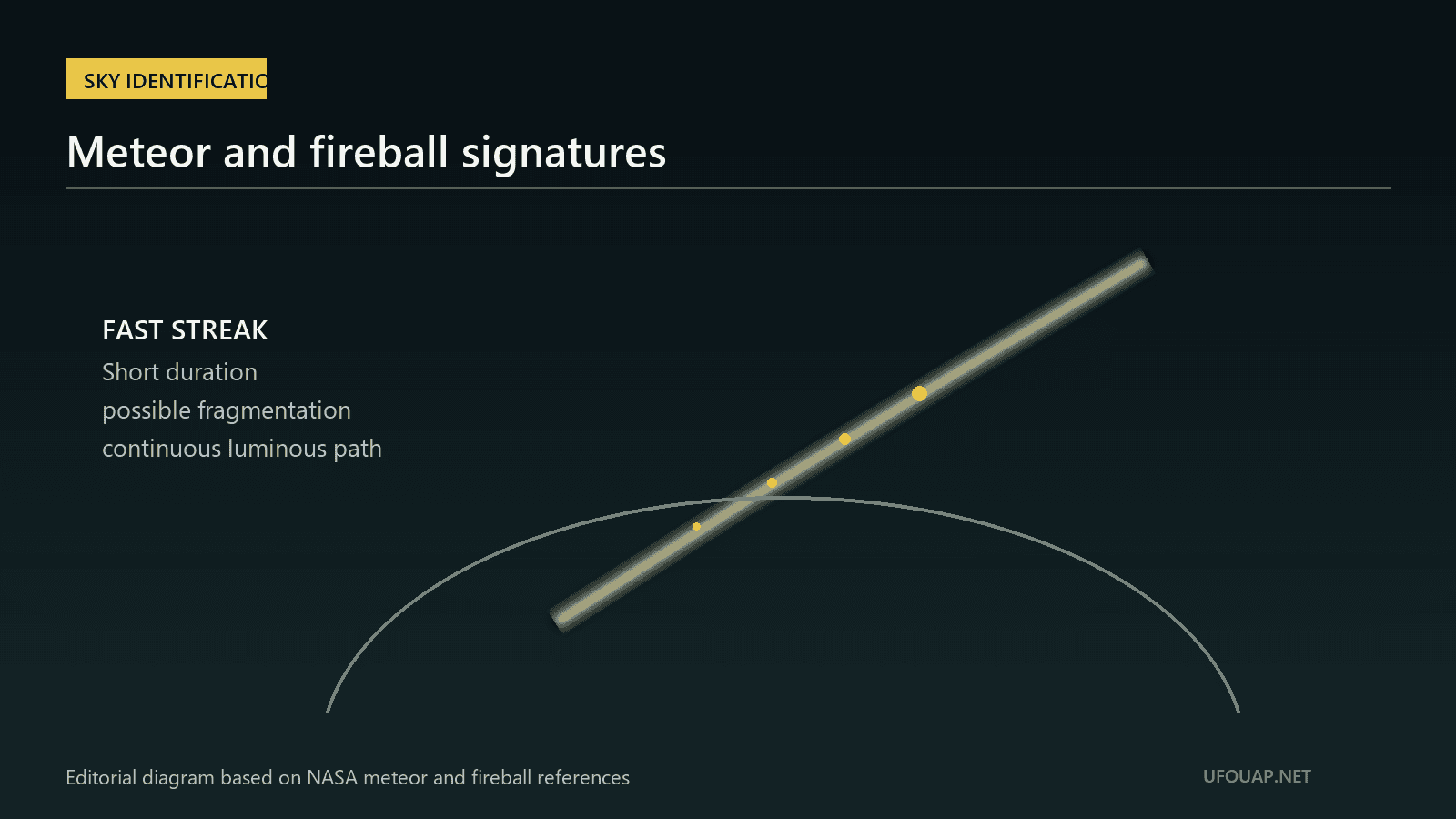
- Short duration, a continuous trajectory and fragmentation favor a meteor explanation over a hovering or maneuvering object.
- Exact time, observing direction and the original unedited file are more useful than color or apparent size alone.
What a fireball usually looks like
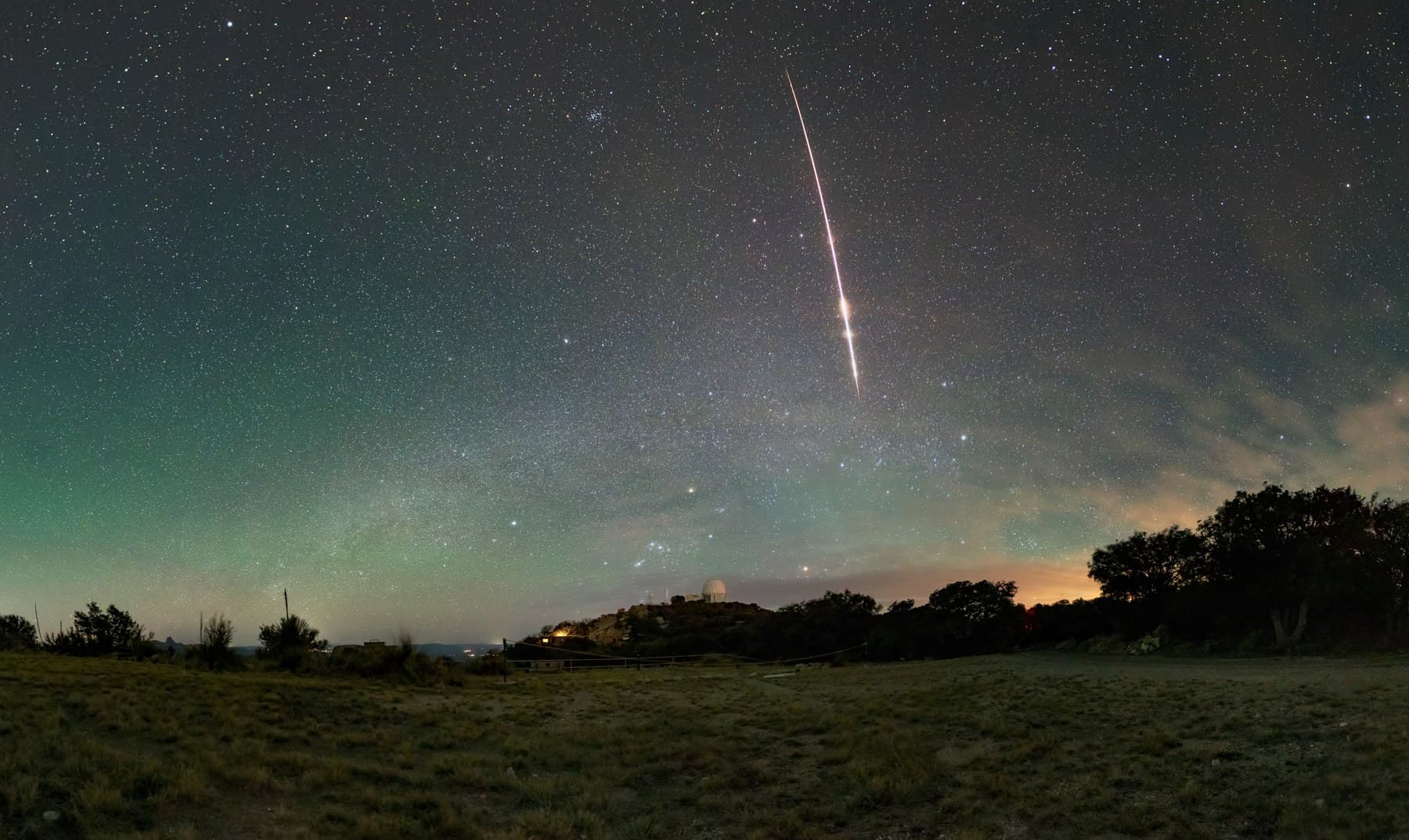
Fireballs commonly appear as fast, bright streaks that move along one continuous path. They may brighten suddenly, change apparent color, leave a persistent luminous trail or separate into smaller points. Perspective can make a path seem nearly vertical or horizontal, and automatic phone exposure can enlarge the glow. A report that describes prolonged hovering, repeated turns or a return along the same path needs a different explanation or better documentation.
Meteor, fireball, bolide and meteorite
NASA distinguishes the object by where it is: a meteoroid remains in space, a meteor is the visible atmospheric path, and a meteorite is material that survives to the ground. NASA's Center for Near Earth Object Studies defines a fireball as an unusually bright meteor, about visual magnitude -3 or brighter at the observer's zenith. A fireball that explodes in the atmosphere is technically a bolide, although public reports often use the terms interchangeably.
How to verify the event
Record the time to the nearest minute, location, viewing direction, elevation angle, duration and whether any sound arrived later. Compare those details with the NASA Fireball Network, the CNEOS fireball table and known meteor-shower dates. Search for reports from neighboring towns because a high-altitude event may be visible across a wide region. A database non-match is not decisive: CNEOS states that its list covers only the brightest events and is not complete.
What photographs and video can establish
An original video can preserve duration, camera movement, exposure changes and the relationship between the trail and fixed landmarks. A compressed social-media copy may remove frames, metadata and audio timing. Saturation can turn a compact bright head into a large white disk, while motion blur can make fragments merge into one streak. Analysts should therefore retain the original file and avoid estimating physical size from a cropped image without distance.
Common mistakes
A meteor is sometimes confused with spacecraft reentry, fireworks, a rocket plume or an aircraft seen through cloud. Reentry often produces several related fragments moving together and may remain visible longer; fireworks usually originate near the horizon and follow repeated local bursts. A single frame cannot reliably separate these possibilities. Duration, direction, multiple viewpoints and an event-time check are the strongest discriminators.
Careful assessment
Meteor and fireball explanations are strong when the motion is rapid, ballistic and continuous and when independent timing data agree. They are weaker when the observation includes verified stopping, acceleration or directional changes that cannot be attributed to camera movement. The correct archive label is the narrowest conclusion supported by the record: identified meteor, probable meteor, or unresolved because the timing and original media are insufficient.
FAQ
Can a fireball appear green, blue or orange?
Yes. Apparent color can be influenced by the object's composition, atmospheric effects, brightness, camera white balance and sensor saturation. Color alone is not a reliable identification test.
Why is a reported fireball missing from the NASA table?
CNEOS says its public table is not a complete list and includes only the brightest events detected by the contributing sensors. A missing entry does not by itself disprove a meteor explanation.
Official sources used
- NASA ScienceMeteors and Meteoritesscience.nasa.gov
- NASA Center for Near Earth Object StudiesFireballs and Bolidescneos.jpl.nasa.gov
- NASANASA Fireball Networkfireballs.ndc.nasa.gov