
United States / 1951 / DISPUTED
1951 Lubbock Lights
The Lubbock Lights case combines two related but not necessarily identical records. Beginning on 25 August 1951, Texas Technological College professors repeatedly reported groups of blue-green lights crossing the night sky. On 31 August, student Carl Hart photographed V-shaped groups of lights. Project Grudge investigators interviewed witnesses and examined the negatives; preliminary laboratory work found no retouching but did not identify the source. One principal observer, William Ducker, later said his research concluded that the professors had seen migratory geese illuminated from below by city lights. That explanation applies most directly to the recurring visual observations and does not automatically resolve Hart's photographs.
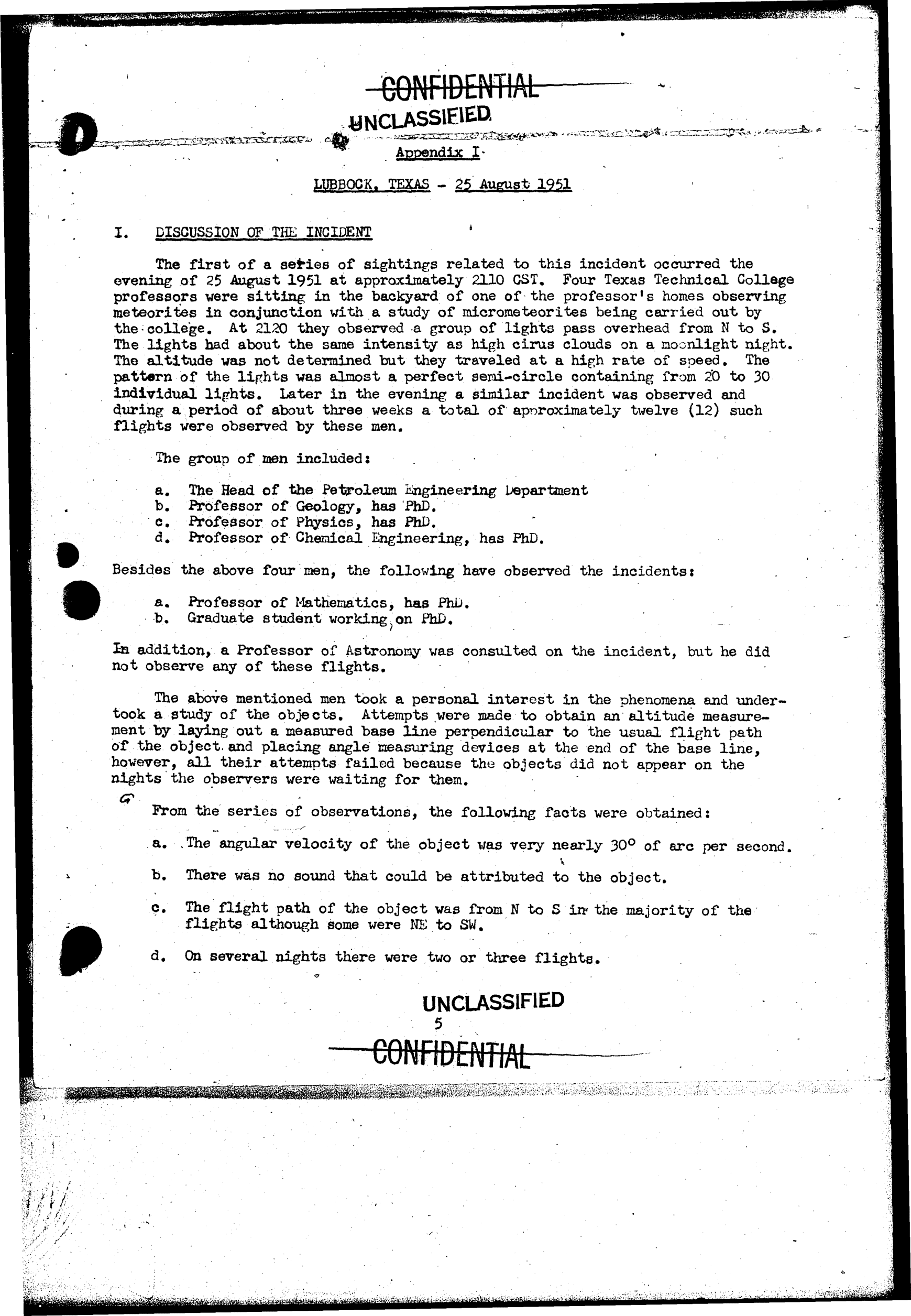
This case is disputed. The archive preserves the claims while separating evidence from interpretation.
- Documentation
- High documentation
- Primary location
- Lubbock, Texas
- Source base
- 7 linked records
- Research use
- Comparison case
What the record supports
- Confirmed record
- Four Texas Tech professors reported recurring lights beginning on 25 August 1951, and the Air Force conducted a documented investigation.[1][3]
- Photographic record
- Carl Hart made five negatives on 31 August. Preliminary review found no retouching but did not identify what produced the light images.[1]
- Evidence separation
- The professors did not report V-shaped formations and doubted that their dim lights could have been photographed, so their observations and Hart's images cannot be assumed identical.[1]
Inside the 1951 investigation
Case dossier
On 25 August 1951, four Texas Technological College professors were outdoors in Lubbock for a meteor and micrometeorite study. The Air Force report says their observing session began at about 21:10 Central Standard Time and that, roughly ten minutes later, a group of lights crossed from north to south. They described twenty to thirty blue-green points in a near-perfect semicircle. A similar group passed again a short time later. The witnesses included specialists in petroleum engineering, geology, physics and chemical engineering; a mathematics professor and a doctoral student later joined the observations.
The professors reported about twelve flights during roughly three weeks. Most moved north to south, although some took a northeast-to-southwest path. The first two groups appeared semicircular; later groups were less orderly. The witnesses estimated about thirty degrees of angular motion per second, no sound, no obvious change in apparent size and disappearance near forty-five degrees elevation. These were visual estimates, not measurements. Attempts to establish a baseline and calculate height failed because the lights did not appear on the nights selected for coordinated observation.
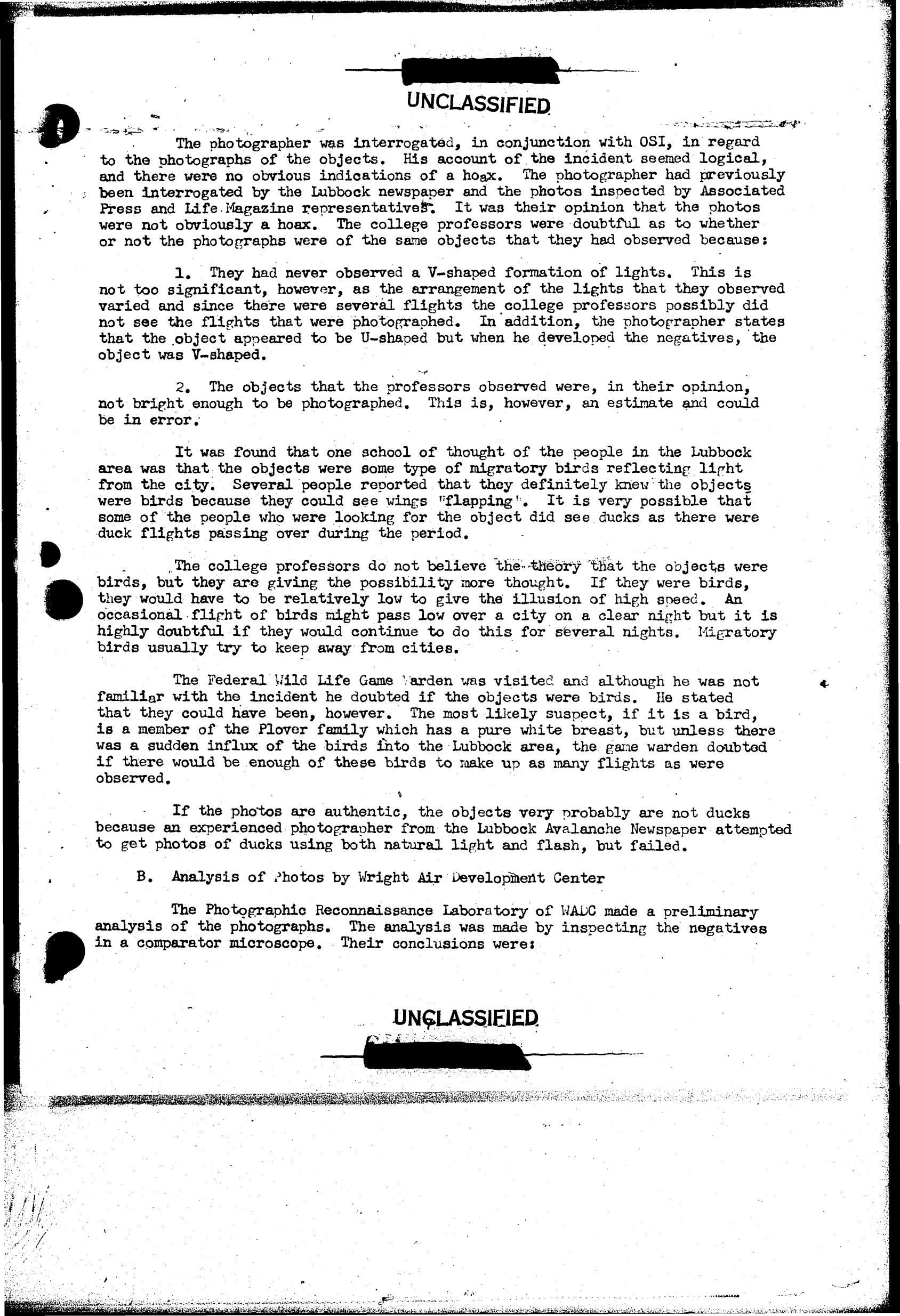
A separate photographic episode occurred on 31 August. The official report says college freshman Carl Hart first saw a group through a window at about 23:30, collected a camera and went outside. He photographed two later groups, producing five negatives: one showed a single V and the others showed double formations. Four negatives reached Air Technical Intelligence Center; one was reported lost or misplaced. The professors said they had never seen a V-shaped formation and thought their lights were too dim to photograph, so the case file itself warns against assuming that Hart captured the same phenomenon.
Air Force investigators visited Lubbock from 6 to 9 November 1951, interviewed witnesses and obtained a signed statement from the professors. Hart was interviewed with the Office of Special Investigations. A preliminary Wright Air Development Center review concluded that light had reached previously unexposed film and found no retouching in the negatives received. It also noted differing intensity and positions among the light images and that stars had not registered. Those observations support that the negatives contained photographic light images; they do not establish distance, scale, physical shape, speed or extraordinary origin.
Birds reflecting city lights were considered while the investigation was still active. Residents reported seeing wing-like movement, ducks and plovers were present in the region, and a newspaper photographer tried unsuccessfully to photograph ducks passing through the lighted area. The professors initially doubted that birds could account for the speed, brightness and silent disappearance they perceived. The 31 December status report therefore discussed the hypothesis without presenting a completed final identification.
The later record gives the bird explanation more weight. In a 27 July 1980 Texas Tech oral-history interview, professor William Ducker said his research had concluded “without question” that the lights seen by the professors were migratory geese illuminated from below by streetlights. He said the finding had been given anonymously to Edward J. Ruppelt, who wrote in 1956 that a natural explanation had been established while withholding the source's identity. Ducker's statement is important first-person evidence, but it is a later recollection and is best applied to the professors' recurring lights, not automatically to every report or to Hart's photographs.
The Lubbock Lights belong in the archive because they show how a famous case can combine strong historical documentation with uneven evidence. The professors' participation, the Air Force investigation and Hart's negatives are documented. The available record does not establish exotic performance, a structured craft or an extraterrestrial origin. The most careful assessment is that a conventional bird explanation is persuasive for the professors' recurring observations, while the identity and relationship of Hart's photographed lights remain insufficiently resolved.
Related video
Timeline
- Four Texas Tech professors report the first blue-green formation crossing north to south.
- The professor group reports about twelve similar passages over roughly three weeks; planned triangulation attempts produce no measurement.
- Carl Hart sees lights from a window and later photographs two groups, producing five negatives.
- Air Force investigators interview witnesses in Lubbock, obtain the professors' statement and examine Hart's account.
- Project Grudge Status Report No. 2 publishes an interim case record, photo-laboratory findings and the unresolved bird discussion.
- Edward J. Ruppelt writes that a natural explanation was established but withholds the source's identity.
- William Ducker tells the Texas Tech oral-history project that the professors' lights were migratory geese illuminated by streetlights.
- KLBK publishes a seventieth-anniversary local-news retrospective; it is not original event footage.
Lubbock Lights questions
What were the Lubbock Lights?
They were recurring groups of lights reported over Lubbock, Texas, beginning in August 1951. The record includes professor observations, Carl Hart's photographs and an Air Force investigation.
Who witnessed the Lubbock Lights?
The best documented group began with four Texas Tech professors and later included another professor and a doctoral student. The Air Force report also said at least one hundred residents had reported related phenomena.
Are the Carl Hart photographs authentic?
Preliminary Air Force laboratory review found no retouching in the negatives received. That supports photographic exposure, but it does not identify the lights, prove a craft or establish that the photos show the professors' phenomenon.
Were the Lubbock Lights birds?
William Ducker later concluded that the professors' recurring lights were migratory geese illuminated by city lights. This is the leading explanation for that observation series, but it does not automatically identify Hart's photographs.
Is there original video of the 1951 event?
No verified original motion footage is public. The embedded KLBK video is a 2021 local-news retrospective using later interviews and archival material, not a recording of the lights in 1951.
Why does the Lubbock Lights case remain disputed?
The bird explanation is persuasive for the professors' observations, but the public record does not fully reconstruct every sighting or identify Hart's photographed lights. The case is historically documented without demonstrating an extraordinary origin.
Sources
- [1] Official fileProject Grudge Status Report No. 2: Lubbock appendixAir Technical Intelligence Center / U.S. Air Force
- [2] ArchiveWilliam Ducker oral history interviewTexas Tech University Southwest Collection
- [3] ArchiveLubbock Lights papers manuscript guideTexas Tech University Southwest Collection
- [4] ResearchEdward J. Ruppelt: The Lubbock LightsThe Report on Unidentified Flying Objects / Wikisource
- [5] Official fileNational Archives guide to Project Blue Book recordsU.S. National Archives and Records Administration
- [6] News reportLubbock Lights local archive retrospectiveLubbock Lights / James Clark
- [7] News reportLubbock Lights: 70 Years LaterEverything Lubbock / KLBK
The main and supplementary images are local renderings of pages from the 31 December 1951 Project Grudge report. They are public-domain U.S. federal archive documents, not photographs of the lights. The old Hart-photo collage is no longer displayed because the underlying private photographs do not have a sufficiently clear commercial republication chain. The KLBK video is a 2021 retrospective, not original event footage.