
Evidence / Updated 2026-07-16 / 6 min read
Military pilot UAP reports: why pilot testimony matters and where it can fail
Pilot reports carry weight because pilots know aviation context, but they still need sensor data, timing, and reconstruction.
Key points
- Pilots are trained observers, but not immune to perception limits.
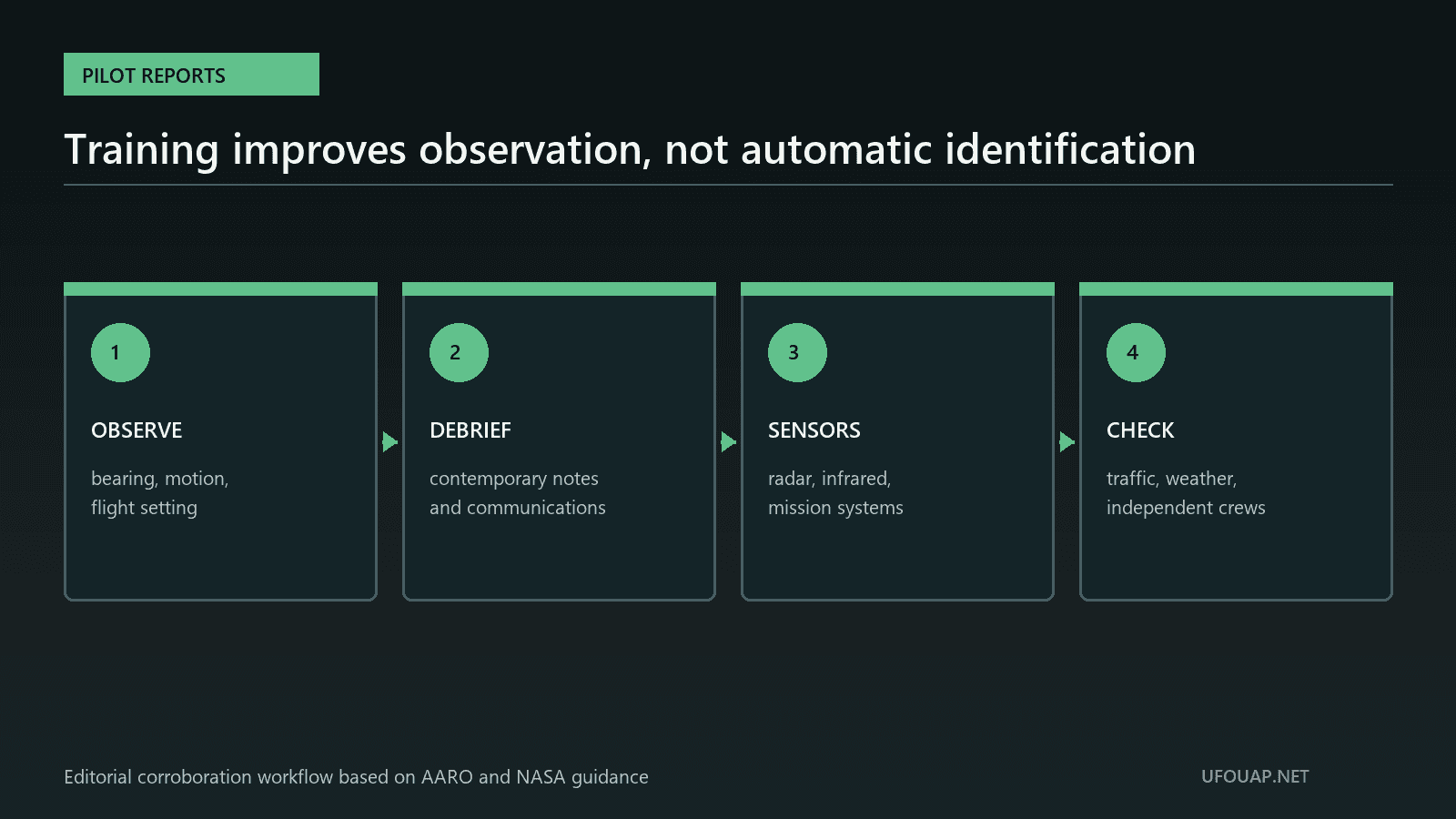
- The strongest pilot cases include radar, infrared, audio, or multiple independent witnesses.
Why pilot reports stand out
A pilot report starts from a stronger baseline than a casual ground sighting because the observer knows aircraft behavior, airspace, and flight conditions. But even pilots estimate size, speed, and distance under uncertainty. The best archive treatment keeps respect for the witness while asking what instruments recorded, what the flight path allows, and what ordinary aviation explanations were tested.
FAQ
Are pilot UAP reports always reliable?
They are important but not automatically conclusive. Corroborating data matters.
Sources
- AAROAARO Submit a Reportwww.aaro.mil
- NASA ScienceUAP FAQsscience.nasa.gov