
Iran / 1976 / DISPUTED
1976 Tehran UFO incident
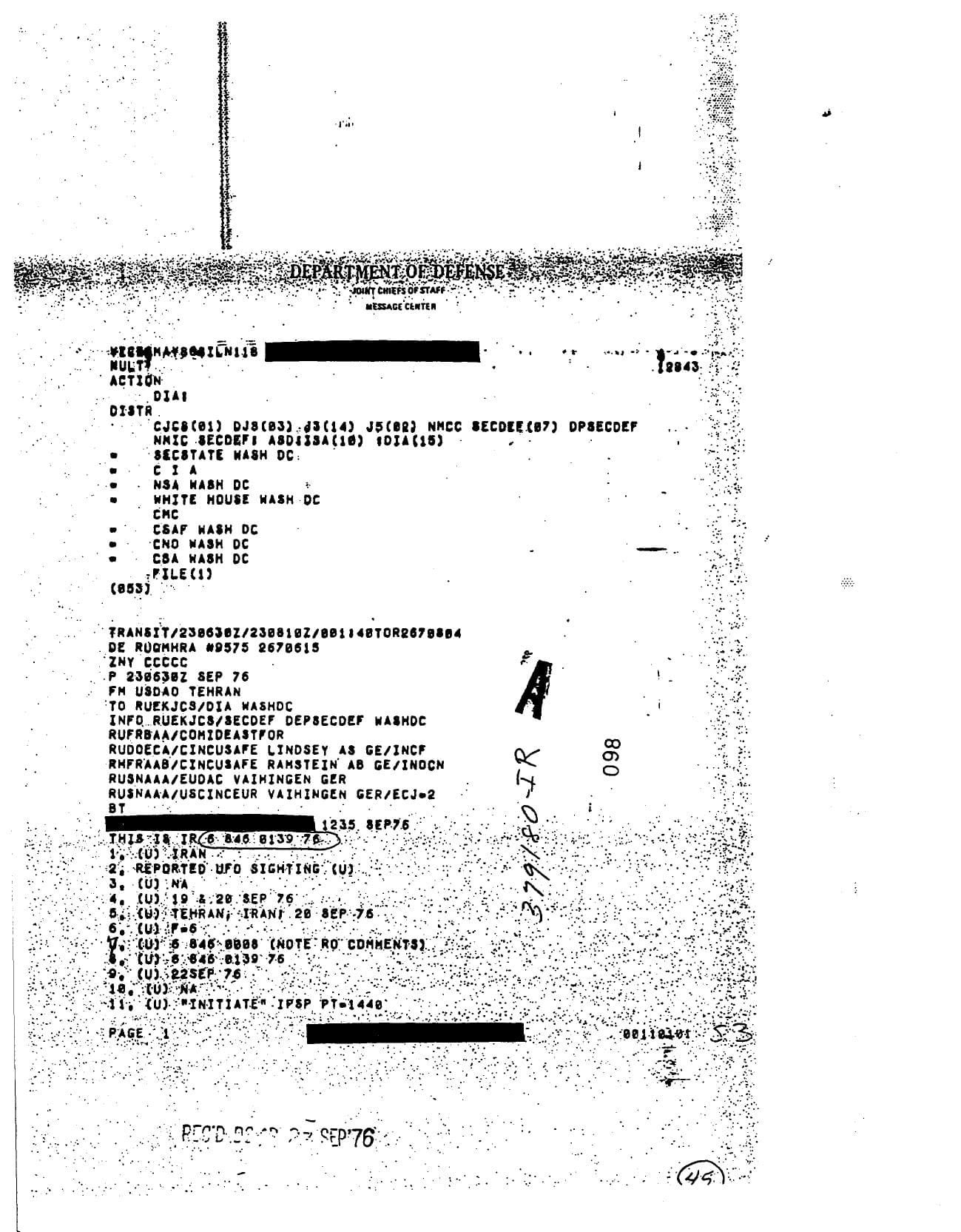
During the early hours of 19 September 1976, Iranian Air Force command personnel sent two F-4 Phantom II aircraft toward a bright object reported over northern Tehran. A U.S. Joint Chiefs report records that the first crew turned back after reported instrument and communications failures, while the second crew reported a radar return, changing colored lights and smaller objects separating from the main light. The same report also preserves claims of temporary weapons-control failure and a later ground search. It does not include raw radar plots, maintenance logs, cockpit or tower recordings, radiation results, authenticated photographs or film. The public file therefore establishes a traceable military report, not independent verification of every reported detail or an extraordinary origin.
This case is disputed. The archive preserves the claims while separating evidence from interpretation.
- Documentation
- High documentation
- Primary location
- Tehran and the Shemiran area
- Source base
- 6 linked records
- Research use
- Comparison case
What the public record supports
- Documented core
- A declassified U.S. military report records two Iranian F-4 sorties on 19 September 1976.[1][2][4]
- Sensor boundary
- The report describes radar acquisition and systems failures, but no raw radar, maintenance or weapons logs are public.[1][2][3]
- Source chain
- The cable relays information through a source and an Iranian-pilot sub-source; it is not a verbatim mission transcript.[1][2]
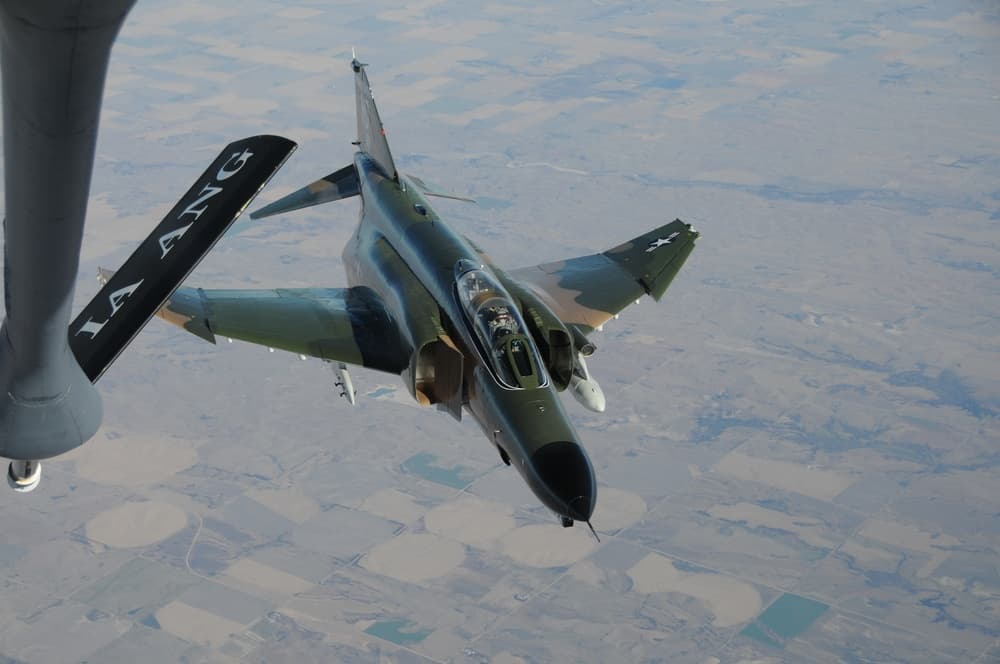
F-4 Phantom II aircraft context
Case dossier
What prompted the alert: The Joint Chiefs report says the Imperial Iranian Air Force command post received four telephone calls from citizens in the Shemiran area at about 00:30. Callers described an unusual object in the sky. A command-post officer looked outside and reported a star-like light that appeared larger and brighter than a star, after which the duty commander authorized an intercept. The document does not publish the callers' names, signed statements, exact viewing positions or telephone records.
The first F-4 sortie: The report says the first F-4 launched from Shahrokhi Air Force Base at about 01:30. As it approached within a reported 25 nautical miles of the light, the crew said its instruments and UHF communications failed. The pilot turned away, and the report says the systems returned to normal once the aircraft moved away. No maintenance worksheet, cockpit recording, electrical trace or post-flight engineering analysis accompanies this account, so the public record preserves a crew report rather than a diagnosed failure.
The second sortie and radar claim: A second F-4 reportedly launched at about 01:40. The back-seat officer was said to acquire a radar return at 27 nautical miles, at twelve o'clock high, with a return comparable in size to a Boeing 707 tanker. The report immediately notes that visual size could not be determined because of the object's brilliance. No raw scope photograph, radar plot, frequency, calibration record or operator log is included. Radar is therefore part of the reported military narrative, but the surviving file does not permit an independent reconstruction of the track.
Lights, smaller objects and weapons-control claims: The second crew described a main object flashing blue, green, red and orange lights. The report says a smaller bright object then moved toward the F-4. When the pilot attempted to select and launch an AIM-9 missile, the weapons-control panel and communications reportedly failed; he turned away and the systems returned. A second small object was later described as descending toward the ground and illuminating an area two to three kilometers across. These are striking claims, but the public file provides no weapons-system log, missile-selection record, infrared data or independent sensor record.
Other observations and the ground search: The report says a civil airliner in the area also experienced communications problems but did not see the object. It adds that the airport tower saw a bright cylindrical object only after the pilot asked controllers to look. At daylight, a helicopter search reportedly found no mark at the dry-lake location where a light was thought to descend. A beeping signal led searchers to a nearby house, whose occupants recalled a loud noise and bright light. Radiation checks were said to be underway, but no result appears in the public file reviewed here.
What the declassified document is: The principal source is a U.S. military intelligence report titled Joint Chiefs of Staff report concerning the sighting of a UFO in Iran on 19 September 1976. The text says its information came through a source who had spoken with a sub-source identified as an Iranian Air Force pilot. That chain makes the document a contemporaneous intelligence report, but not a verbatim cockpit transcript. The cable does not name the pilots. Names and expanded personal narratives entered the public story through later interviews and publications.
What the routing slip adds: A separately released NSA routing and evaluation sheet shows that the report circulated among U.S. offices and was judged noteworthy against intelligence-reporting criteria. That is useful provenance: it establishes that officials received and evaluated the document. Distribution and an enthusiastic evaluation do not independently validate the radar, equipment or object descriptions, because the slip does not add raw technical evidence or a second investigation.
Evidence strengths and limits: The case is stronger than an anonymous anecdote because a traceable military report gives a date, place, sequence, aircraft type and multiple reported participants. It is weaker than a fully documented aviation event because almost every technical claim survives through narrative text rather than underlying data. The absence of raw radar, maintenance, communications and search results prevents tests of synchronization, independent corroboration and alternative failure mechanisms.
Possible explanations: Skeptical reviews have proposed a combination of bright celestial objects, possible meteors, electrical or avionics problems, maintenance conditions and the difficulty of night interception. These proposals address portions of the story but do not form a public, data-driven reconstruction of both sorties. Conversely, the document's unresolved status does not establish an exotic craft. Without the missing records, competing explanations cannot be ranked with high confidence.
Careful archive assessment: The Tehran incident belongs in the archive because it combines an identifiable military report, two reported intercepts, sensor and systems claims, and a surviving declassification trail. The appropriate rating is B / disputed: historically significant and document-rich compared with many UFO reports, yet technically incomplete. The strongest defensible conclusion is that Iranian military personnel reported an unusual night interception; the public evidence does not determine what produced all of the observations and failures.
Timeline
- The Tehran command post reportedly receives four citizen calls from Shemiran and a duty officer observes a bright star-like light.
- The first F-4 launches from Shahrokhi. Its crew later reports instrument and UHF failures near the light and recovery after turning away.
- A second F-4 launches. The back-seat officer reportedly obtains a radar return at 27 nautical miles.
- The crew describes alternating colored lights and a smaller object approaching. Weapons control and communications reportedly fail during an attempted AIM-9 selection.
- Another light is reported descending and illuminating the ground. A civil airliner and the airport tower are also mentioned in the military narrative.
- A helicopter search reportedly finds no mark at the dry-lake site. A signal leads to a nearby house; radiation tests are mentioned without a published result.
- The incident is summarized in a U.S. military intelligence report that later enters declassified collections.
- An NSA routing sheet records circulation and a favorable reporting-quality evaluation, but adds no raw technical evidence.
- A Skeptical Inquirer review summarizes Philip J. Klass's conventional explanation involving celestial objects, possible meteors and equipment or maintenance problems.
- The archive separates what the declassified files report from later witness identification, missing records and unverified event media.
Frequently asked questions
What happened in the 1976 Tehran UFO incident?
Iranian command personnel sent two F-4s toward a bright object after citizen calls. Crews reported radar, colored lights and temporary systems failures, but the raw technical records are not public.
Was the Tehran object tracked on radar?
The report says the second F-4 acquired a return at 27 nautical miles. No raw plot, scope image, calibration record or operator log has been published, so this remains a reported radar claim rather than a reproducible track.
Did the F-4 weapons and communications really fail?
The declassified report records crew claims of failures and recovery after turning away. Without maintenance, electrical, radio and weapons logs, the failures and their cause cannot be independently verified.
Who were the Iranian pilots?
The contemporary U.S. cable does not name them. Parviz Jafari and other names appear in later interviews and publications, so those identifications should be treated as retrospective rather than as names printed in the original report.
Are there authentic photos or videos of the Tehran incident?
No authenticated contemporaneous event photograph or original video was located. The main image is a scan of the declassified report; the F-4 image is a 2008 U.S. aircraft-type photograph, not an Iranian event aircraft.
What is the best explanation for the Tehran incident?
No single explanation is demonstrated by the public data. Celestial objects, possible meteors and ordinary equipment or maintenance problems may explain parts of the account, but missing technical records prevent a complete reconstruction.
Did U.S. agencies confirm an extraterrestrial craft?
No. The files show that agencies received, routed and evaluated a report. Circulation and a favorable assessment of report quality are not an identification of the object or validation of an extraterrestrial origin.
Sources
- [1] Official fileJoint Chiefs report on the 19 September 1976 Iran sightingNational Security Agency
- [2] ArchiveBlack Vault archive copy of the 1976 Iran incident fileThe Black Vault
- [3] ArchiveNSA routing and evaluation slip for the Iran UFO reportNational Security Agency / The Black Vault copy
- [4] Reference databaseNICAP transcription of the declassified Iran reportNICAP
- [5] ResearchSkeptical Inquirer review summarizing a conventional Tehran explanationSkeptical Inquirer
- [6] Reference databaseF-4 Phantom II aircraft-type context photographDefense Visual Information Distribution Service
The main image is a scan of the declassified Joint Chiefs report, not a photograph of the object or intercept. The supplementary F-4 image is a public-domain U.S. aircraft photograph made in 2008 and shows only the aircraft type. No authenticated photograph or original video of the 1976 event was located.