
Evidence / Updated 2026-09-27 / 3 min read
Parallax in UAP videos: why objects can seem extremely fast
A moving camera can make a distant, slow object appear to race across nearby terrain. Speed cannot be recovered from image motion without geometry and range.
Reviewed and maintained byGlobal UFO Archive Editorial DeskEditorial policy
Quick answer
Parallax is the apparent shift of an object against a background when the observer moves. In airborne video, nearby terrain sweeps across the frame much faster than a distant target, making the target seem to race over the ground. Image motion alone does not give true speed. Analysts need camera position and velocity, viewing angles, field of view, target range and wind before estimating performance.
Key points
- Apparent speed in the image combines target motion, observer motion and distance.
- A low viewing angle over nearby terrain can create a strong sensation of rapid travel.
- Range uncertainty can produce very different speed estimates from the same pixels.
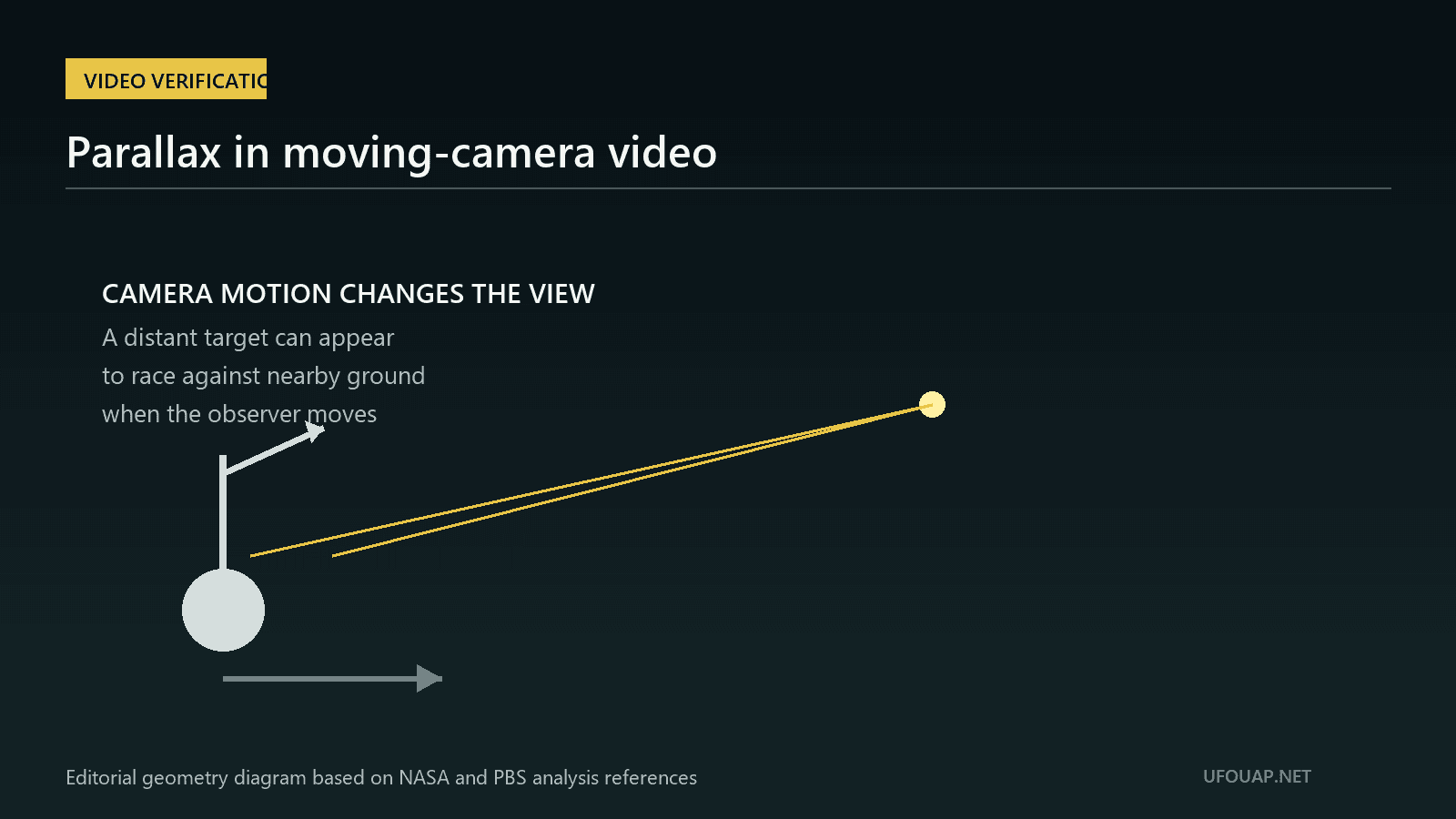
How parallax changes the scene
Hold a finger in front of your face and move your head: the finger shifts against the distant room. The same geometry applies when an aircraft-mounted camera moves past terrain. Nearby ground features change bearing quickly, while a distant object changes more slowly. When the camera tracks the object and keeps it near the center, the background streams behind it and can be mistaken for target speed.
What data a speed estimate needs
A defensible calculation requires timestamps, sensor field of view and zoom, camera orientation, platform location and velocity, target line of sight and a range estimate. Wind matters for balloons and other drifting objects. Without range, angular motion can describe several combinations of size and speed. A single displayed number should therefore include assumptions and uncertainty, not be presented as direct measurement.
How to test a video
Use fixed landmarks to reconstruct camera motion and check whether the sensor is panning or locked to a target. Compare frames before and after the highlighted segment, preserve the full display symbology and seek platform telemetry. Try more than one plausible range instead of choosing the value that produces the most dramatic result. Independent radar or another viewpoint can reduce the geometric ambiguity.
Careful assessment
Parallax is strong when the observer is moving, the background is relatively near and the target range is poorly constrained. It does not prove the target is stationary or ordinary; it shows that apparent image speed is not enough to establish exceptional performance. If telemetry, range and independent sensors support acceleration after camera motion is modeled, that residual evidence should be evaluated separately.
Related checks and records
- GoFast: the Navy video and official analyses
- Read infrared and FLIR footage carefully
- Bonilla 1883: solar observations and an unmeasured comet hypothesis
- Gemini IV: astronaut testimony and disputed photographs
- Skylab 3: red light, frame records and conditional size estimates
- STS-48: testing ice, thrusters and video motion
FAQ
Can parallax make a balloon look fast?
Yes. A slowly drifting object can appear fast against nearby ground when filmed from a moving aircraft, especially if the camera keeps it centered.
Can speed be calculated from a video alone?
Only when the video contains reliable scale, timing, camera motion and range information. Pixel motion without geometry is insufficient.
Official sources used
- NASAUAP Independent Study Team Final Reportscience.nasa.gov
- PBS NewsHour3 ways scientists use math to help debunk UFO videoswww.pbs.org
- AAROOfficial UAP Imagerywww.aaro.mil