
United States / 2015 / EXPLAINED
2015 GoFast UAP Video
In January 2015, a U.S. Navy F/A-18F recorded a small round object with a forward-looking infrared sensor over the Atlantic east of Florida. The authentic 34-second GoFast clip appears to show a target racing just above the ocean. NASA calculated in 2023 that it was about 13,000 feet high and moving near 40 mph; AARO's broader 2025 model produced a wind-compensated range of 5-92 mph and found with high confidence that no anomalous performance occurred. Motion parallax explains much of the apparent speed. The public video does not identify the object, and AARO lacked the original file, aircraft position and heading, and aircrew accounts. GoFast is therefore best described as a resolved performance claim attached to an unidentified object, not proof of extraordinary technology.
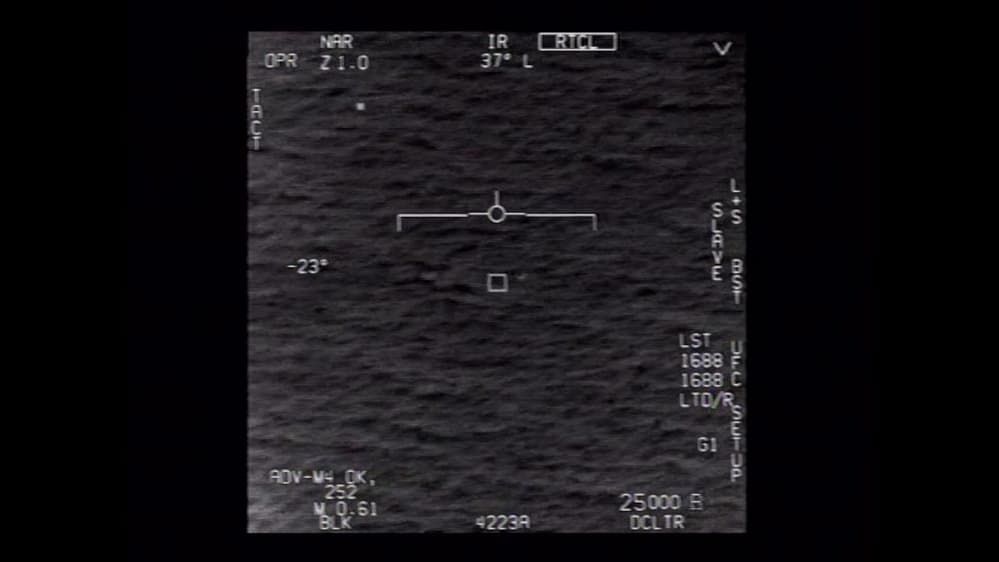
This archive treats the case as explained or substantially resolved by conventional evidence.
- Documentation
- High documentation
- Primary location
- Atlantic Ocean east of Florida
- Source base
- 8 linked records
- Research use
- Comparison case
What the public record supports
- Confirmed record
- An F/A-18F recorded an authentic 34-second Navy FLIR sequence east of Florida in January 2015.[1][3][4][5]
- Date precision
- Primary official sources specify January 2015 but do not verify an exact day; DVIDS' 2016 catalog date conflicts with them.[1][3][4]
- Measured geometry
- NASA and AARO place the target near 13,000 feet, not immediately above the ocean surface.[1][2][6]
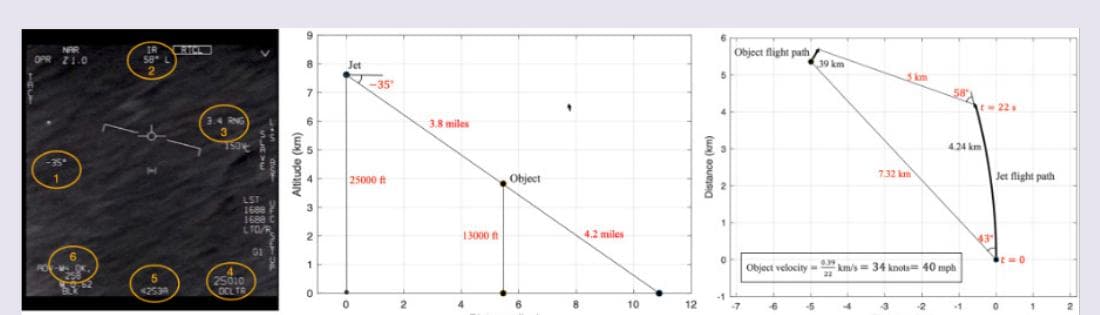
NASA's GoFast geometry analysis
Case dossier
Case scope: In January 2015, a U.S. Navy F/A-18F recorded a small round object with a forward-looking infrared sensor over the Atlantic east of Florida. The authentic 34-second GoFast clip appears to show a target racing just above the ocean. NASA calculated in 2023 that it was about 13,000 feet high and moving near 40 mph; AARO's broader 2025 model produced a wind-compensated range of 5-92 mph and found with high confidence that no anomalous performance occurred. Motion parallax explains much of the apparent speed. The public video does not identify the object, and AARO lacked the original file, aircraft position and heading, and aircrew accounts. GoFast is therefore best described as a resolved performance claim attached to an unidentified object, not proof of extraordinary technology.
Chronology: GoFast is a genuine U.S. Navy sensor recording, but authenticity and extraordinary performance are separate questions. A forward-looking infrared sensor aboard an F/A-18F tracked a small object for 34 seconds over the Atlantic east of Florida in January 2015. The dark ocean moves rapidly behind the locked target, creating the visual impression that the object is skimming the surface at exceptional speed. Official analyses instead place it thousands of feet above the water and find no need for anomalous propulsion or acceleration.
Evidence record: Provenance is strong. DoD formally confirmed the clip as a Navy video, NAVAIR distributes it through a FOIA library and DVIDS identifies Naval Air Systems Command as the provider. This establishes that the sensor sequence is authentic government imagery. It does not establish the target's altitude, speed, identity or origin without geometric analysis.
The performance evidence is measurable but model-dependent. NASA and AARO independently used the display geometry to place the object near 13,000 feet and to show that motion parallax greatly inflates its apparent speed. NASA's approximate 40 mph result and AARO's wind-compensated 5-92 mph range are not identical because their methods and wind treatment differ, but both reject the need for extraordinary velocity. AARO modeled all headings because aircraft heading was missing and found no against-wind solution.
Identity evidence remains weak. The target occupies too few pixels for a reliable shape or size classification; AARO's one-metre-or-less estimate is an analytic bound, not a direct measurement. The original file and metadata, georeferenced aircraft track, exact heading and aircrew accounts are not publicly available. A wind-borne small object, bird or small drone remains compatible with parts of the record, but the released evidence does not select one category conclusively.
Official record: DoD's 2020 statement had a narrow purpose: it confirmed the Navy provenance of three already-circulating videos and authorized their release. Saying the phenomena were still characterized as unidentified in 2020 did not certify extraordinary craft; it described the identification status at the time of release. NAVAIR's FOIA copy and DVIDS record preserve the same 34-second visual evidence, not a larger public sensor package.
NASA and AARO answer different but complementary questions. NASA used GoFast to demonstrate how platform motion and missing metadata can mislead interpretation. AARO later bounded altitude, speed and heading more extensively and resolved the anomalous-performance claim with high confidence. Neither agency definitively identified the object. The careful official conclusion is therefore: authentic Navy video, ordinary performance within the modeled conditions, unresolved object type.
Possible explanations: Motion parallax is the leading explanation because a fast moving jet and turning sensor make a slower, more distant target appear to sweep over the ocean. The range and elevation values place the target well above the surface, while winds at that altitude can account for much of its motion. This explanation addresses the dramatic speed impression without claiming that every pixel or the exact object identity is solved.
A conventional explanation should not be overstated either. AARO's model depends on values read from a compressed display and explores possible headings because crucial position data are absent. Bird, balloon-like object or small drone are comparison classes rather than identifications. The defensible archive judgment is narrower: GoFast does not demonstrate anomalous speed, acceleration or propulsion, and the released evidence is insufficient to name the target.
Archive assessment: The public official record gives only January 2015, not a verified day. AARO identifies the observing platform as a Navy F/A-18F and the location as off Florida's eastern coast. NASA's independent-study report associates the video with aviators from USS Theodore Roosevelt. No named aircrew account or complete mission log accompanies the public clip, so details about who recorded it, the exact sortie and what the crew saw outside the sensor display should not be filled from later retellings.
The display contains unusually useful measurement clues: sensor elevation and azimuth, range to the tracked target, aircraft altitude, indicated speed, bank angle and elapsed time. It also shows the object as a few bright pixels against a colder-looking ocean background in the chosen infrared polarity. Those values can constrain geometry, but they do not provide a high-resolution outline, material composition or a direct measure of object size. The apparent round or oblate shape is therefore descriptive, not an identification.
The provenance has several distinct stages. The clip circulated publicly after an unauthorized release in 2017. On 27 April 2020, the Department of Defense formally authorized publication of this and two other Navy videos, stating that release did not reveal sensitive capabilities and that the observed phenomena remained characterized as unidentified at that time. NAVAIR now lists the downloadable GOFAST file in its FOIA document library, while DVIDS hosts a public-domain 34-second copy credited to Naval Air Systems Command.
DVIDS metadata must not be mistaken for the event date. Its current catalog says 'Date Taken: 11.01.2016' and 'Date Posted: 03.26.2025,' while DoD, NASA and AARO consistently place the recording in January 2015. NAVAIR's FOIA listing does not supply a second event date. Because DVIDS was cataloging a later public copy rather than publishing a contemporaneous mission record, this archive treats 2016 as conflicting catalog metadata and uses January 2015 as the supported event date.
NASA's 2023 independent-study report used the visible range, elevation angle and aircraft altitude to estimate that the object was about 13,000 feet above sea level and 4.2 miles from the ocean behind it. Over a 22-second interval, NASA estimated roughly 390 metres of movement, or about 40 mph, while the jet's groundspeed was about 435 mph. It attributed much of the visual impression to sensor-platform motion and parallax, and noted that the bright infrared signature indicated an object colder than the ocean, with no visible propulsion heat. NASA also stated that its calculation neglected wind effects on the aircraft, leaving uncertainty and no firm object identification.
AARO's February 2025 resolution expanded the speed calculation across every possible aircraft heading because the public file does not contain the aircraft's heading or georeferenced position. It analyzed a stable 13-second segment, historical winds near 69 mph at 13,000 feet and the display geometry. After removing the wind contribution, modeled intrinsic speeds ranged from about 5 to 92 mph; no scenario placed the object moving against the wind, and AARO judged with high confidence that it showed no anomalous performance. An intelligence-community pixel estimate suggested one metre or less, comparable in scale to a small drone or bird, but the low resolution prevented a definitive identity.
The remaining uncertainty concerns identity and missing context, not a demonstrated physics violation. AARO analyzed a compressed public WMV because the original file and metadata were no longer available, could not recover aircrew accounts and did not know the aircraft's exact position or compass heading. Ryan Graves' 2023 written congressional testimony says GoFast had been attached to a 2015 classified email about flight safety; that statement records operational concern but is testimony, not a released email or proof about the target's performance. GoFast belongs in the archive because it shows how an authentic military image can remain unidentified while its most dramatic interpretation becomes testable and substantially weaker.
Related video
Timeline
- A Navy F/A-18F records the 34-second infrared sequence off Florida's eastern coast; public official sources identify only the month.
- The clip begins circulating publicly after an unauthorized release.
- DoD formally authorizes publication of GoFast, Gimbal and FLIR1 and confirms their Navy provenance.
- Ryan Graves' written congressional testimony describes GoFast as attached to a 2015 safety-of-flight email; the email itself is not public.
- NASA's UAP independent-study report publishes a parallax calculation of roughly 13,000 feet and 40 mph.
- AARO presents its GoFast characteristics-and-performance assessment to the Senate Armed Services Committee.
- AARO publishes its case resolution and methodology, finding no anomalous performance with high confidence.
- DVIDS posts a public-domain NAVAIR copy; its 2016 Date Taken field conflicts with the 2015 official event record.
Frequently asked questions
Is the GoFast UAP video authentic?
Yes. DoD confirmed its Navy provenance, NAVAIR distributes it through FOIA and DVIDS hosts an official public-domain copy. Authenticity does not by itself establish extraordinary performance.
When and where was GoFast recorded?
Official sources place it in January 2015 over the Atlantic east of Florida. They do not publicly verify an exact day. NASA associates the aviators with USS Theodore Roosevelt.
Was the object flying just above the ocean?
The video creates that impression, but NASA and AARO used the displayed range, elevation and aircraft altitude to place it near 13,000 feet above sea level.
How fast was the GoFast object moving?
NASA estimated about 40 mph in an approximate calculation. AARO's broader heading-and-wind model produced an intrinsic range of about 5-92 mph. Both analyses found no need for extraordinary speed.
What is motion parallax in the GoFast video?
A fast moving and turning observer makes a slower target appear to sweep rapidly across a distant background. In GoFast, the jet and sensor motion make the ocean move behind the locked object, amplifying apparent speed.
Did AARO identify the GoFast object?
No. AARO concluded with high confidence that the performance was not anomalous, but the low-resolution video and missing original data prevented a definitive object identification.
Does GoFast prove advanced or extraterrestrial technology?
No. The released evidence authenticates a Navy recording but does not show anomalous speed, acceleration, heat or propulsion. The object type remains unidentified, which is not evidence of extraterrestrial origin.
Sources
- [1] Official fileAARO GoFast case resolution and methodologyAll-domain Anomaly Resolution Office
- [2] Official fileNASA UAP Independent Study Team Final ReportNational Aeronautics and Space Administration
- [3] Official fileGOFAST - UAP: official Navy videoNaval Air Systems Command / DVIDS
- [4] Official fileNAVAIR FOIA document library: GOFASTNaval Air Systems Command
- [5] Official fileDoD statement on the release of historical Navy videosU.S. Department of Defense
- [6] Official fileAARO Mission Brief 2025: GoFast characteristics and performanceAll-domain Anomaly Resolution Office
- [7] Official fileAARO case slides for the 19 November 2024 Senate hearingU.S. Senate Committee on Armed Services
- [8] Official fileRyan Graves written testimony to the House Oversight CommitteeU.S. House Committee on Oversight and Accountability
The main image is an unaltered frame from the official public-domain NAVAIR/DVIDS video. It records the sensor display but does not independently establish range, speed or identity. The supplementary image is a cropped figure from NASA's 2023 public report that visualizes its geometry and parallax calculation; it is later analysis, not a second event image.