
United States / 2015 / UNRESOLVED
2015 Gimbal UAP Video
In January 2015, a U.S. Navy F/A-18 sensor recorded the 34-second infrared sequence known as Gimbal during East Coast training. The official clip is authentic and shows a warm, indistinct target that appears to rotate while crew audio refers to a group of objects. The public file does not include the claimed radar display, original metadata, exact range, full mission record or complete video. Independent reconstructions reach different results depending mainly on assumed distance: a nearby path can appear highly unusual, while a more distant conventional aircraft and infrared glare can fit the short clip. No public official resolution identifies the object or verifies extraordinary performance, so the case remains unresolved rather than evidence of exotic technology.
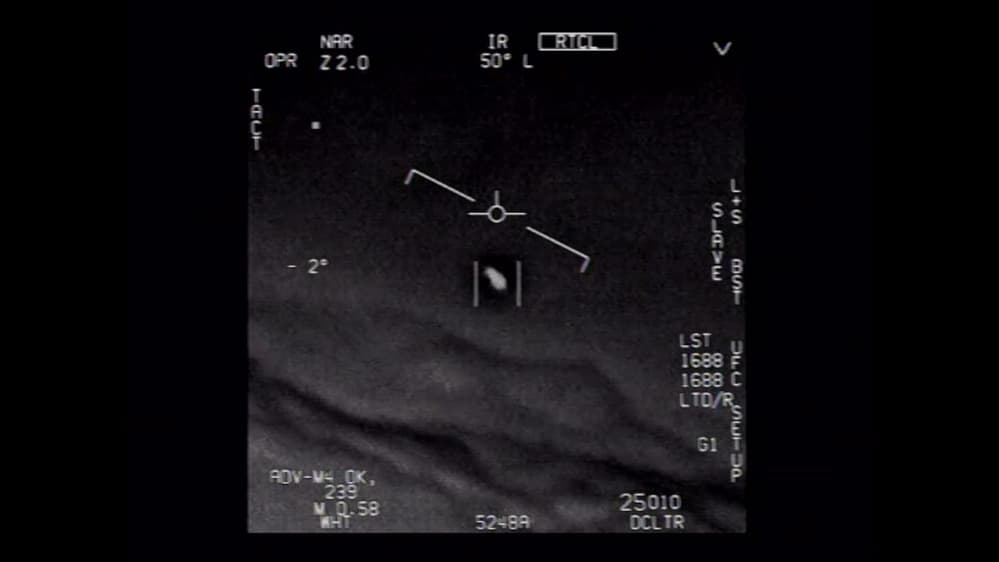
This case remains unresolved in the public record, with credibility grade A.
- Documentation
- High documentation
- Primary location
- U.S. East Coast Atlantic training area
- Source base
- 7 linked records
- Research use
- Comparison case
What the public record supports
- Confirmed record
- The 34-second Gimbal file is authentic Navy sensor imagery recorded in January 2015.[1][2][3]
- Date and place
- Official sources verify only January and the United States; East Coast Atlantic details rely on later testimony and analysis.[1][4][6]
- What the clip shows
- A compact infrared target appears to rotate; crew audio mentions a fleet, wind and an off-screen ASA display.[1]
Case dossier
Case scope: In January 2015, a U.S. Navy F/A-18 sensor recorded the 34-second infrared sequence known as Gimbal during East Coast training. The official clip is authentic and shows a warm, indistinct target that appears to rotate while crew audio refers to a group of objects. The public file does not include the claimed radar display, original metadata, exact range, full mission record or complete video. Independent reconstructions reach different results depending mainly on assumed distance: a nearby path can appear highly unusual, while a more distant conventional aircraft and infrared glare can fit the short clip. No public official resolution identifies the object or verifies extraordinary performance, so the case remains unresolved rather than evidence of exotic technology.
Source finding — U.S. Department of Defense: The April 2020 statement authenticated the circulating Navy videos and explained why the unclassified recordings were formally released.
Source finding — U.S. Department of Defense: The department said one video was recorded in November 2004 and two in January 2015. It released them to resolve questions about whether the circulating footage was genuine Navy material.
Source finding — Naval Air Systems Command / DVIDS: DVIDS hosts the official 34-second copy credited to Naval Air Systems Command, identifies it as public-domain media and preserves the infrared display and crew audio used on the case page.
Source finding — Naval Air Systems Command / DVIDS: The catalog verifies an official file and only a U.S. location. Its 1 January date is treated as month-level cataloging because DoD verifies January 2015 but not a day. The pixels do not establish target range, physical shape, speed or identity.
Public chronology: 2015-01: A Navy F/A-18 sensor records the 34-second Gimbal infrared sequence during East Coast training; the public official record verifies only the month. This is the event date attached to the structured archive record. Dates on later archive pages, news reports or documentary programs describe the source history and are not treated as a second occurrence or as contemporaneous evidence.
Evidence basis: The linked record includes material published or preserved by U.S. Department of Defense, Naval Air Systems Command / DVIDS, Naval Air Systems Command, and U.S. House Committee on Oversight and Accountability. Agreement between independent records carries more weight than repeated summaries of the same claim, while later broadcasts and documentary programs are treated as context rather than original sighting evidence.
Archive assessment: 2015 Gimbal UAP Video remains in the archive as an unresolved report because its public record can be tied to U.S. East Coast Atlantic training area in 2015 and compared across 7 linked sources. Those sources document the report, its reception and later analysis; they do not by themselves prove that an extraordinary craft or non-human cause was present.
Related video
Timeline
- A Navy F/A-18 sensor records the 34-second Gimbal infrared sequence during East Coast training; the public official record verifies only the month.
- The clip begins circulating publicly after an unauthorized release.
- DoD formally authorizes release of Gimbal, GoFast and FLIR1 and confirms their Navy provenance.
- ODNI publishes its aggregate UAP preliminary assessment, emphasizing limited data and sensor-error checks; it does not resolve Gimbal by name.
- Peings and von Rennenkampff publish an arXiv preprint reconstructing close- and long-range flight-path scenarios.
- Ryan Graves tells Congress that his squadron recorded a longer Gimbal video that remains classified; the file is not attached to his testimony.
- DVIDS posts the official 34-second NAVAIR copy, credited to Naval Air Systems Command and marked public domain.
Frequently asked questions
Is the Gimbal UAP video authentic?
Yes. DoD confirmed its Navy provenance, NAVAIR lists the file through FOIA and DVIDS hosts an official public-domain copy. Authenticity does not identify the target or prove extraordinary performance.
When and where was Gimbal recorded?
Official sources verify January 2015 and only a U.S. location. Later testimony and technical studies associate it with East Coast Atlantic training by the USS Theodore Roosevelt air wing, but exact coordinates and day are not public.
Does the Gimbal object really rotate?
The infrared shape rotates on the displayed image. Public data cannot determine whether a physical object rolled or whether ATFLIR glare and derotation produced the appearance.
What does 'a whole fleet of them' refer to?
It is a crew statement audible in the clip, apparently referring to an off-screen air-situational-awareness display. That display and its radar data are not included in the public video, so the number and tracks cannot be independently checked.
Is there a longer Gimbal video?
Ryan Graves told Congress that a full Gimbal video recorded by his squadron remains classified. The longer file is not publicly attached to his testimony, so its contents cannot be independently assessed.
What is the leading conventional explanation?
A distant aircraft viewed roughly from behind, with hot exhaust producing infrared glare whose apparent rotation is affected by ATFLIR derotation. The hypothesis fits important frame behavior but remains unconfirmed without range and raw sensor data.
Does Gimbal prove extraterrestrial technology?
No. The evidence authenticates a Navy recording of an unidentified target. It does not publicly verify extraordinary performance, a non-human craft or extraterrestrial origin.
Sources
- [1] Official fileGIMBAL - UAP: official Navy videoNaval Air Systems Command / DVIDS
- [2] Official fileDoD statement on historical Navy videosU.S. Department of Defense
- [3] Official fileNAVAIR FOIA document library: GIMBALNaval Air Systems Command
- [4] Official fileRyan Graves written testimony to CongressU.S. House Committee on Oversight and Accountability
- [5] Official fileODNI Preliminary Assessment: Unidentified Aerial PhenomenaOffice of the Director of National Intelligence
- [6] ResearchReconstruction of Potential Flight Paths for the January 2015 Gimbal UAPYannick Peings and Marik von Rennenkampff / arXiv
- [7] ResearchFrame analysis of Gimbal rotation and ATFLIR derotationMetabunk technical discussion
The main image is an unaltered frame from the official public-domain NAVAIR/DVIDS Gimbal video, and the embedded player presents the same 34-second event recording. The frame documents the sensor display; it does not independently establish distance, physical shape, rotation, speed or identity. No unrelated reenactment or later news screenshot is used as event evidence.