
Skywatching / Updated 2026-07-16 / 3 min read
Satellite flares and tumbling objects mistaken for UFOs
A satellite can brighten, fade or pulse as sunlight reflects from changing surfaces. One moving point behaves differently from a newly launched Starlink train.
Reviewed and maintained byGlobal UFO Archive Editorial DeskEditorial policy
Quick answer
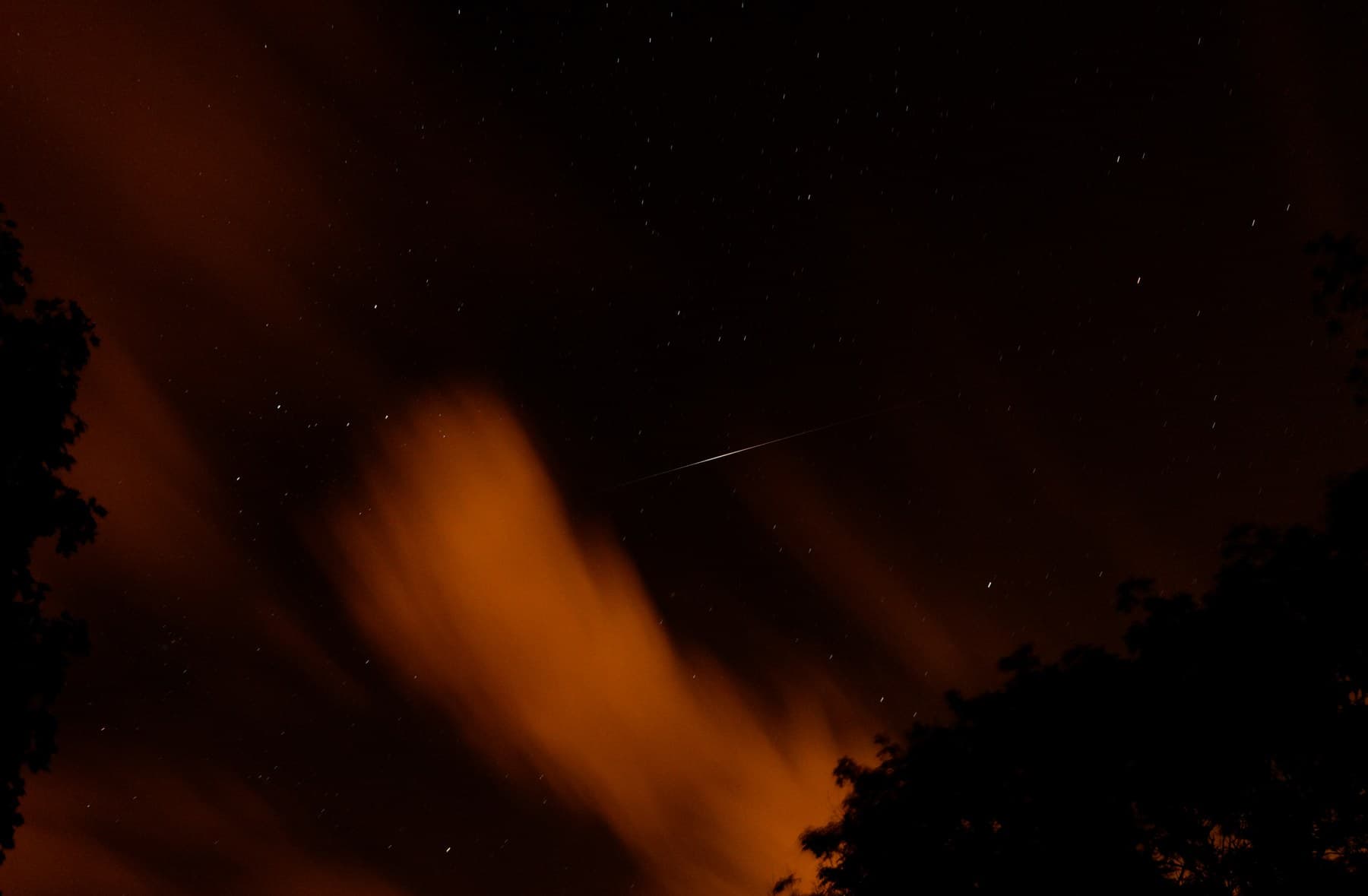
A satellite or rocket body may appear as a steady moving point and then flare, fade or pulse when reflective surfaces change angle to the Sun. It normally follows a smooth path among the stars and may disappear abruptly when entering Earth's shadow. Record exact time, direction and path, then compare an orbital prediction. Unlike a Starlink train, a flare may involve one object; a catalog non-match is not decisive because orbit data and viewing predictions have limits.
Key points
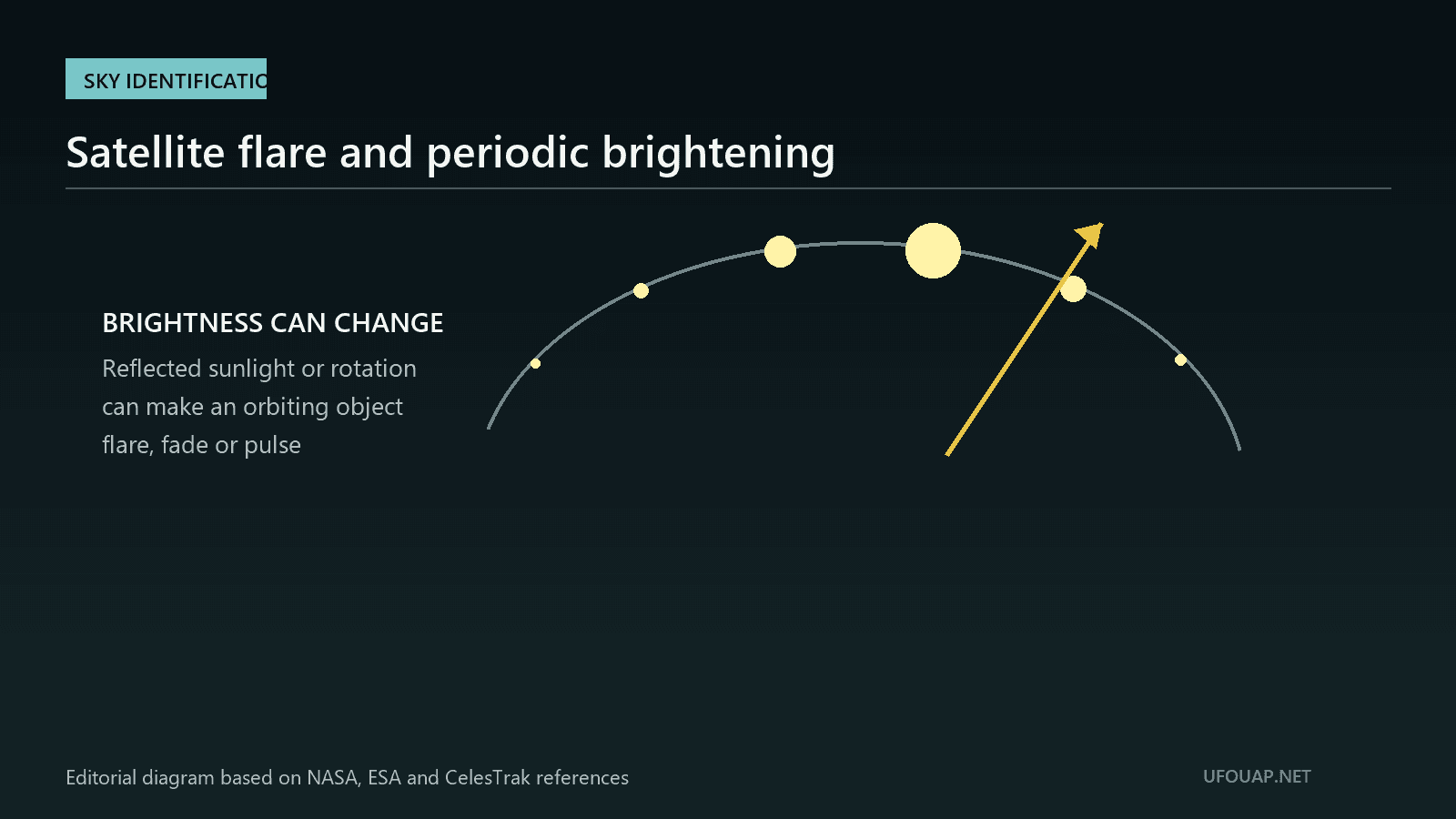
- Reflected sunlight can change brightness without any acceleration or emitted beam.
- Periodic brightening may indicate rotation or tumbling.
- A smooth stellar path and shadow disappearance support an orbital explanation.
Why orbiting objects change brightness
Satellites do not need their own visible lights to be seen. Sunlight reflected from solar panels, antennas or the body can reach an observer at a favorable angle. As geometry changes, the object can flare and then fade. A rotating rocket body may repeat the pattern. Exposure and thin cloud can exaggerate the pulse, so brightness change alone is not evidence of propulsion.
How this differs from Starlink trains
New Starlink groups can form a line of many lights after launch. A satellite flare is often one cataloged object whose brightness changes along a smooth path, while a tumbling object may pulse periodically. Other formations are possible, so count alone is not enough. Direction, angular speed, spacing and launch timing separate the categories more reliably.
How to verify the pass
Record location, time to the second if possible, start and end direction, highest elevation and duration. Compare NASA pass information where applicable and a reputable orbital catalog such as CelesTrak. Use the observation-time orbit data rather than only current data, because orbits change. Check whether the disappearance occurred near the predicted shadow boundary and whether stars confirm a smooth track.
Careful assessment
An orbital explanation is strong when time, direction, angular motion and shadow entry match a predicted pass. It is weaker if fixed cameras show verified stops or directional changes. Public catalogs may omit classified objects or contain stale elements, so no match leaves the report unresolved rather than proving it non-orbital. State which catalog and epoch were checked so another analyst can reproduce the result.
FAQ
Can a satellite suddenly become much brighter?
Yes. A favorable reflection angle can create a brief flare, and rotation can produce repeated pulses.
Why can a satellite disappear in a clear sky?
It may enter Earth's shadow and stop reflecting sunlight even though it continues along the same orbit.
Official sources used
- NASASpot the Stationspotthestation.nasa.gov
- CelesTrakCelesTrakcelestrak.org
- NASANASA Orbital Debris Program Officeorbitaldebris.jsc.nasa.gov