
Skywatching / Updated 2026-08-02 / 8 min read
Why Starlink Satellites Are Mistaken for UFOs
Newly launched Starlink groups can look like a moving train of lights. Time, direction, launch records and satellite tracks usually provide the fastest identification checks.
Reviewed and maintained byGlobal UFO Archive Editorial DeskEditorial policy
Quick answer
Starlink satellites are a common source of UFO reports because newly launched groups can appear as a moving line of bright lights. A careful check compares the sighting time, direction, launch window, satellite trackers, and local sky conditions before treating the report as anomalous.

Key points
- A line of evenly spaced lights moving together often points to satellites.
- Launch timing and viewing geometry decide how bright or surprising they look.
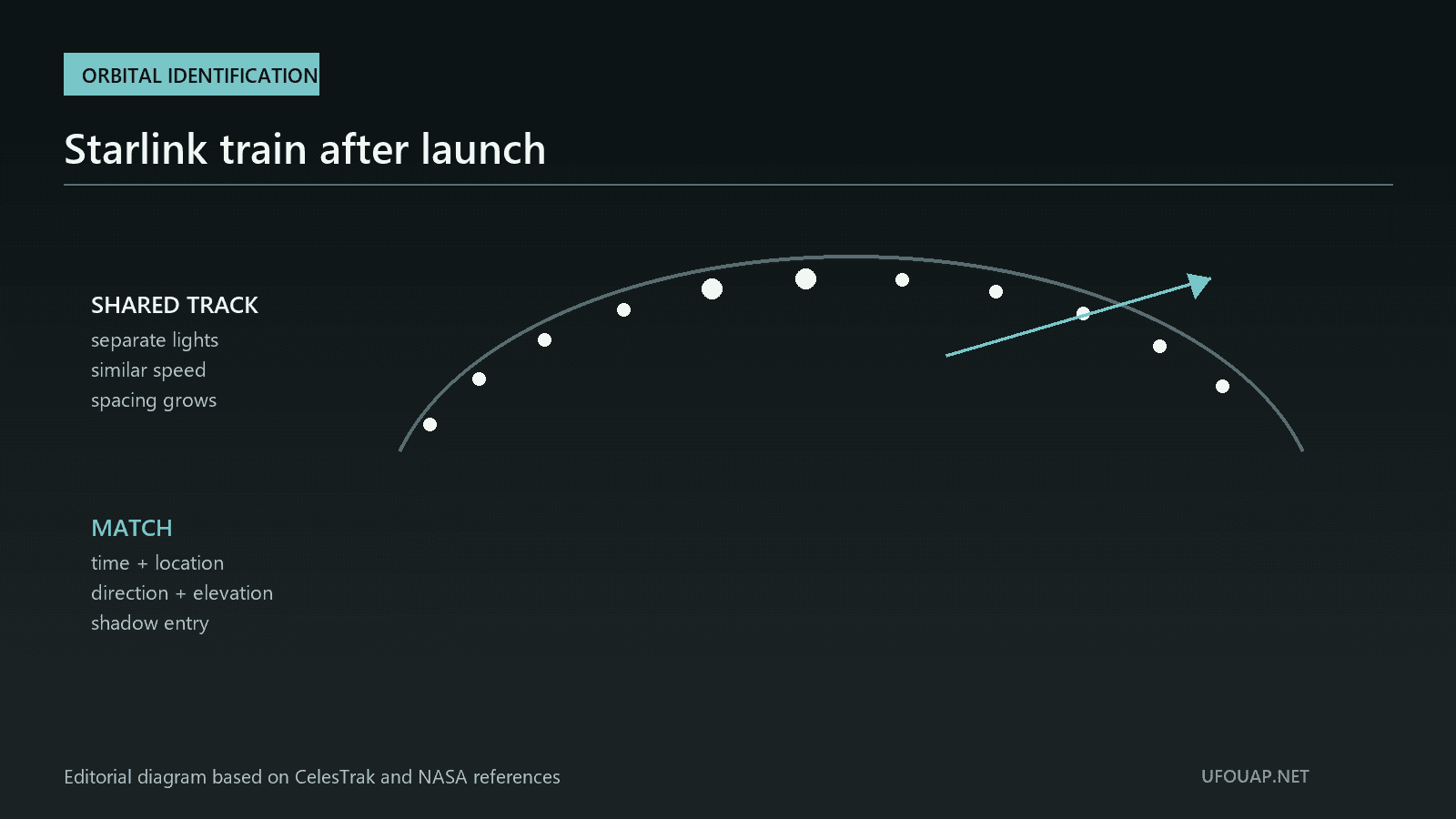
- A newly launched Starlink group usually appears as several lights sharing one path and speed, then spreads out over later passes.
- A tracker match is strongest when time, observing location, direction and track agree, not merely when Starlink was visible somewhere that night.
The modern satellite problem
A Starlink train can look artificial, coordinated, and unfamiliar. That is exactly why it becomes a UFO report. The object is real, but the interpretation can be wrong. Checking launch schedules, satellite passes, direction of travel, and whether multiple lights moved in a straight line is often enough to resolve the sighting.
Train, flare or reentry?
A Starlink train consists of separate satellites moving along nearly the same track after launch. A satellite flare is a brightness change from reflected sunlight and may involve only one object. Reentry can produce slower, fragmenting streaks with multiple glowing trails. These patterns are visually different and should not be collapsed into one label. The sequence, spacing, duration and whether lights fade at the same part of the sky are more informative than a single enlarged frame.
How to test a Starlink match
Preserve the original timestamp, coordinates and camera direction, then check recent launch times and orbital-element services such as CelesTrak. Reconstruct the pass from the witness location rather than using a generic visibility map. A convincing match should reproduce the direction of travel, approximate elevation, number or spacing of visible lights, and the moment they enter Earth's shadow. If those details conflict, Starlink remains a hypothesis rather than a resolution.
FAQ
How can I tell if it was Starlink?
Look for a train of lights moving together, then compare the time and location with satellite tracking or launch information.
Are Starlink satellites often mistaken for UFOs?
Yes. Newly launched Starlink satellites can appear as a line or train of lights, especially soon after launch and before the group spreads out into normal operational orbits.
What official source explains Starlink sightings?
Official launch information from SpaceX, skywatching guidance from NASA, and satellite-tracking tools can be compared with the date, time and direction of a sighting.
Why can a Starlink train suddenly disappear?
The satellites can enter Earth's shadow and stop reflecting sunlight even though they continue along the same orbit. Thin cloud can also reduce visibility, so direction and timing still need checking.
Official sources used
- NASA ScienceIdentifying UFOs and UAPsscience.nasa.gov
- UAP Sightings Reporting SystemCommon UAP Misidentificationsuapsightings.org
- CelesTrakSupplemental GP element sets: Starlinkcelestrak.org
- SpaceXSpaceX launcheswww.spacex.com