
U.S. Air Force records expected for the National Archives' unidentified anomalous phenomena collection remain unavailable on its public Record Group 615 page, according to an August 5 report by researcher HM05UAP. The report concerns the status of an archival transfer, not a new claim about the contents or origin of any UAP event.
HM05UAP said 30 Air Force records briefly appeared in a National Archives cloud-storage location roughly two months earlier and were removed within 24 hours. The researcher also reported that National Archives links changed from the storage service to catalog.archives.gov on July 15, making pending material harder to monitor. Those observations document the researcher's account; the public catalog does not establish why the files appeared or disappeared.
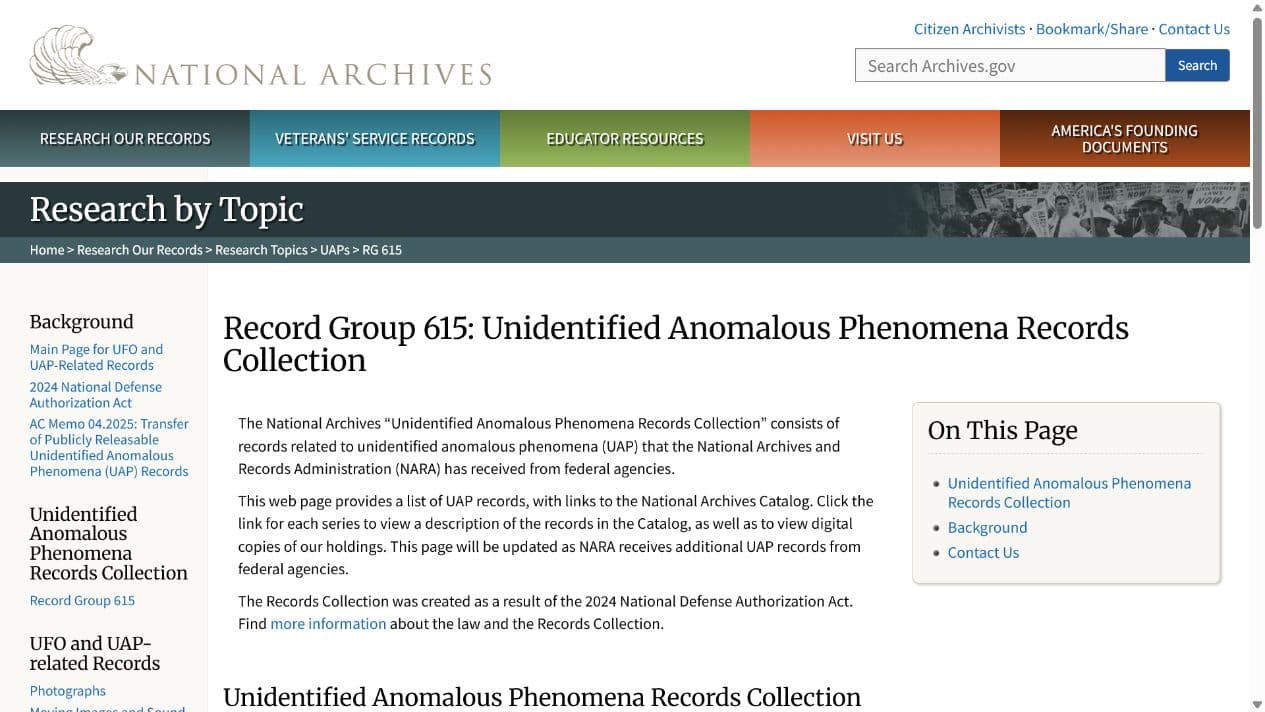
The official Record Group 615 page, checked on August 6, lists UAP accessions from the Federal Aviation Administration, Nuclear Regulatory Commission, Office of the Director of National Intelligence, Office of the Secretary of Defense, National Security Agency, Department of State and Federal Bureau of Investigation. It does not currently list a U.S. Air Force series, and the National Archives says the page will be updated on a rolling basis as agencies transfer records.
National Archives guidance issued under the 2024 National Defense Authorization Act directed agencies to identify and transfer publicly releasable UAP records no later than September 30, 2025. Transfer deadlines, archival processing, classification review and public catalog publication are distinct steps, so the missed public appearance alone does not show where the Air Force records are in that process.
The unresolved issue is therefore administrative transparency. The present catalog supports the narrow finding that an Air Force series is not publicly listed, but it does not prove deliberate suppression or outside intervention. A dated status notice from the National Archives or the Air Force identifying the inventory, transfer date, review stage and expected publication schedule would allow the public to distinguish delay from withholding.