
United States / 1897 / DISPUTED
1897 Aurora UFO Incident
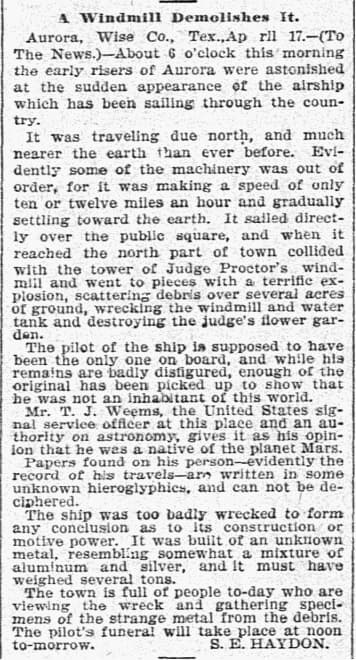
The Aurora UFO story comes from S. E. Haydon's newspaper item published on April 19, 1897. It alleged that an airship had struck a Texas windmill on April 17, killing a pilot described as not of this world. The article survives, but it is not a verified crash or burial record. Investigations revived the story in 1973 and produced conflicting interpretations of recollections, a grave marker and metal finds. Historical scholarship treats it as fiction. No authenticated extraterrestrial remains or material establish the extraordinary claims.
This case is disputed. The archive preserves the claims while separating evidence from interpretation.
- Documentation
- Moderate documentation
- Primary location
- Aurora, Texas
- Source base
- 4 linked records
- Research use
- Comparison case
The article versus the alleged crash
Case dossier
The surviving item, A Windmill Demolishes It, is signed S. E. Haydon and datelined Aurora, Wise County, April 17. It places the alleged event at about six that morning: an airship traveling north, descending and moving at an estimated ten or twelve miles an hour, struck Judge Proctor's windmill tower in the northern part of town. The story describes an explosion, scattered debris and damage to the windmill, water tank and flower garden. These particulars belong to Haydon's narrative. They are not independently established flight measurements, damage surveys or a contemporary official accident report.
Haydon next alleged a single pilot, badly damaged remains, papers in an undecipherable script and metal resembling aluminum mixed with silver. He attributed a Martian interpretation to T. J. Weems, whom he described as a Signal Service officer and astronomy authority. That description is a claim in the newspaper, not an independently verified government finding. The pilot is unnamed in the original. Its final sentence announces a funeral at noon the following day, implying April 18 from the dispatch date; it does not document that a burial actually occurred. April 19 is the newspaper publication date, not the alleged crash date.
The Texas State Historical Association's Aurora entry, by David Minor, calls the article fictional and identifies Haydon as a cotton buyer. It places the story against the town's decline after epidemic and a lost railway opportunity, describing publicity for the community as an apparent motive. That is a historical assessment, not a surviving confession by Haydon. The wider nineteenth-century airship-reporting setting matters because later UFO terminology can make an old newspaper tale sound like a modern technical case. A printed claim's age and repetition do not independently authenticate its extraordinary details.
The 1973 revival must be separated from 1897 testimony. In Skylook, Walter H. Andrus describes work led by Dallas Times Herald aviation writer Bill Case, who also held a MUFON role. His account largely relies on Case's interviews, not a second independent interview series. Mary Evans recalled family discussion but had not been allowed to visit the scene. Charlie Stephens repeated his father's account rather than reporting his own crash observation, and the account did not supply a body description. These are late recollections and secondhand testimony, not newly located contemporaneous witness statements.
Andrus records a July 14, 1973 cemetery meeting and the association's refusal to permit excavation. An August 17 follow-up reports aluminum-alloy analyses and argues for further investigation. The article does not reproduce signed laboratory reports or establish when the samples entered the ground. Metal composition, even if accurately reported, cannot by itself connect a fragment to an 1897 airship. Proposed legal action and conditional discussion of exhumation must also not be converted into a completed excavation or an authenticated discovery of remains. The investigator's account documents a search and its claims, not their independent confirmation.
Bill Porterfield's independent field report in The Texas Observer on September 21, 1973 offers a different reading. He observed ordinary items being unearthed and interpreted the supposed spaceship outline on a marker as cracks and fossils. He also interviewed Robbie Reynolds Hanson, who recalled her father regarding a local version of the story as a joke. These are valuable counterpoints, but they remain a reporter's observations and a late recollection. They do not constitute an exhaustive test of every metal fragment or a signed admission from the original author.
Even the grave's documentary description is unsettled. Porterfield names C. A. Carr as the plot owner while leaving its occupant unresolved; Andrus says records failed to identify the owner or occupant. The disagreement should not be silently merged into a single verified burial history. Nor does refusal to disturb a cemetery establish a government concealment operation. The sources preserve a dispute over access and interpretation, not a medical examination, burial register or official identification of an extraterrestrial pilot. Claims about what must lie underground exceed that record.
Aurora belongs in the archive as a case in the transmission and testing of a historical legend. The firm starting point is a real newspaper text, reproduced here as a document, not as a photograph of the claimed event. The physical crash, non-human pilot and burial are separate claims needing separate evidence. Fiction or local satire is better supported by the historical assessments than an extraterrestrial recovery, but the author's exact intent is not directly recorded in a confession. Reading the original alongside opposing 1973 accounts shows how repetition, indirect memories and unproven material associations can make one story appear to have many independent confirmations.
Related checks and records
Timeline
- Date of the alleged crash in Haydon's dispatch, not an independently verified accident date.
- The Dallas Morning News publishes A Windmill Demolishes It.
- Andrus reports meeting cemetery representatives, who maintain their refusal to permit excavation.
- Andrus dates a follow-up discussing metal analyses and conditional further steps, later printed in September's Skylook.
- The Texas Observer publishes Porterfield's skeptical on-site investigation and interviews.
Aurora story questions
Is an alien buried in Aurora Cemetery?
That has not been established. The original article announces a future funeral; later records dispute the grave's history. Neither a marker nor denied excavation supplies an authenticated non-human body.
Was the story proved to be a hoax?
Historical assessments favor fiction or satire, and the extraordinary claims lack authenticated physical support. But the cited record contains no signed confession establishing Haydon's precise motive; that distinction should be retained.
Does the image show the crashed airship?
No. It is a scan of Haydon's 1897 newspaper item. It shows the wording of the claim, not a crash scene, recovered body or spacecraft photograph.
Sources
- [1] ArchiveHaydon's 1897 newspaper item: the original claimS. E. Haydon / The Dallas Morning News / Wikimedia scan
- [2] News reportPorterfield, 21 September 1973: independent field reporting, pp.11–14Bill Porterfield / The Texas Observer
- [3] ResearchAndrus, Skylook September 1973: investigators' claims and limitsWalter H. Andrus / Skylook / MUFON archive
- [4] ArchiveTexas State Historical Association: the town and fiction assessmentDavid Minor / Handbook of Texas Online