
United States / 1948 / DISPUTED
Aztec UFO incident
No contemporaneous crash report, named recovery witness, military file, photograph, artifact with a documented chain of custody, or authenticated event film has been produced for a craft allegedly recovered near Aztec, New Mexico, on 25 March 1948. The public story emerged in Frank Scully’s 1949 Variety columns and his 1950 book Behind the Flying Saucers, based chiefly on claims by oil promoter Silas Newton and the man presented as “Dr. Gee,” later identified as Leo GeBauer. Reporter J. P. Cahn tested their purported saucer metal and investigated their business history; his 1952 and 1956 True articles connected the tale to dubious oil-finding devices and victims. Newton and GeBauer were convicted in 1953 of operating a confidence game involving such equipment. That verdict is powerful evidence about their reliability and commercial scheme, but it did not adjudicate the alleged Aztec recovery point by point. The FBI’s 1950 Guy Hottel memo is likewise not confirmation: the Bureau says it relayed an uninvestigated second- or third-hand New Mexico story and cannot verify that it repeated the Aztec narrative. The case remains D / disputed and is best understood as a poorly sourced crash-retrieval story amplified by publishing and associated with proven fraud.
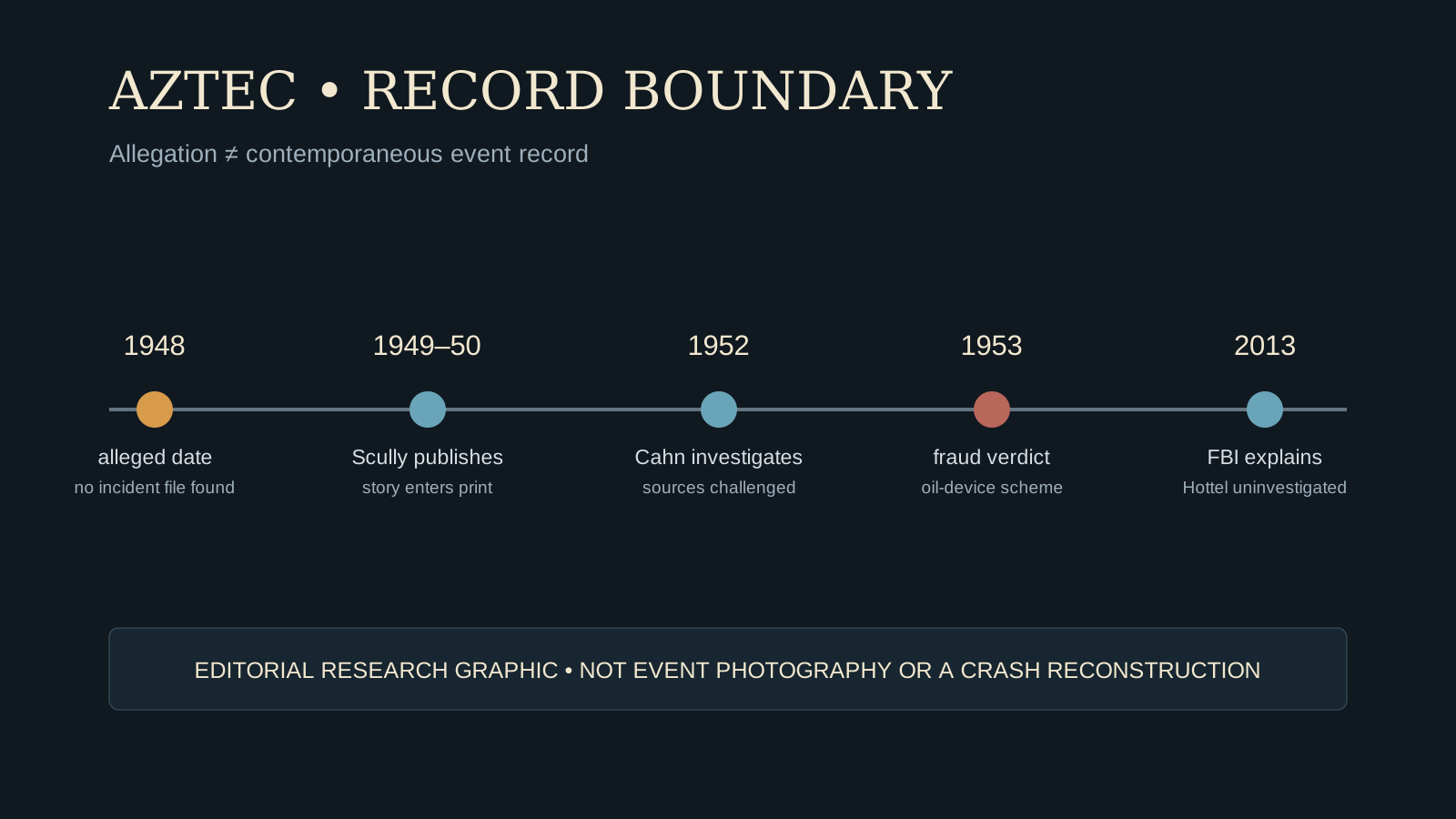
This case is disputed. The archive preserves the claims while separating evidence from interpretation.
- Documentation
- High documentation
- Primary location
- Aztec, New Mexico
- Source base
- 6 linked records
- Research use
- Comparison case
What the record supports
- Public origin
- The story entered print through Scully’s 1949 columns and 1950 book, not a surviving 1948 incident report.[3]
- Source problem
- Newton and GeBauer were later convicted over an oil-device confidence scheme, seriously weakening their credibility.[2][5]
- Court boundary
- The 1953 verdict adjudicated the commercial fraud; it did not rule separately on every alleged crash detail.[5]
- Hottel boundary
- The FBI calls the memo uninvestigated second- or third-hand information and cannot verify that it repeated the Aztec story.[1]
Case dossier
The date and place belong to the later stabilized narrative, not to a surviving incident file. Retellings place a crash on 25 March 1948 near Aztec and describe a circular craft and small bodies recovered in secrecy. Yet no identified person has produced a contemporary diary, report, order, photograph or recoverable sample showing that a retrieval occurred there. The archive can date the allegation; it cannot treat that date as a verified occurrence.
Scully was the publication channel, not a recovery witness. His 1949 Variety columns introduced crashed-saucer claims to a broad readership; his 1950 book expanded them and relied on Newton and an anonymized scientist called “Dr. Gee.” Library catalogs establish the book and publication date, but cataloging a book does not authenticate its contents. The move from columns to a successful book explains how a privately sourced story acquired the appearance of a documented case.
Cahn approached the sources as an investigative reporter. He sought witnesses and documentation, examined Newton and GeBauer’s backgrounds, and arranged analysis of material represented as unusually resistant saucer metal; the sample was ordinary aluminum. His September 1952 True article challenged the story, and his 1956 follow-up traced people who said they lost money in Newton and GeBauer ventures. These are reported investigative findings, not a recovered official crash investigation.
The criminal record must be used precisely. Cahn reported that a Denver jury convicted Newton and GeBauer on 10 November 1953 of conducting a confidence game and conspiracy, after evidence about oil-locating apparatus and Herman Flader’s losses; probation and restitution followed in 1954. This demonstrates adjudicated fraud in their commercial conduct. It does not mean the jury separately tested whether a craft crashed at Aztec, and the dossier does not claim that it did.
The FBI Vault adds a separate documentary layer. Its Silas Newton collection describes Bureau investigations of fraudulent activity from 1951 to 1970 and identifies him as a source used by Scully. The files establish government attention to Newton’s suspected or proven schemes; they are not an FBI Aztec crash file and do not convert every allegation recorded about him into a Bureau finding.
Guy Hottel’s one-page memo is often attached to Aztec because it mentions recovered saucers, small bodies and New Mexico. The FBI’s own 2013 explanation says the 22 March 1950 memo merely relayed an unconfirmed second- or third-hand account, received no follow-up and proves no UFO recovery. Crucially, the Bureau says some people think it repeated a circulating hoax but its files cannot verify that theory. Similarity is not a documented source chain to Aztec.
Later books and conferences revived the Aztec story, sometimes adding witnesses, geography or documentary certainty absent from the earliest publication trail. Those claims require their own provenance and do not repair the missing contemporary record by repetition. The archive therefore preserves the story’s cultural and investigative history while declining to present a recovered craft, bodies or government operation as established fact.
Timeline
- Later versions place the alleged recovery near Aztec on this date; no contemporaneous incident record has been produced.
- Frank Scully publishes Variety columns circulating crashed-saucer claims supplied through Newton and “Dr. Gee.”
- Behind the Flying Saucers expands the claims into a book; the Smithsonian catalog confirms the edition, not its factual accuracy.
- Guy Hottel sends an FBI memo repeating an unconfirmed New Mexico account; the FBI later says it was not investigated.
- J. P. Cahn’s True investigation challenges Scully’s sources and the purported saucer material.
- A Denver jury convicts Newton and GeBauer of a confidence game and conspiracy involving oil-finding equipment—not of inventing every Aztec claim.
- Cahn’s follow-up reports additional alleged victims and the outcome of the oil-device prosecution.
- The FBI publishes its official Hottel explanation: second- or third-hand, uninvestigated, and not proof; any tie to a circulating hoax remains unverified.
Questions about the Aztec story
Did a UFO crash at Aztec in 1948?
The claim is not supported by a contemporaneous incident record or independently documented recovery evidence. The public trail begins with later publishing, so the archive treats it as disputed rather than verified.
Who first publicized the Aztec crash story?
Frank Scully carried crashed-saucer claims in 1949 Variety columns and expanded them in his 1950 book, relying chiefly on Silas Newton and “Dr. Gee,” later identified as Leo GeBauer.
What did J. P. Cahn find?
Cahn found no reliable recovery documentation, reported serious problems in Newton and GeBauer’s business history, and had purported saucer metal tested as ordinary aluminum. His work was journalism, not an official crash inquiry.
Were Newton and GeBauer convicted because of the UFO story?
No. They were convicted of a confidence game and conspiracy involving oil-finding equipment and financial loss. The case damages their credibility but was not a judicial trial of every Aztec claim.
Does the Guy Hottel memo confirm Aztec?
No. The FBI says it was uninvestigated second- or third-hand information. Although details resemble circulating New Mexico crash stories, the Bureau says its files cannot verify the proposed hoax connection.
Are there authentic Aztec crash photographs or video?
None with a reliable event chain was found. The displayed graphic is site-authored and explicitly not event evidence; no original event video is used.
Sources
- [1] Official fileFBI explanation of the Guy Hottel memoFederal Bureau of Investigation
- [2] Official fileFBI Vault collection on Silas M. NewtonFederal Bureau of Investigation
- [3] ArchiveSmithsonian catalog record for Scully’s 1950 bookSmithsonian Libraries and Archives
- [4] Official fileU.S. Air Force historical discussion of the Aztec storyU.S. Air Force
- [5] News reportJ. P. Cahn’s 1956 follow-up in TrueTrue magazine (public scan)
- [6] ResearchSkeptical Inquirer review of the revived Aztec storySkeptical Inquirer
The hero is a site-authored chronology graphic, not an event photograph or reconstruction. No authenticated event image, original video or artifact with an Aztec chain of custody was found; the prior generic saucer cover is excluded.