
United States / 1947 / DISPUTED
Maury Island incident
The Maury Island incident is a disputed 1947 story, not a verified aircraft encounter. Dahl said that six ring-shaped objects hovered over his boat on June 21 and that one dropped metal-like material and dark rocks; Crisman later promoted samples as possible disc fragments. The surviving FBI file confirms that Army intelligence officers William L. Davidson and Frank M. Brown interviewed the men in Tacoma on July 31. It also records that Dahl and Crisman admitted the material had been collected as ordinary rock formations and falsely represented as flying-disc debris. Davidson and Brown died hours later when their B-25 suffered an engine and wing fire near Kelso. The same record found no sabotage indication and did not treat the crash as proof of the claim.
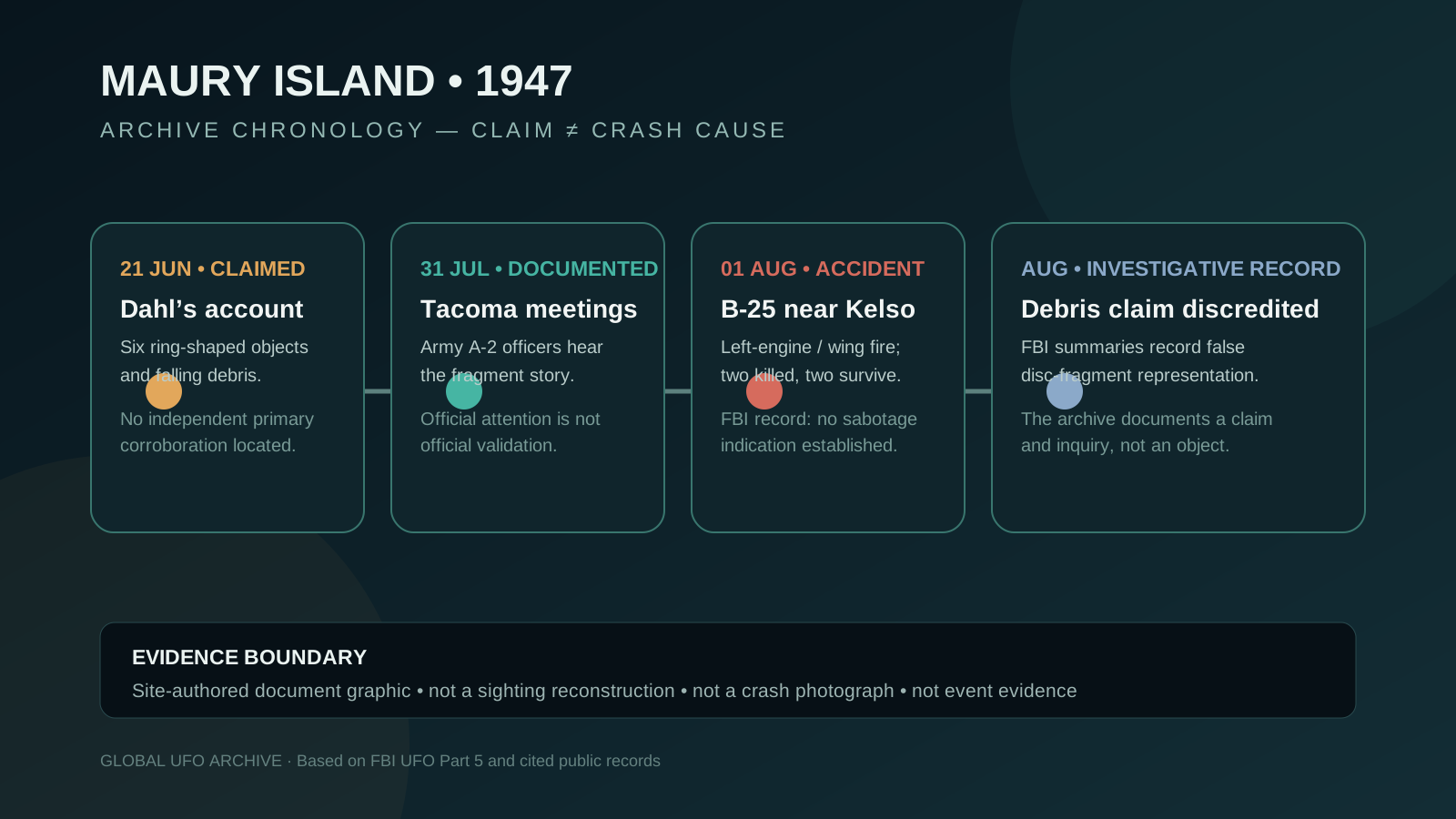
This case is disputed. The archive preserves the claims while separating evidence from interpretation.
- Documentation
- High documentation
- Primary location
- Puget Sound near Maury Island, Washington
- Source base
- 5 linked records
- Research use
- Comparison case
What the surviving record supports
- Confirmed record
- FBI records confirm the Tacoma meetings, Army intelligence involvement and later interviews.[1]
- Unverified claim
- No independent primary record verifies Dahl’s June 21 objects, injuries, dead dog or photographs.[1][2]
- Debris finding
- The FBI file records admissions that ordinary rocks were falsely represented as flying-disc fragments; no controlled extraordinary sample survives.[1]
Archive chronology
Case dossier
Dahl’s later account placed him in a patrol boat near Maury Island on June 21, 1947, with his son, two crew members and a dog. He described six large ring-shaped objects, one apparently distressed, and said falling material damaged the boat, injured a crewman and killed the dog. No contemporaneous log, photograph with a verifiable chain of custody, medical record, damaged boat or independent statement from the other alleged occupants is public. The date and details therefore remain attributed claims.
Crisman said he visited the shore, collected dark fragments and also saw an unusual object. The FBI record instead traces the material to rock formations collected from a Maury Island gravel pit and sent to publisher Ray Palmer for analysis. After the national flying-disc story broke, the material was offered as possible disc debris. The file records admissions that this representation was false. Similarity to slag near a Tacoma smelter further weakened any claim of exotic composition; no controlled sample, laboratory chain or surviving extraordinary material is public.
Palmer paid pilot Kenneth Arnold to investigate. Arnold met Dahl and Crisman in Tacoma and involved airline pilot E. J. Smith. On July 31, Army A-2 intelligence officers Captain William L. Davidson and First Lieutenant Frank M. Brown joined meetings in room 502 of the Winthrop Hotel. Their presence establishes official attention, not official validation. The FBI file describes the officers as listening to the accounts and handling alleged fragments while also preserving doubts and inconsistencies.
At about 2: 12 a.m. on August 1, the TB-25J departed McChord Field for Hamilton Field. Roughly fifteen to forty minutes later, depending on the surviving summary, a burned exhaust stack or left-engine fire ignited the wing; the wing and tail failed near Kelso. Crew chief Woodrow Matthews and passenger Elmer Taff parachuted out. Davidson and Brown died. The FBI summary states that McChord intelligence found no sabotage indication. An independent accident database identifies aircraft 44-31316 and the same engine-fire sequence.
Anonymous calls to Tacoma journalists supplied details about the hotel meeting and then claimed the B-25 had been shot down or sabotaged. The timing made the crash central to later conspiracy narratives. Yet the FBI distinguished the calls from the mechanical accident record and wrote that the aircraft was not carrying parts of a disc and that sabotage was unsubstantiated. The crash is historically connected because the officers had attended the meeting; causation is not established.
Later retellings made Maury Island an early source for ‘men in black’ lore and sometimes called the crash the first military deaths connected with a UFO investigation. Those are cultural-history descriptions, not additional evidence. Washington Senate Resolution 8648 commemorated the story and honored Davidson and Brown in 2017, but a ceremonial resolution is not an accident report or scientific finding and includes contested narrative claims.
The archive value of Maury Island lies in the paper trail: it shows how a weak debris claim, paid magazine interest, military interviews, anonymous calls, a genuine aviation tragedy and later popular culture merged into one durable legend. The careful conclusion is that the official investigation and crash are documented, while the alleged June 21 aerial event lacks independent primary support and the fragment claim was materially discredited. Preserving that distinction is more useful than presenting either mystery or hoax as a slogan.
Timeline
- Dahl later says the boat encounter and falling debris occurred near Maury Island.
- After flying-disc reports become national news, Crisman and Dahl correspond with publisher Ray Palmer about the rocks and a possible story.
- Kenneth Arnold investigates in Tacoma; E. J. Smith, Davidson and Brown join the Winthrop Hotel meetings.
- The TB-25J crashes near Kelso after a left-engine/wing fire. Davidson and Brown die; two other occupants parachute to safety.
- Dahl and Crisman give the FBI a signed statement; the inquiry records evasions and admissions about the rocks and false disc-fragment representation.
- FBI summaries reject sabotage, separate the crash from the disc claim and close the Seattle inquiry absent contrary direction.
- Washington Senate Resolution 8648 commemorates the story’s cultural legacy and honors Davidson and Brown.
Maury Island incident questions
What was the Maury Island incident?
It was Dahl and Crisman’s 1947 claim that ring-shaped objects dropped debris near Maury Island, followed by magazine interest and official interviews.
Did the FBI investigate Maury Island?
Yes. Its file records interviews, the fragment story, anonymous calls and the crash inquiry. Investigation confirms attention, not an extraordinary craft.
Were the Maury Island fragments extraordinary?
No verified evidence shows that. The FBI record describes ordinary rocks, false representation and slag similarity; no controlled sample or extraordinary analysis is public.
Did the B-25 crash because of the UFO investigation?
No evidence establishes that. The documented sequence is a left-engine/exhaust fire and structural failure, and the FBI found no sabotage indication.
Was Maury Island a hoax?
The fragment claim was explicitly discredited and the broader story is widely characterized as a hoax. Because the alleged sighting lacks independent records and the surviving statements conflict, this archive labels the whole case disputed rather than claiming every detail’s authorship is proven.
Are there authentic photos or videos of the event?
No authenticated event image or original video was located. The archive uses a clearly labeled site-authored document graphic, not a reconstruction or event evidence.
Sources
- [1] Official fileFBI UFO Part 5: Maury Island and B-25 investigationFederal Bureau of Investigation
- [2] ResearchHistoryLink Essay 2068: Maury Island claims and aftermathHistoryLink.org
- [3] Reference databaseNorth American TB-25J 44-31316 accident recordBureau of Aircraft Accidents Archives
- [4] Official fileWashington Senate Resolution 8648Washington State Legislature
- [5] ArchiveLibrary of Congress catalogue: The Tacoma TimesLibrary of Congress
The displayed visual is a site-authored archival timeline graphic based on the cited records. It is not a photograph of the alleged objects, a reconstruction of Dahl’s account, a crash-scene image or evidence of an extraordinary craft. No authenticated event photograph or original video was located.