New Zealand / 1978 / DISPUTED
Kaikōura lights
The Kaikōura lights were not one continuous encounter. New Zealand's declassified RNZAF file separates reports on the night of 20-21 December 1978 from a television-assisted newspaper flight on 30-31 December. Named SAFE Air crews described unusual lights; Wellington air-traffic radar and aircraft weather radar produced returns during parts of both episodes; and cameraman David Crockett filmed lights on 31 December. The records do not establish a single object tracked continuously by eye, radar and camera. The official investigation attributed most observations to anomalous propagation, astronomical or surface lights, shipping and radar effects, while acknowledging that a few details remained inconclusive.
This case is disputed. The archive preserves the claims while separating evidence from interpretation.
- Documentation
- High documentation
- Primary location
- Kaikōura coast, South Island
- Source base
- 3 linked records
- Research use
- Comparison case
What the December 1978 record establishes
- Event structure
- The official file separates the 20-21 December aircrew reports from the planned television flight of 30-31 December; they were not one uninterrupted encounter.[1]
- Crew distinction
- Fogarty and David and Ngaire Crockett flew south; Ngaire stayed in Christchurch and TV1 journalist Dennis Grant joined the return flight. No television crew was on the first December flights.[1]
- Film provenance
- Crockett's 31 December 16 mm film was shot through an Argosy window. TV1's 3 January ground footage was a separate recording; DSIR discussed different limitations for each.[1][2]
- Radar boundary
- The file records unusual ground and aircraft-radar indications, but several lacked visual counterparts and the main return-flight light had no matching unidentified ground-radar contact.[1]
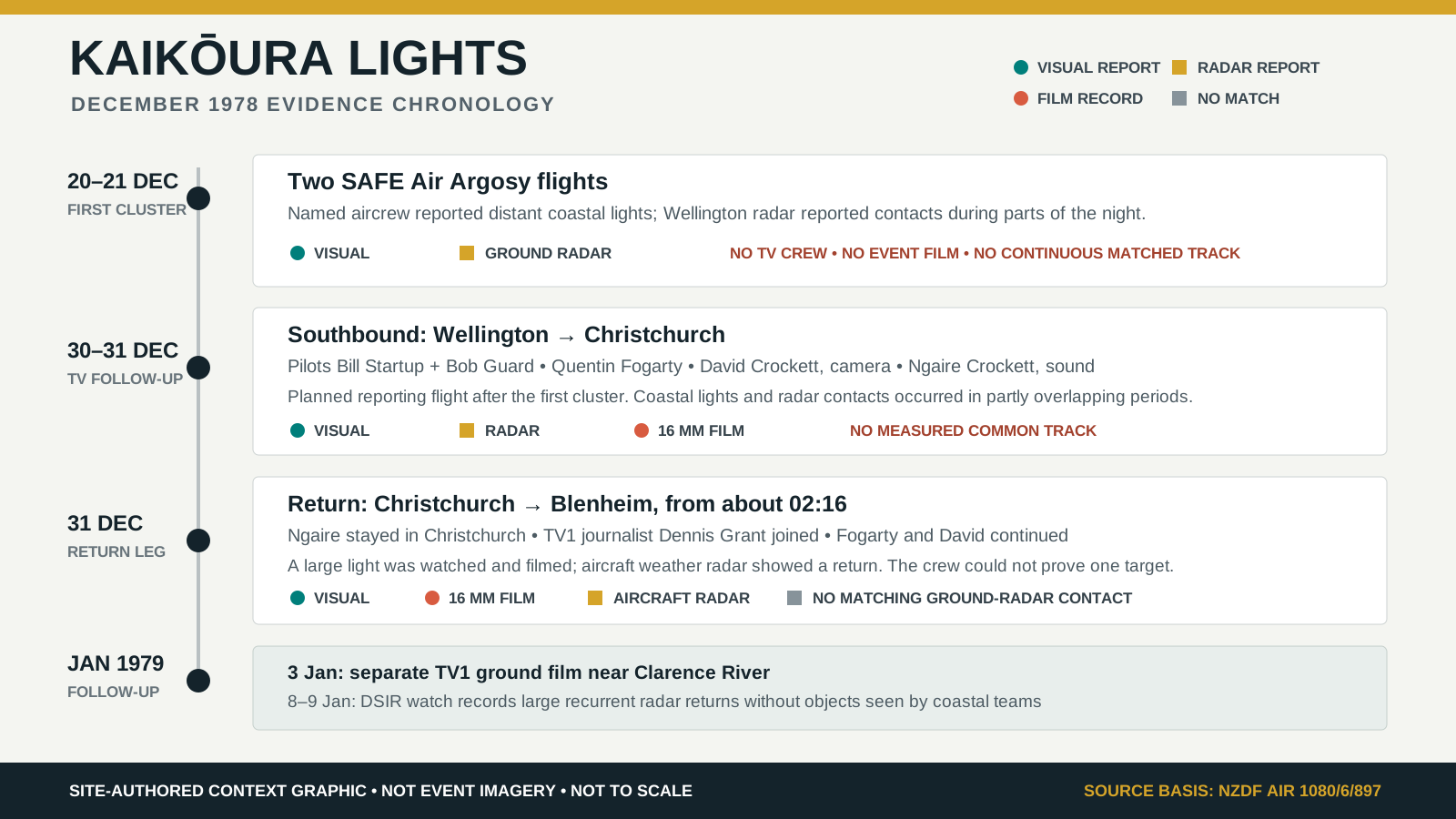
Two-flight chronology and evidence boundary
Case dossier
The official report defines two event clusters. On the night of 20-21 December, two SAFE Air Argosy flights operated from Woodbourne toward Christchurch. Captain J. Randle described distant, intermittent beams or lights after Wellington radar asked him to inspect the Clarence River area. A later flight crew, Captain Vern Powell and First Officer Ian Pirie, reported a bright light on a radar-indicated bearing and then a brief fast radar sequence accompanied by a flashing light. The file repeatedly warns that apparent bearing agreement did not establish equal range. No television crew or event film belonged to this first cluster.
The second cluster was deliberately observed for television. A routine SAFE Air newspaper flight left Wellington at 23:46 on 30 December with pilots Bill Startup and Robert 'Bob' Guard. Melbourne Channel 0 reporter Quentin Fogarty had hired Wellington freelancers David and Ngaire Crockett; David operated the 16 mm camera and Ngaire recorded sound. They joined the flight because Fogarty was preparing a report on the earlier sightings. Their presence therefore documents a planned follow-up, not an independent camera that happened to capture the first episode.
On the southbound leg toward Christchurch, the pilots first described four or five lights near the coast shortly after midnight. Wellington advised of contacts ahead, but the crew could not relate the visible lights to those returns. At 00:18 a reported radar return behind the Argosy produced no visual contact after an orbit. At 00:42 Wellington described a larger return behind the aircraft, yet Startup and Guard again saw nothing during a turn. Near Woodend, a visible white light and a reported radar target occurred in the same general sector, but the inquiry did not establish a measured common track.
The return flight left Christchurch for Blenheim at about 02: 16. Ngaire Crockett, distressed by the southbound experience, stayed behind; Christchurch TV1 journalist Dennis Grant took her place, while Fogarty and David Crockett continued. Soon after departure the crew and passengers watched and filmed a large light to the northeast. The aircraft's weather radar, used in mapping mode, showed a return that moved from about 18 to 10 nautical miles as the Argosy turned. Startup's interview explicitly says the crew could not prove that the visible light and radar return were the same target. Christchurch radar reported nothing, and Wellington did not report an unidentified contact during this approximately twenty-minute sequence.
Film provenance is often blurred in later accounts. Crockett's colour 16 mm footage came from the Argosy on 31 December and was made through aircraft glazing. A separate TV1 crew recorded a bright light near Clarence River early on 3 January 1979; that ground-based sequence was not part of the newspaper flight. A DSIR briefing later described Crockett's film as strongly distorted by the window and said a torch-through-window test reproduced similar effects. It called the TV1 film more interesting because it avoided aircraft glazing, but still noted aberrations and unfinished analysis. Neither statement identifies what every filmed light was.
The radar record is meaningful but heterogeneous. Wellington's surveillance radar generated recurring returns off the northeast South Island coast, including times when pilots saw lights. Aircraft weather radar also produced reported contacts, usually in ground-mapping mode. Yet the inquiry documented longstanding spurious returns, recent radar modifications and a DSIR watch on 8-9 January during which large Wellington returns had no matching object visible to coastal field teams. Raw calibrated plots, complete synchronized recordings and a demonstrated sensor-to-film match are not publicly available. Radar therefore confirms that operators handled unusual indications; it does not convert every light into a solid airborne target.
The RNZAF inquiry worked with the Department of Scientific and Industrial Research, Civil Aviation Division and Meteorological Service. Its public release said the radar and visual reports resulted from natural but unusual atmospheric phenomena. The underlying report is narrower: it says 'almost all' sightings could be explained, lists a few as inconclusive, and states there was no evidence linking the numerous Clarence-area reports to the larger eastern lights shown in the widely publicized films. It also records that interviews were not a judicial inquiry and that some witnesses were questioned together, limits that matter when assessing corroboration.
The official explanation was a combination, not a single identification. It considered Venus and other astronomical lights, Japanese squid-fishing vessels and other shipping, vehicle or train lights near the coast, meteors, reflection and refraction, radar ducting and equipment artifacts. Squid boats fit some surface-light and ship-return reports but were not proved to be every light. Venus matched some bearings and brightness descriptions but could not itself create radar returns. Anomalous propagation and radar faults could produce returns without objects, yet do not individually reconstruct every witness impression. These are evidence-bounded possibilities rather than interchangeable proof.
Later reports did not erase the disagreement. The declassified file also contains a private New Zealand UFO Studies Centre analysis by Bruce Maccabee that argued for unknown objects; its inclusion records an external submission, not RNZAF adoption. RNZ's 2021 review of a separate DSIR briefing showed officials still described the TV1 film as under analysis while treating extraterrestrial intervention as extremely remote. The careful archive judgment is therefore DISPUTED, grade B: named witnesses, contemporary recordings and a substantial official file deserve preservation, but no public record demonstrates one extraordinary craft or a complete synchronized sensor track.
Timeline
- Two SAFE Air Argosy crews report unusual coastal lights. Wellington radar reports contacts during parts of the night, but the file does not establish one continuous visual-radar track. No television crew is aboard.
- The Civil Aviation Division's operational office informs Air Staff of the overnight reports and asks that any recurrence be passed promptly for investigation.
- The newspaper flight leaves Wellington for Christchurch with pilots Bill Startup and Bob Guard, reporter Quentin Fogarty, camera operator David Crockett and sound recordist Ngaire Crockett aboard for a planned follow-up.
- On the southbound leg, visible coastal lights and several reported radar contacts occur in overlapping periods. Turns to inspect returns at 00:18 and 00:42 produce no visual target, and no measured common track is demonstrated.
- The return flight departs Christchurch with TV1 journalist Dennis Grant replacing Ngaire Crockett. A large light is watched and filmed, and an aircraft weather-radar return is reported; Startup says the two could not be proved identical, while ground radars report no matching unidentified contact.
- An RNZAF Orion conducts a night surveillance flight along the northeast South Island coast. Its observations are added to the official inquiry rather than treated as a new filmed event.
- A separate TV1 team films a bright light from the ground near Clarence River. DSIR later distinguishes this sequence from Crockett's aircraft-window footage.
- A DSIR-coordinated radar and coastal watch records recurrent large Wellington returns without corresponding objects seen by field teams, strengthening the anomalous-propagation and equipment-artifact concern.
- New Zealand releases AIR 1080/6/897 with RNZAF interviews, agency papers and external submissions. The mixed-provenance volume becomes the principal public record of the investigation.
Kaikōura lights questions
When did the Kaikōura lights occur?
The core file covers two clusters: SAFE Air reports on the night of 20-21 December 1978 and a planned television-assisted newspaper flight on 30-31 December. Follow-up surveillance and a separate TV1 film continued in early January 1979.
Who was aboard the television flight?
Pilots Bill Startup and Bob Guard flew both legs. Reporter Quentin Fogarty and camera operator David Crockett continued throughout. Sound recordist Ngaire Crockett flew south but stayed in Christchurch; TV1 journalist Dennis Grant took her place on the return.
Were a light, radar target and film recorded at the same time?
During the return flight, witnesses filmed a large light while the aircraft weather radar displayed a return. Startup's official interview says the crew could not prove they were the same target. Christchurch saw nothing on radar, and Wellington reported no matching unidentified contact during that sequence.
What does the Kaikōura film prove?
It proves that a television crew made contemporaneous images of lights reported during the follow-up. It does not by itself establish range, size or origin. DSIR found strong aircraft-window distortion in Crockett's film and unresolved aberrations in a separate ground-based TV1 sequence.
What was New Zealand's official conclusion?
The detailed RNZAF report said almost all observations could be explained by a combination of atmospheric propagation, astronomical and surface lights, shipping and radar effects, with a few details inconclusive. The public release said no unexplained physical object or security threat was found.
Were squid boats or Venus proved to explain every light?
No. The official inquiry used a bundle of explanations. Shipping fit some low coastal lights and returns, while Venus fit selected bearings and brightness descriptions. Neither source could account for every visual and radar report, and the file left a small number of particulars inconclusive.
Sources
- [1] Official fileAIR 1080/6/897 Vol. 1: Investigations of unidentified and radar sightings, east coast South IslandNew Zealand Defence Force
- [2] News reportGovernment officials could not explain every Kaikōura-lights film detail, documents showRadio New Zealand
- [3] News reportCarter Observatory astronomer dismisses famous UFO sightingRadio New Zealand
The displayed chronology is an archive-authored contextual graphic derived from AIR 1080/6/897. It is not event photography, a radar plot, a reconstruction of object motion or a claim that visual and radar reports shared one source. The former YouTube interview thumbnail is not recommended because it is later footage and commercial republication rights were not verified.