
Argentina / 1995 / DISPUTED
Bariloche UFO incident
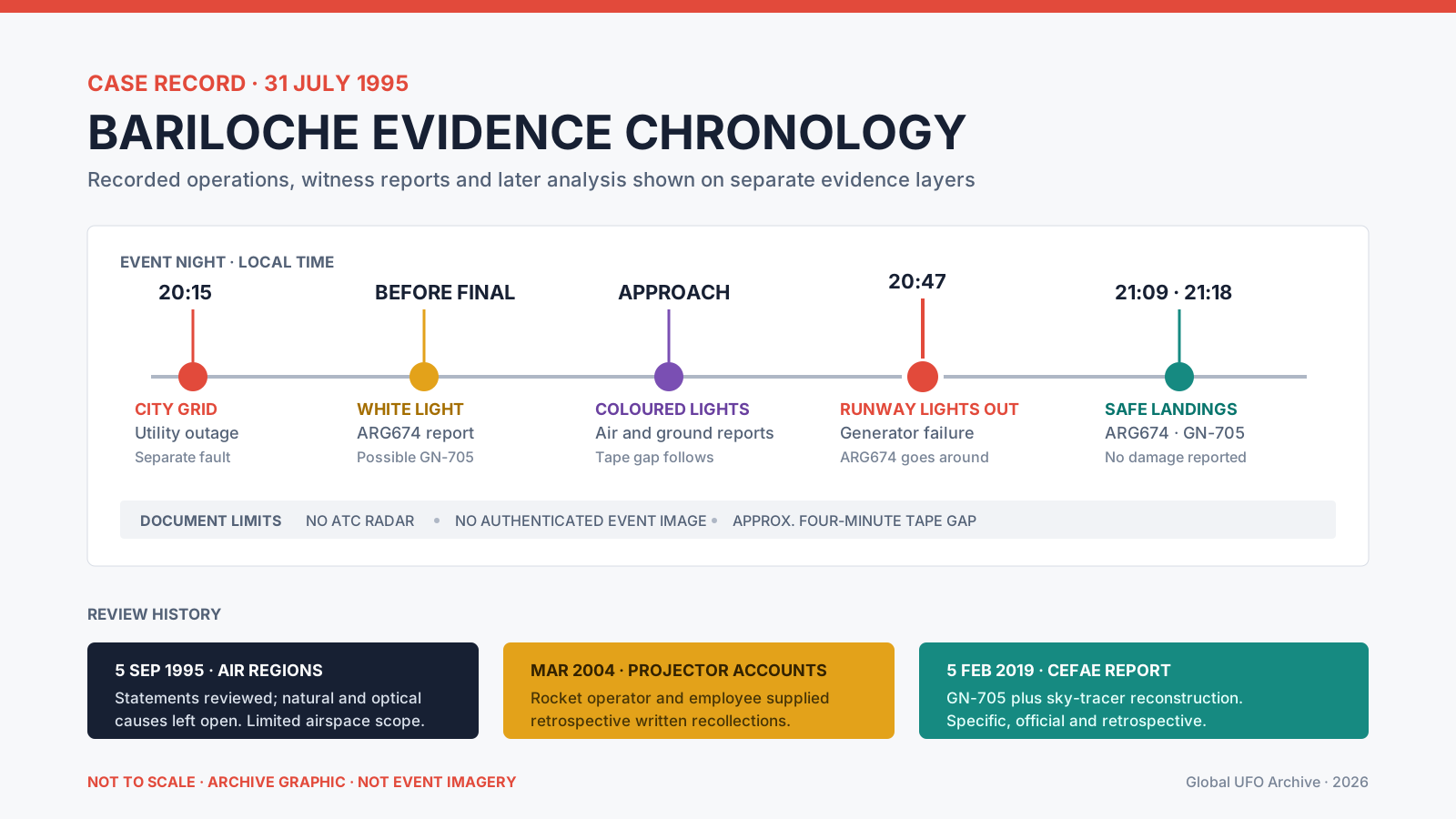
On 31 July 1995, Aerolíneas Argentinas Flight ARG674 and Gendarmería Nacional aircraft GN-705 reported bright lights near San Carlos de Bariloche airport. ARG674 abandoned final approach when the runway lights failed at 20:47 local time and landed at 21:09 after power returned; GN-705 landed at 21:18. Transcriptions of the radio traffic and signed statements preserve a substantial witness chain, but the airport had no radar, no event photograph or physical trace is known, and the surviving tape has an approximately four-minute recording gap. The city-grid outage and the airport generator failure were documented as separate faults, not proven effects of an object. The Argentine Air Force's Air Regions Command performed a limited airspace review in 1995. A CEFAE report released in 2019 attributed the first light to GN-705 and the main display to a nightclub sky-tracer reflecting from thin cloud. That combined conventional explanation is the best documented one, but its late reconstruction and missing primary data justify the present B / DISPUTED rating.
This case is disputed. The archive preserves the claims while separating evidence from interpretation.
- Documentation
- High documentation
- Primary location
- San Carlos de Bariloche, Río Negro
- Source base
- 10 linked records
- Research use
- Comparison case
What the Bariloche record establishes
- Confirmed operation
- ARG674 went around when the Runway 28 lights failed at 20:47 local, then landed safely at 21:09; GN-705 landed at 21:18.[1][3][4][5][6]
- Power-claim boundary
- The city-grid outage and the later mechanical failure of the airport's auxiliary generator were separate. No record reviewed proves that a reported light caused either one.[1][5][7]
- Sensor and media limit
- The airport had no ATC radar. No authenticated event photo or video is known, and the surviving VHF record has an approximately four-minute recording gap.[1][4][5]
Operational chronology and evidence boundary
Case dossier
The primary event involved two arriving aircraft and several people on the ground. ARG674 was a Boeing 727 from Buenos Aires. Its signed post-flight statement names commander Jorge Néstor Polanco, co-pilot Carlos Atilio Dortona and flight engineer Jorge Allende; the later CEFAE report also places visiting Boeing 747 captain Roberto Benavente in the cockpit, though he is not a signatory to that immediate statement. GN-705 was a Gendarmería Nacional Piper PA-31T Cheyenne whose crew included Juan Domingo Gaitán and Rubén Adolfo Cipuzak. Airport and ground records name Daniel Alberto García, Ramón Alfredo Blanco and meteorological observer Nicolás Enoe Araya. These are reports from trained aviation personnel and named ground witnesses, but they are still visual testimony rather than a common instrument track.
The first reported light must be separated from the later multicoloured display. While ARG674 was descending on a heading of about 120 degrees, its crew reported a white light at roughly eleven o'clock. The tower initially treated it as converging traffic and told ARG674 that GN-705 should be about forty nautical miles away. GN-705's radio position reports and Cipuzak's 1996 hand drawing do not align perfectly. CEFAE's later geographic reconstruction placed GN-705 much closer than the radio estimate and concluded that it was the likely white source. That is a plausible traffic identification, not a radar confirmation: Bariloche had no air-traffic-control radar in 1995, and positions were plotted manually from pilot reports.
During the later approach, ARG674 reported a bright source to its right and another aircraft above it. The radio transcript records the crew describing two strong flashing lights and saying they thought it was a flying saucer. The signed statement describes green lights at the ends and an orange centre that appeared to depart rapidly toward the southeast. Ground witnesses described white, yellow or amber light and no consistently resolved silhouette. Dortona and Allende later emphasized lights or reflections; Gaitán reported a light without a structure; Polanco's more solid craft description is clearest in later interviews. The variation does not erase the observation, but it prevents the witnesses from being treated as independent measurements of one agreed shape, distance or path.
The electrical chronology is narrower than the popular 'UFO blacked out Bariloche' claim. Tower chief García placed a total utility cut at about 20:15 local time and restoration by the airport's auxiliary generator around 20:20. The preserved VHF recording begins at that second time. At 20:47, during ARG674's final approach to Runway 28, the auxiliary generator suffered a mechanical failure and the runway lighting went out, prompting the go-around. García's statement says the anemometer stopped but the VOR and ILS remained normal and some lights stayed on. A near-contemporary El Cordillerano clipping separately attributed the city outage to human error involving a transformer. No reviewed record demonstrates that the reported light caused either fault.
Utility power returned, ARG674 landed at 21: 09 and GN-705 at 21:18. The outcome was a safe go-around and delayed landing, with no collision, damage or physical residue reported. The public record nevertheless has important holes. Bariloche lacked radar, so there is no radar track of the lights or both aircraft. No authenticated event photograph or video is known. The VHF tape contains an approximately four-minute non-recording interval after the most relevant exchange, and the public version is a transcription rather than a released forensic audio master. Witness bearings were descriptive, while GN-705's reported positions conflict. These limits matter more than later claims that every airport instrument failed.
The 1995 official response was real but limited. A 5 September Air Regions Command reply, preserved as a researcher-hosted transcription, says airport authorities took statements and analyzed the event. It provisionally excluded confusion with known conventional aerial objects, yet did not exclude natural objects, light reflected from cloud bases or another optical phenomenon. The inquiry stopped after officials found no intrusion of jurisdictional airspace by a known conventional aerial object. It was not an aviation-accident finding or an official confirmation of an anomalous craft. A National Meteorological Service report and NOAA station data support cold weather, westerly winds and cloud or ceiling observations, while the 4 September El Cordillerano article recorded competing optical and electrical explanations close to the event.
Researcher Heriberto Janosch later traced a powerful sky-tracer to the Rocket nightclub. Operator Juan Carlos Rivero wrote in 2004 that he had used it that night, and employee Sergio Segade said he recognized the beam. CEFAE revisited the case in 2018 and published its report in early 2019. It interviewed Rivero, Dortona and Segade, overlaid Cipuzak's 1996 drawing on Google Earth, and used scale aircraft, an acrylic cloud layer and a flashlight to reproduce sight lines. CEFAE judged the match decisive: GN-705 explained the first white light and the projector explained the moving coloured display. The experiment is informative, but it depends on a hand drawing, 2004 emails and memories collected more than two decades later; no contemporaneous projector log, measured beam direction, radar data, photogrammetry or original audio master was produced. The best current conclusion is therefore a well-supported conventional reconstruction, not a fully repeatable identification.
Timeline
- Meteorological observer Nicolás Araya later placed a voltage drop at about 19:30 and a strong yellow light roughly twenty minutes later. His timing conflicts with the tower chief's later electrical chronology and remains a witness estimate.
- The tower record places a total utility outage near 20:15 and airport auxiliary power around 20:20. The surviving VHF transcript begins at 23:20 UTC, equivalent to 20:20 local time.
- ARG674 reported a white light near its eleven-o'clock position. The tower first treated it as possible GN-705 traffic; the two aircraft's reported positions were not fully consistent.
- On later approach, ARG674 described two bright flashing lights to its right and another aircraft above. An approximately four-minute non-recording gap follows the key exchange in the surviving tape record.
- The airport auxiliary generator failed mechanically during ARG674's final approach to Runway 28. The runway lights went out and the crew executed a go-around.
- After utility power returned, ARG674 landed at 21:09 and GN-705 at 21:18. No collision, aircraft damage or physical trace was reported.
- The Argentine Air Force's Air Regions Command replied that statements had been analyzed. It left natural objects, cloud-base reflections and other optical effects open, then ended the review after finding no known conventional airspace intrusion.
- A document-delivery act records that Heriberto Janosch received copies of the VHF transcript and four signed statements. The surviving online pages are researcher-hosted transcriptions, not an authenticated government digital archive.
- Rocket operator Juan Carlos Rivero and employee Sergio Segade supplied Janosch with written recollections connecting the nightclub's sky-tracer to the display. These are retrospective witness accounts, not a 1995 operating log.
- The PDF metadata dates CEFAE's 2018 annual report to 5 February 2019. Its Bariloche chapter closed the case with a combined GN-705 and sky-tracer reconstruction.
Bariloche incident questions
What happened in the 1995 Bariloche UFO incident?
Two arriving crews and airport personnel reported unusual lights on 31 July. ARG674 went around when runway lighting failed at 20:47, then it and GN-705 landed safely after power returned. The sightings and operational sequence are documented; an extraordinary craft is not.
Which Aerolíneas Argentinas flight was involved?
It was ARG674, a Boeing 727 arriving from Buenos Aires. The signed statement names commander Jorge Néstor Polanco, co-pilot Carlos Atilio Dortona and flight engineer Jorge Allende. A later report also places visiting captain Roberto Benavente in the cockpit.
Did a UFO cause the Bariloche blackout?
No causal link is established. The city utility failed first, reportedly after a transformer-related human error. The airport switched to auxiliary power, whose generator then failed mechanically at 20:47. The timing is dramatic, but sequence is not proof of electromagnetic interference.
Was there an official investigation?
Airport and Air Regions authorities took statements and conducted a limited airspace analysis in 1995. CEFAE performed a detailed retrospective review in 2018 and published it in 2019. No separate JIAAC/JST accident-investigation report was located in the reviewed public catalog.
What is the sky-tracer explanation?
A powerful rotating projector at the Rocket nightclub could illuminate thin cloud and appear as a moving coloured source. Its operator later said he used it that night. CEFAE recreated the sight lines and paired that effect with GN-705's aircraft lights, but the reconstruction used later memories and a 1996 sketch.
Is there an authentic photo or video of the event?
None was found in the reviewed record. The previously associated YouTube thumbnail belongs to a 2013 Science Channel clip about a different alleged Argentine crash story and is a copyrighted television image, not Bariloche airport evidence. This page uses an original, clearly labeled archive graphic instead.
Why is the case rated B / DISPUTED?
B reflects named aviation witnesses, signed records and a documented go-around. DISPUTED reflects the missing radar and imagery, conflicting position and timing details, and a strong conventional explanation that remains retrospective rather than fully instrumented.
Sources
- [1] Official fileCEFAE 2018 annual report: Bariloche case studyFuerza Aérea Argentina / CEFAE
- [2] Official fileCentro de Identificación Aeroespacial: institutional history and missionFuerza Aérea Argentina / CIAE
- [3] ArchiveBariloche file index and 28 December 1995 document-delivery actHeriberto Janosch research archive
- [4] ArchiveBariloche airport VHF transcript, 31 July-1 August 1995Heriberto Janosch archive / Bariloche airport transcription
- [5] ArchiveARG674 and Bariloche airport witness statementsHeriberto Janosch archive / Argentine Air Force copies
- [6] ArchiveMeteorological report and 1995 Air Regions Command responseHeriberto Janosch archive / SMN and Argentine Air Force transcriptions
- [7] News report'Opiniones disímiles sobre los Ovnis de Bariloche,' El Cordillerano, 4 September 1995El Cordillerano clipping reproduced by CEFAE
- [8] Reference databaseNOAA Global Hourly observations for Bariloche station SAZS, 1995NOAA National Centers for Environmental Information
- [9] Official fileJST public aeronautical-occurrence catalog: 1995 queryJunta de Seguridad en el Transporte
- [10] ResearchFOTOCAT review of the CEFAE Bariloche reportFOTOCAT / Vicente-Juan Ballester Olmos
The displayed image is an original site-authored evidence chronology. It is not an event photograph, radar plot, flight-path reconstruction, depiction of the reported lights or copy of the CEFAE report. No authenticated event image was found. The former YouTube thumbnail is excluded because it is copyrighted television imagery for a different Argentine story.