
United States / 1964 / UNRESOLVED
1964 Socorro UFO incident: Lonnie Zamora and the Blue Book file
On 24 April 1964, Socorro police officer Lonnie Zamora abandoned a traffic pursuit after hearing a roar and seeing a blue-orange flame. He said he then approached a smooth, pale oval object, briefly saw two figures in white nearby and watched the object rise and depart southwest. Sergeant M. S. Chaves arrived about three minutes later and saw fresh-looking indentations and scorched vegetation, but not the object. Air Force investigators documented the scene, tested soil and brush, checked aircraft, balloons and military activity, and retained the report as unidentified. Those records establish a prompt police report and a real investigation; they do not establish an extraterrestrial craft, because no authenticated event image, radar track, unusual residue or second close-range witness identifies what Zamora saw.
This case remains unresolved in the public record, with credibility grade B.
- Documentation
- High documentation
- Primary location
- Socorro, New Mexico
- Source base
- 8 linked records
- Research use
- Comparison case
What the record supports
- Direct observation
- Lonnie Zamora was the sole identified witness to the object, two reported figures and its departure on 24 April 1964.[1]
- Immediate corroboration
- Sergeant M. S. Chaves arrived about three minutes later and corroborated Zamora's shaken condition and the presence of fresh-looking marks, not the object.[1][2]
- Trace results
- Four indentations and burned vegetation were documented, but tests found normal radiation, no foreign soil material and no propellant residue.[1][2][3]
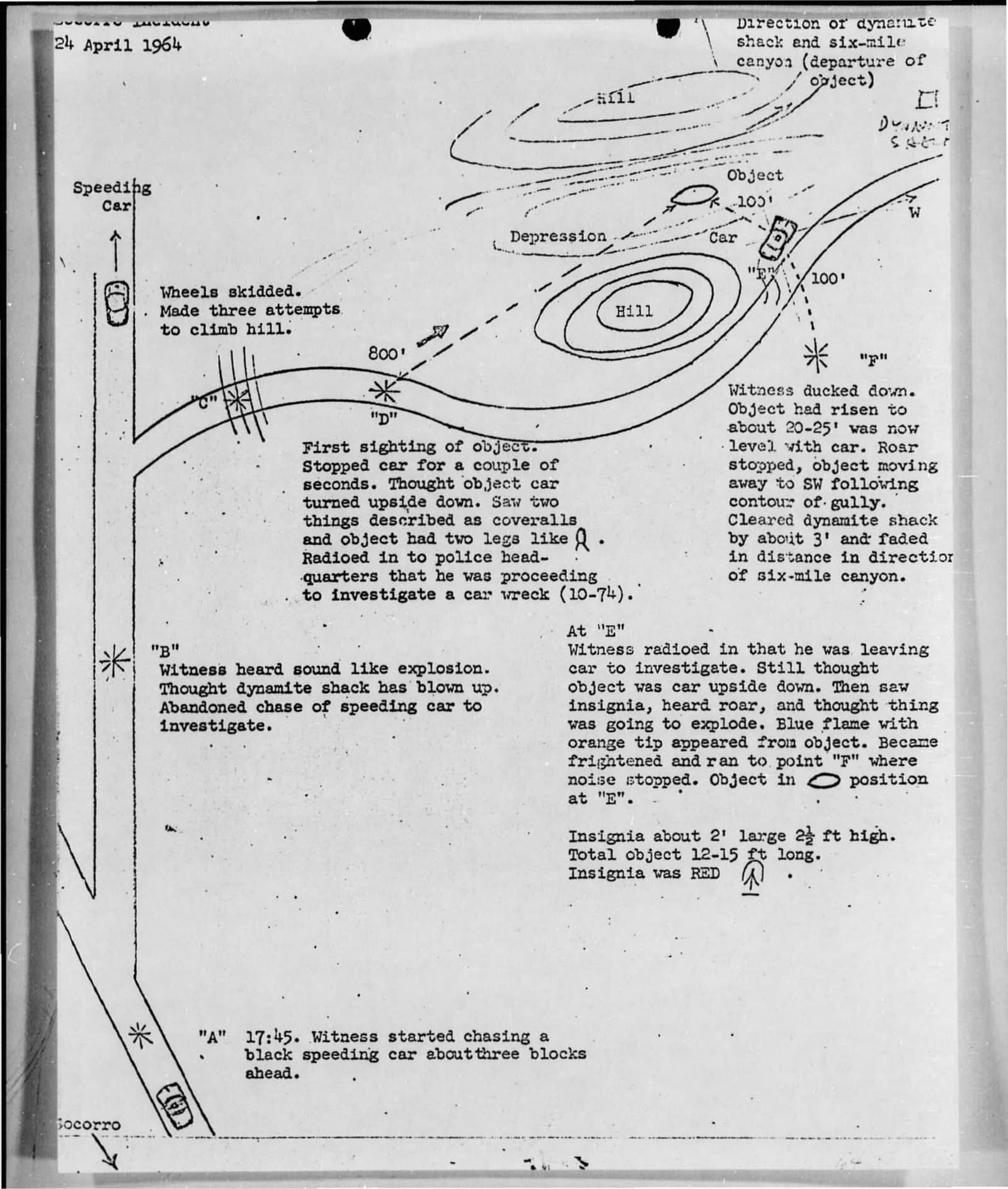
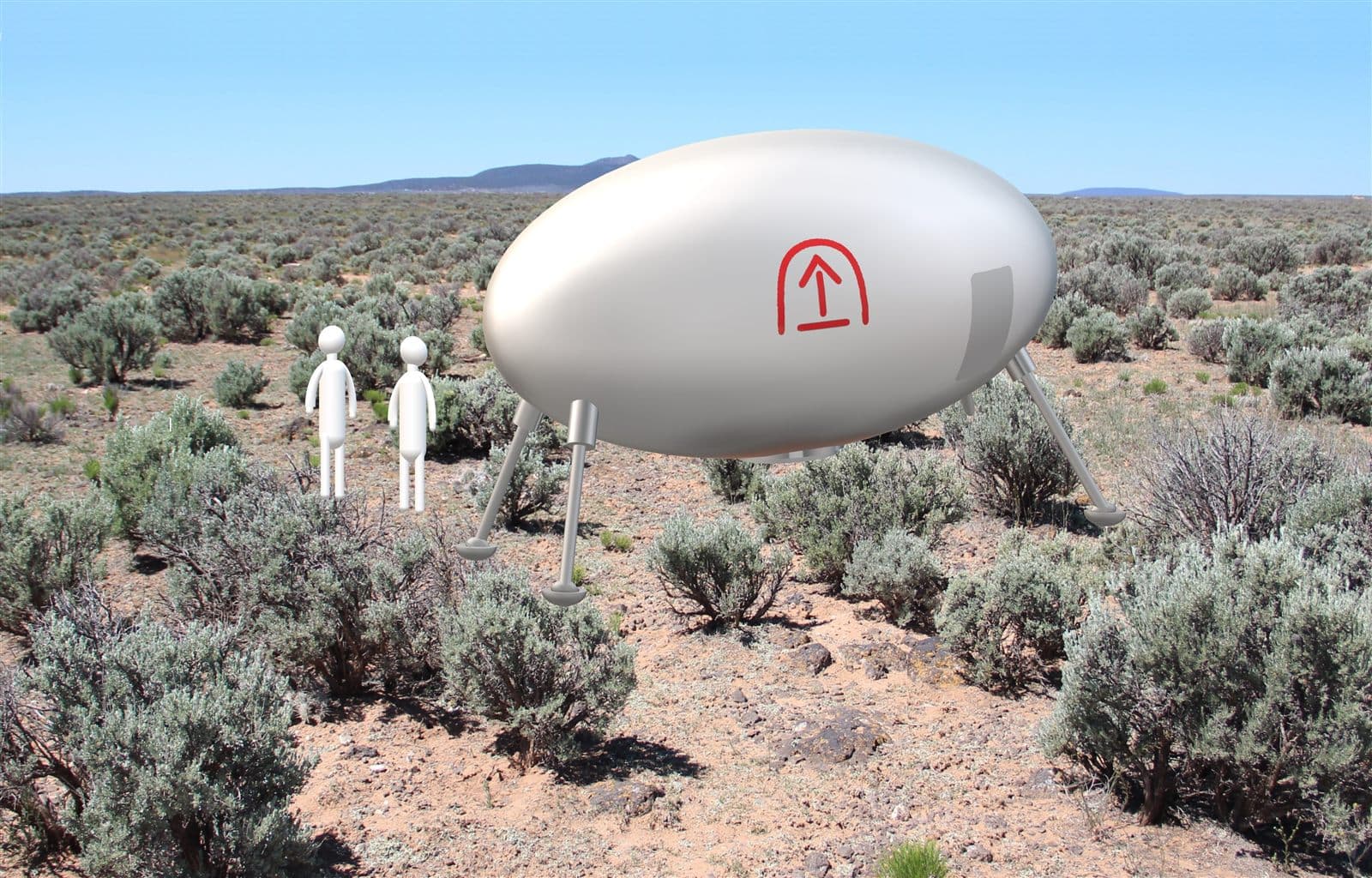
Official diagram and later reconstruction
Case dossier
At about 5: 45 p.m. on Friday, 24 April 1964, patrolman Lonnie Zamora was chasing a speeding black car south of Socorro. His signed statement says he heard a roar and saw a blue-orange flame southwest of the road. Thinking the dynamite shack in that direction might have exploded, he abandoned the chase and turned onto a rough gravel route. Clear weather and strong wind gave him an unobstructed daylight view, although loose gravel forced three attempts to climb the first hill.
From the hilltop Zamora reported a bright white or aluminum-colored object 150 to 200 yards away in a shallow depression. He first took it for an overturned car. For only a few seconds he also reported two figures close to it, dressed in what looked like white coveralls; one appeared to react to his arrival. This is the only figure observation in the primary account. Zamora did not see the figures again after driving closer, and no other identified person independently reported them.
Zamora radioed that he was checking a possible wreck, parked and approached on foot. He described the object as smooth, oval or egg-like, about the size of a car and without visible windows or doors. A red marking was visible on its side, but later publications reproduce more than one version of that symbol. The archive can therefore preserve that he reported a red insignia; it cannot use a later drawing to identify the object's maker or origin.
As he neared the depression, Zamora said a loud roar began at low pitch and rose in frequency. He saw a blue flame with orange toward its lower part and dust around the object, but no smoke. Frightened that it might explode, he ran, struck or fell near his patrol car and lost his glasses. Looking back, he said the object rose to roughly 20–25 feet; the roar stopped, a brief whine followed, and it then moved southwest at low altitude without visible flame, smoke or further noise.
After the object disappeared beyond the terrain, Zamora called dispatcher Nep Lopez and asked that no public announcement be made. New Mexico State Police Sergeant M. S. Chaves reached him about three minutes later. Chaves did not see the object or figures. He reported finding Zamora visibly shaken and then observing fresh-looking ground depressions and scorched or burned vegetation. This distinction matters: the departure rests on one witness, while Chaves independently corroborates only Zamora's immediate condition and the existence of marks at the site.
The site was secured and examined by police, FBI personnel, Army Captain Richard Holder from White Sands and Air Force investigators. The field report described four fresh indentations, several burned bushes and no tire tracks other than police vehicles. Soil, vegetation and radiation readings were collected. However, later consultant J. Allen Hynek warned that crowds had badly trampled the location before his visit; he could no longer assess the burned areas reliably and noted charred particles and cardboard among the disturbed material.
Investigators checked local and military aircraft, helicopters, weather and research balloons, reconnaissance activity, White Sands range operations, nearby radar and firms developing lunar-landing hardware. The Air Force Materials Laboratory found no foreign material in the soil, radiation was normal, and the burned brush contained no chemical residue attributable to propellant. No unusual radar return was found, although the nearest relevant Holloman moving-target radar had closed for the day before the sighting. The checks eliminated several specific activities but did not provide a positive identification.
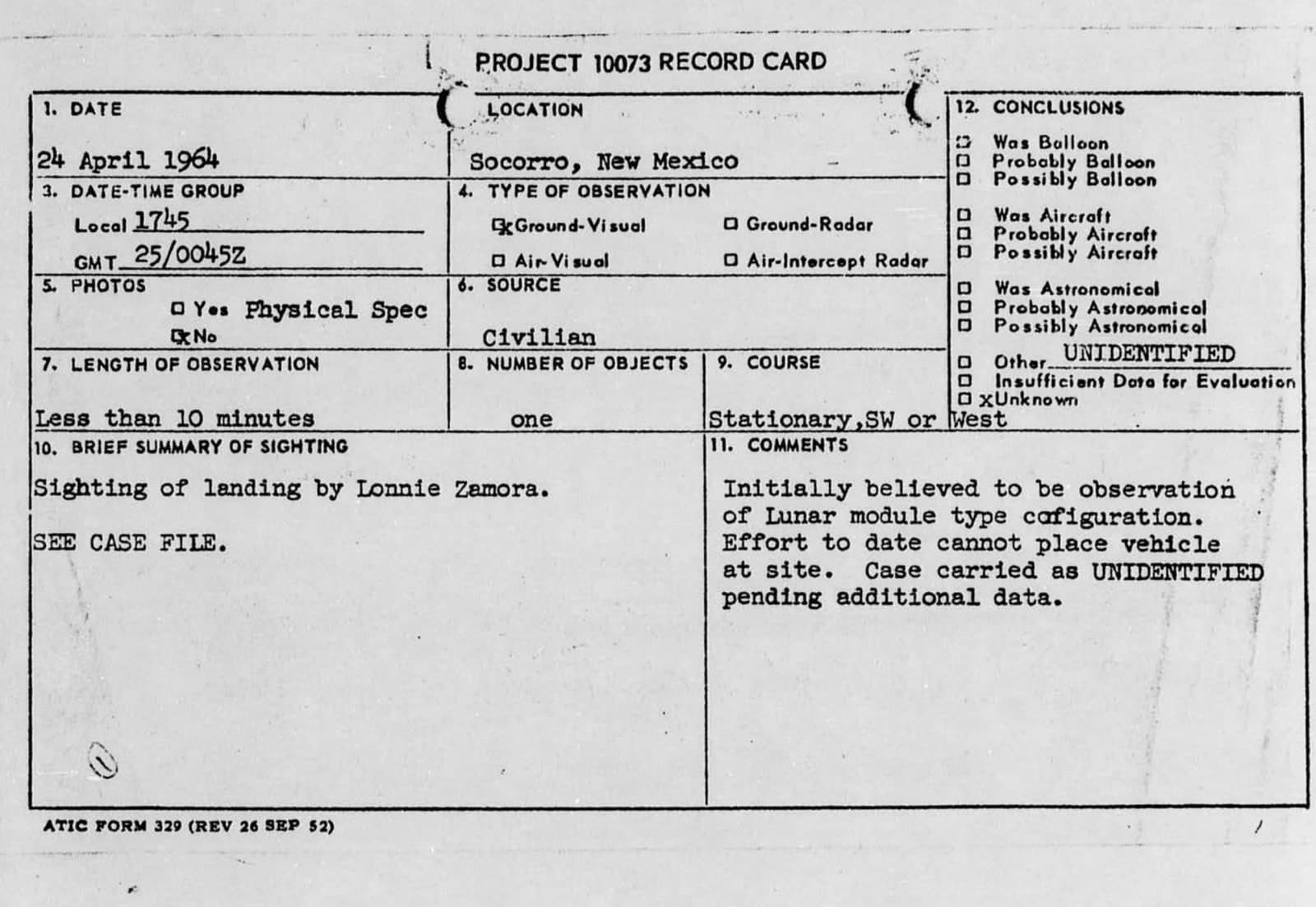
Project Blue Book chief Hector Quintanilla considered Zamora a reliable witness and wrote that everything reasonably checkable had been checked. The record card marked the case Unknown or Unidentified, not extraterrestrial. Hynek likewise judged Zamora sincere, but emphasized that he was the sole witness to the actual event, there were no photographs or radar detection, and the traces had evidentiary limits. Nine people reportedly saw the marks within hours, which supports their early presence but not the identity or cause of the object Zamora described.
Conventional proposals include an experimental vehicle or lunar-landing prototype, a balloon or aircraft event, and a student hoax. Investigators could not match a known test vehicle to the shape, marks and reported flight. A 1968 marginal note by New Mexico Tech president Stirling Colgate said he had a good indication of a student responsible for a hoax, but no participant was named, no contemporary confession or apparatus was produced, and later mechanism claims rely on indirect correspondence. The hoax idea is therefore a serious but unproven hypothesis, not a resolved finding.
Socorro belongs in the archive because it combines a rapid police report, a preserved official case file, documented field checks and trace claims that can be evaluated separately from later legend. Its strongest point is not that Blue Book proved an extraordinary craft, but that investigators failed to correlate a detailed report with a known activity. Its central limitation is equally clear: one close witness, no event image or radar, negative laboratory results and a compromised scene cannot determine what the object was or where it came from.
Timeline
- Zamora begins pursuing a speeding black car south of Socorro.
- A roar and blue-orange flame lead him off the road toward the dynamite-shack area.
- From a hilltop he reports an oval object and, for a few seconds, two figures in white nearby.
- He radios a possible wreck, approaches on foot and reports a smooth object with a red marking.
- Zamora reports a rising roar, flame and dust; the object lifts, becomes quiet and departs southwest.
- State Police Sergeant M. S. Chaves arrives, sees no object and observes Zamora's condition and ground marks.
- Police, FBI and White Sands personnel secure and inspect the site; samples and radiation readings are collected.
- Air Force investigators compare the report with aircraft, balloons, range operations, radar and experimental hardware.
- Soil contains no foreign material, radiation is normal and burned brush shows no propellant residue.
- Project 10073 is carried as Unknown or Unidentified after no known vehicle is matched to the site.
- Blue Book chief Hector Quintanilla publishes a retrospective account calling the case exceptionally well documented but unresolved.
- Stirling Colgate writes a private marginal note suggesting a student hoax; no named participant or contemporary proof accompanies it.
Frequently asked questions
Did Lonnie Zamora photograph the object?
No. The Project Blue Book record card explicitly records no photographs. Existing object images are later reconstructions, while official scene photographs show terrain or traces after the event.
Did Sergeant Chaves see the UFO?
No. Chaves arrived about three minutes after the reported departure. He corroborated Zamora's immediate condition and the presence of ground marks, not the object or figures.
Were two occupants independently witnessed?
No. Zamora reported two figures in white for only a few seconds at his first distant view. He did not see them again closer to the object, and no identified second witness reported them.
What physical evidence was tested?
Investigators documented four indentations and burned vegetation and collected soil, brush and radiation readings. Tests found no foreign soil material, abnormal radiation or chemical propellant residue.
What did Project Blue Book mean by Unidentified?
It meant investigators could not correlate a sufficiently detailed report with a known object or phenomenon. It did not mean the Air Force had identified an extraterrestrial vehicle.
Was the Socorro incident proven to be a student hoax?
No. A surviving 1968 note by Stirling Colgate suggests he had an indication of a student hoax, but it names no participant and supplies no contemporary confession, apparatus or complete evidence chain. It remains a disputed hypothesis.
What is the best explanation for the Socorro UFO incident?
No public explanation matches all documented elements. Experimental hardware and a hoax are plausible conventional hypotheses, but neither has a complete evidence chain. The case is best described as unresolved, with a credible primary report and important missing corroboration.
Sources
- [1] Official fileProject Blue Book Socorro case file, 24 April 1964U.S. Air Force / Project Blue Book
- [2] Official fileThe Investigation of UFOs: Hector Quintanilla's Blue Book retrospectiveCIA Center for the Study of Intelligence
- [3] Official fileHow to Investigate a Flying Saucer: CIA summary of the Socorro investigationCentral Intelligence Agency
- [4] Official fileProject Blue Book records and Air Force conclusionsU.S. National Archives
- [5] ArchiveNICAP Socorro report directory and document indexNICAP
- [6] ResearchThe Zamora case: early civilian investigation accountNICAP
- [7] ResearchThe Socorro UFO: physical evidence points to a prankSkeptical Inquirer
- [8] ArchiveLater reconstruction of Zamora's reported objectJMK / Wikimedia Commons
The main image is the official Project Blue Book record card for Project 10073. It records the date, location, ground-visual report, absence of photographs and Unknown/Unidentified disposition; it is an archival document, not an image of the reported object. No authenticated event photograph, original video or object audio is known in the public file.