
United States / 1952 / DISPUTED
Tremonton UFO film
On 2 July 1952, U.S. Navy photographer Delbert C. Newhouse exposed roughly 30 feet of 16 mm Kodachrome after his wife noticed about ten to twelve bright objects seven miles north of Tremonton, Utah. The film is real, entered Air Force custody, and was examined by Air Force and Navy analysts, the Robertson Panel, and later the Colorado UFO project. Those reviews did not converge: the Navy laboratory argued that the lights were self-luminous controlled objects, while the Robertson Panel rejected that analysis and emphasized reflections and gulls. In 1968 William K. Hartmann judged the film consistent with white birds and later regarded birds as the identification. Missing distance, scale and calibration, conflicting frame counts, and uncertain relationships among the original, duplicates and modern transfers prevent a stronger claim.
This case is disputed. The archive preserves the claims while separating evidence from interpretation.
- Documentation
- High documentation
- Primary location
- Tremonton, Utah
- Source base
- 5 linked records
- Research use
- Comparison case
What the Tremonton record supports
- Recorded observation
- At about 11:10 MST on 2 July 1952, Newhouse's wife noticed roughly ten to twelve bright objects about seven miles north of Tremonton; Newhouse then filmed them.[1][3]
- Camera boundary
- The hand-held 16 mm camera ran at 16 fps with a three-inch lens, but the sky supplied no reference for speed, size, altitude or distance.[1][3]
- Documented custody
- The processed film passed through Navy superiors, Hill AFB, Air Force technical and photo units, the Navy laboratory, and Robertson Panel review; NARA now catalogs a Tremonton reel.[1][2][3][4]
Case dossier
Newhouse was driving with his wife and their two children from Washington, D.C., toward Portland, Oregon. At about 11:10 MST, approximately seven miles north of Tremonton on U.S. Highway 30, his wife drew attention to lights in the sky. His 11 August letter described about ten or twelve objects milling in a rough formation and moving west. Newhouse stopped, opened the luggage compartment, took a camera from a suitcase and loaded it. The family observation is a witness account; the road location, time and later film are separately recorded in the Blue Book file.
The camera was a hand-held 16 mm Bell & Howell Automaster with a three-inch telephoto lens, loaded with daylight Kodachrome and running at 16 frames per second. Newhouse reported roughly 30 feet of film. About 20 to 25 seconds into the sequence he changed the aperture from f/8 to f/16 because he thought he was overexposing. He panned across the group, then tried to hold the camera still as one object crossed the field several times. Most importantly, his early letter says there was no reference point from which to estimate speed, size, altitude or distance.
Newhouse was not an untrained camera owner. The later Colorado study recorded 19 years in the Navy, naval photographic schooling and more than 1,000 hours on aerial-photography missions; another analyst cited 2,200 hours as chief photographer. Expertise supports competence in operating the camera, not a guaranteed identification of unresolved points against an empty sky. A detailed description of gun-metal, double-saucer forms and a half-degree apparent size appears in a 1955 interview tradition, but William Hartmann could not find it in the early Blue Book depositions. The page therefore keeps that description as a later recollection, not part of the first account.
After processing, Newhouse submitted the film to his Navy superiors. His 11 August letter sent it to Hill Air Force Base, and the Air Technical Intelligence Center and Wright Field photo laboratory examined it before the Navy Photo Interpretation Laboratory at Anacostia undertook a frame-by-frame study at Air Force request. The Robertson Panel minutes say the Navy team spent about 1,000 professional and sub-professional hours preparing motion and brightness plots. This is a documented institutional chain, but it does not establish that every laboratory worked from the same generation: the Panel specifically said the light-intensity work used a duplicate rather than the original.
The Air Force review reportedly rejected airplanes and balloons but did not securely eliminate birds. The Navy laboratory went further. Its earliest known report copy bears a 5 December 1952 stamp and treated continuous brightness and plotted movement as evidence against birds, balloons and aircraft; the team described the lights as self-luminous and intelligently controlled. Yet its linear speed depended on a stated, arbitrary five-mile distance. At that assumed range the average result was about 654 to 670 mph. Because the film contains no measured range, the number scales directly with whichever distance is inserted and cannot establish extraordinary speed by itself.
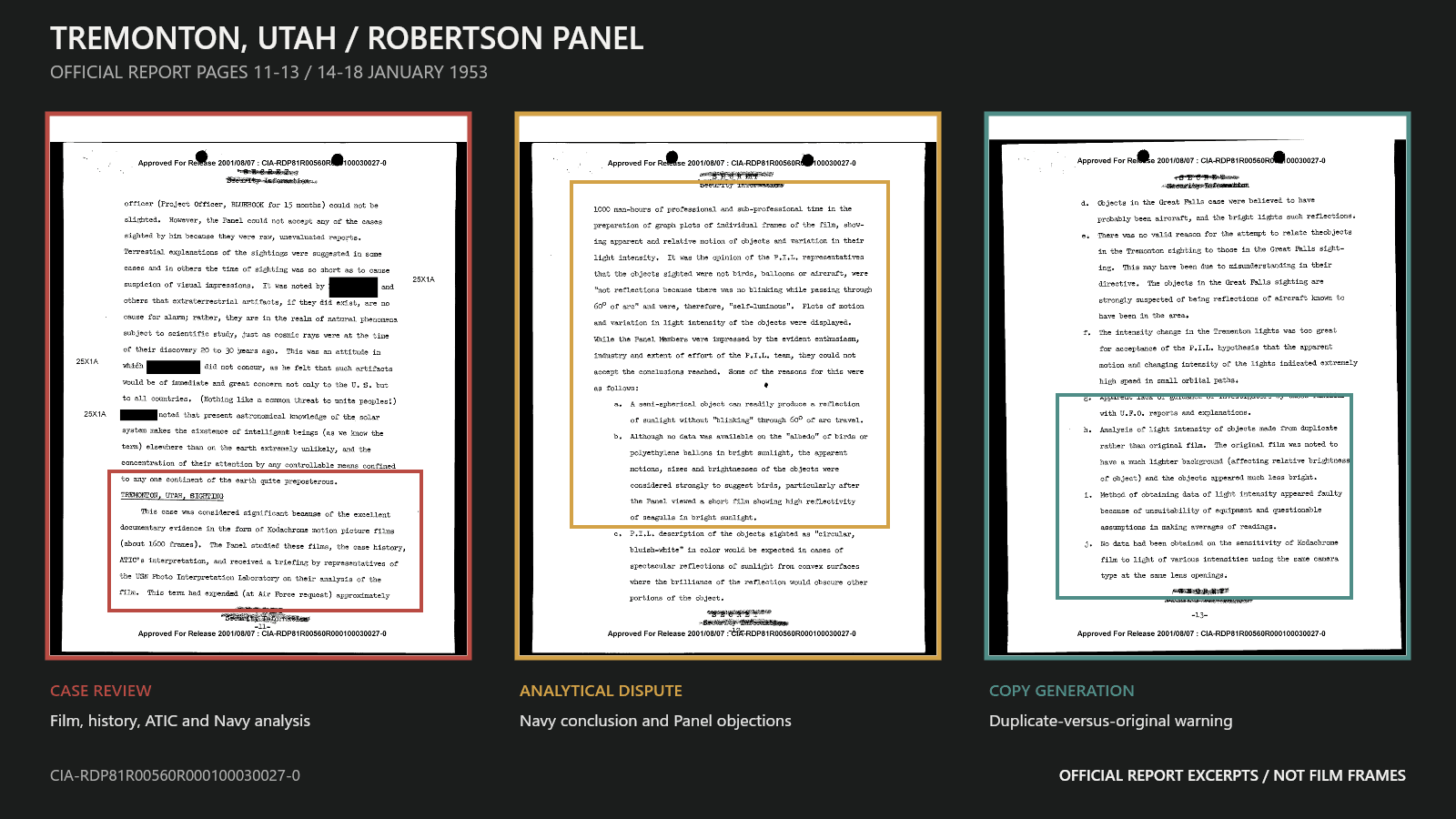
Meeting from 14 to 18 January 1953, the Robertson Panel viewed the film, case history, Air Force interpretation and the Navy briefing. Its members respected the work but rejected the Navy conclusions. They noted that sunlight can remain steady on a curved reflective surface, that the apparent motions, sizes and brightness strongly suggested birds after comparison with sunlit gull footage, and that the team had not corrected fully for hand-held camera motion. They also criticized unsuitable photometric equipment, questionable averaging and the lack of Kodachrome response tests using the same camera and apertures. The minutes favored terrestrial explanations and proposed balloon and bird experiments; they did not report a completed experiment or a species-level identification.
Copy generation is central to the dispute. The Panel said the original had a much lighter background and the objects looked much less bright than on the duplicate used for intensity analysis. The surviving records also count the material differently: Newhouse wrote of about 30 feet, the Robertson minutes said about 1,600 frames, and the later Colorado report described about 1,200 frames or 75 seconds at 16 fps. These are not interchangeable measures. They may reflect estimates, selected sequences or different film generations, and the accessible sources do not provide an inventory that reconciles them.
For the 1968 Colorado report, William K. Hartmann revisited the file, the film analyses and the bird hypothesis. At a hypothetical range of 2,000 feet, the measured angular rates corresponded to roughly 14 to 95 mph, with two sequence averages near 42 and 53 mph, compatible with birds. He found the brightness changes and intermingled motion suggestive of wheeling white birds and initially called the identification provisional. On 23 August 1968, after seeing similar distant flocks in Utah and verifying that one flock took off from the ground, he added that the comparison was strong evidence and regarded the Tremonton objects as birds. That is an argued identification, not a laboratory proof of each image.
The National Archives now catalogs Project Blue Book Motion Picture Films as series 341-PBB. Its official list identifies case 1003345 as Tremonton, dated 2 July 1952, with one three-inch reel of 16 mm color film; a footnote also flags a black-and-white reel labeled with another case number but marked “b&w Tremonton.” The NARA bulk package contains a modern MP4 named for case 341-PBB-345. Local technical inspection found a 70.08-second, 1920 × 1080 AVC file at 24 samples per second with 1,682 video samples. Those properties describe a digital derivative, not the 16 fps Kodachrome original. Public YouTube copies add another undocumented generation and are not used here as evidence.
Related checks and records
- Salem 1952: a photograph and changing official explanations
Compare the signed statements with the initial double-exposure assessment and later window-reflection interpretation.
Timeline
- Seven miles north of Tremonton, Newhouse's wife notices about ten to twelve bright objects. He stops and exposes roughly 30 feet of 16 mm Kodachrome.
- Newhouse's letter records the early account, its missing scale and range, and transmits the processed film to Hill Air Force Base.
- An Air Force interview records no sound or contrails and Newhouse's view that the brightness was reflected light, while retaining the inability to measure distance.
- The earliest known copy of the Navy laboratory report is stamped on this date. It argues for controlled, self-luminous objects using motion and brightness analysis.
- The Robertson Panel reviews the films and Navy briefing, rejects the laboratory conclusions, highlights duplicate-film and calibration problems, and favors reflected sunlight and birds.
- R. M. L. Baker performs an independent film analysis. Around this period, the detailed metallic double-saucer description enters later interviews but is absent from the early file reviewed by Hartmann.
- Hartmann's Colorado Report Case 49 rechecks the early statements, camera record, prior analyses and angular motion, provisionally identifying white birds and finding no probative evidence of extraordinary aircraft.
- After observing similar distant flocks in Utah and confirming one by seeing it take off, Hartmann adds that the comparison is strong evidence and regards the Tremonton objects as birds.
- The Air Force transfers Blue Book records to NARA, which prepares them for public reference. The current 341-PBB catalog lists the Tremonton reel and supplies a modern digital derivative with a separate rights warning.
Tremonton film questions
What happened in the Tremonton UFO film case?
Newhouse's wife noticed about ten to twelve bright objects while the family drove north of Tremonton on 2 July 1952. Newhouse stopped and recorded roughly 30 feet of 16 mm Kodachrome as the group milled and moved west.
Is the Tremonton film genuine?
Yes in the archival sense: a real film was submitted, analyzed and cataloged. That does not authenticate the objects as extraordinary. The chain among the camera original, analytical duplicates, preservation reels and public digital versions remains incompletely documented.
What did the Navy analysis conclude?
The Navy laboratory argued that the lights were not birds, balloons or aircraft and inferred self-luminous, intelligently controlled objects. Its speed estimate used an arbitrary five-mile range, and its brightness analysis used a duplicate; the Robertson Panel rejected the conclusions.
What did the Robertson Panel say about Tremonton?
The Panel considered the case important and the Navy effort extensive, but rejected its inference. It emphasized reflected sunlight, apparent similarity to gulls, hand-held motion, duplicate-versus-original brightness, weak calibration and unsuitable photometry, then proposed conventional tests.
Are public Tremonton videos the original film?
No public digital file should be labeled the camera original. NARA's MP4 is a modern 1080p, 24-sample-per-second derivative of cataloged film material. Other uploads often lack reel identity, scanning history, generation and edit documentation.
Were the Tremonton objects birds?
Probably, on the best available conventional analysis. The Panel favored gulls, and Hartmann's 1968 motion study and Utah comparison led him to identify birds. No species-level image proof exists, so the page retains DISPUTED rather than claiming an absolute identification.
Sources
- [1] ArchiveProject Blue Book case file: Tremonton, Utah, 2 July 1952U.S. Air Force / Internet Archive
- [2] Official fileRobertson Panel report: Tremonton, Utah, sightingCentral Intelligence Agency
- [3] ResearchCondon Report Case 49: Tremonton, UtahUniversity of Colorado / NCAS
- [4] Official fileProject Blue Book Motion Picture Films, series 341-PBBU.S. National Archives and Records Administration
- [5] Official fileNational Archives guide to Project Blue Book recordsU.S. National Archives and Records Administration
The displayed visual is a site-authored montage of pages 11-13 of the official Robertson Panel report. It shows the case-review text, the Navy-versus-Panel analytical dispute, and the warning that brightness work used a duplicate rather than the original. It contains no frame from Newhouse's film. NARA's digital film transfer and public video uploads are not reproduced because the archive marks the series as possibly copyright-restricted and their relationship to the camera original is not fully documented.