
United States / 1975 / DISPUTED
Wurtsmith AFB UFO incident
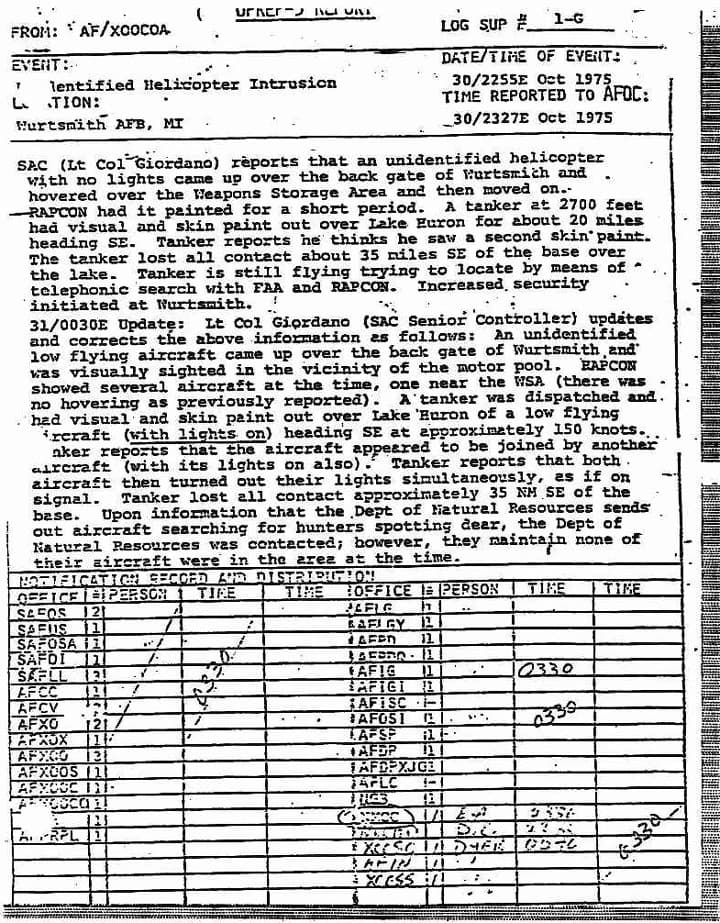
On the evening of 30 October 1975 in Michigan, 31 October in UTC, Wurtsmith Air Force Base security personnel reported an unidentified low-flying aircraft near the motor pool and Weapons Storage Area. An initial OPREP-3 called it a dark helicopter that hovered, but a 00:30 EST correction explicitly said there was no hovering and described several aircraft on RAPCON. A KC-135 tanker was sent to investigate. Its crew reported visual contact with a lighted aircraft moving southeast at about 150 knots and radar “skin paint”; a second lighted aircraft appeared to join it, both lights went out, and contact was eventually lost toward Lake Huron. These documents establish a real security and flight response, not an identified extraordinary craft. They record no weapons effect, landing, damage or measured high-performance maneuver. Names and richer witness details come mostly from a 1979 wing-history reconstruction; a 2012 daylight-disc story is a still later, uncorroborated account. A conventional helicopter or aircraft, or the mistaken association of several ordinary aircraft, remains plausible, but no public record identifies the traffic conclusively. The case therefore remains B-grade and disputed.
This case is disputed. The archive preserves the claims while separating evidence from interpretation.
- Documentation
- High documentation
- Primary location
- Wurtsmith Air Force Base, Oscoda, Michigan
- Source base
- 7 linked records
- Research use
- Comparison case
What the Wurtsmith record establishes
- Date and clocks
- The operational event occurred on 30 October 1975 local EST, crossing into 31 October in UTC. Primary messages give both about 22:20 and 22:55 EST for the opening report.[1][2]
- Reported locations
- Duty reports mention the back gate, motor pool and Weapons Storage Area. Later names come from a 1979 reconstruction, not signed 1975 statements.[1][4]
- Base response
- Security was increased, local agencies were contacted, RAPCON monitored several aircraft and a KC-135 was sent to investigate. No landing evidence was reported.[1][2][4][5]
Case dossier
Wurtsmith was a Strategic Air Command base at Oscoda, Michigan. Official Air Force history places the 379th Bombardment Wing there with B-52 bombers and KC-135 tankers, which explains the active traffic pattern and why an unknown low flyer near a controlled area prompted an immediate response. The surviving incident packet uses Eastern Standard Time and UTC. Its operational date is the evening of 30 October locally, crossing into 31 October in UTC; that distinction resolves later one-day date drift without moving the event to a different year.
The contemporary messages identify witnesses mainly by duty, not by name: a back-gate security guard, personnel near the motor pool and Weapons Storage Area, RAPCON controllers, and the KC-135 crew. A 1979 wing historian later named Airmen Martin Tackabury and Michael Myers, Sergeants Robert Anderson, Roger Skipper and James Miller, vice commander Colonel John Doran, and members of the tanker crew led by Major Frederick Pappas. Those names are useful provenance, but they belong to interviews and memoranda assembled more than three years later, not to signed 1975 witness statements in the surviving packet.
The first security reports were not uniform. One message placed a low aircraft over the back gate and near the Weapons Storage Area; another operational line used 22:55 EST as the event time, while a teletype placed the guard report at about 03:20 UTC, or 22:20 EST. Some personnel reported red or white lights and possible helicopter-like sound, but jet noise interfered. The control tower had no independent visual confirmation. Local police were alerted, and later reconstruction says no evidence of a landing was found. Michigan Department of Natural Resources personnel, contacted because aircraft sometimes searched for deer spotlighters, said none of their aircraft was in the area; that check did not exclude every private or transient aircraft.
RAPCON initially painted several aircraft, including one return near the Weapons Storage Area. A KC-135 already associated with local operations was directed toward a contact. The tanker crew reported seeing a lighted low-flying aircraft and receiving a non-beacon radar return, called “skin paint,” about northeast of the base. It proceeded southeast near 150 knots; an apparent second lighted aircraft joined it, both lights went out together, and the tanker later lost contact toward Lake Huron before returning as fuel approached minimums. The packet does not preserve raw radar plots, controller audio, transponder data or flight logs, so it cannot prove that every visual report and radar return belonged to the same aircraft.
The packet preserves its own correction. The first OPREP described an unlighted helicopter hovering over the Weapons Storage Area. At 00:30 EST, the updated message changed the wording to unidentified low-flying aircraft, said several aircraft had appeared on RAPCON and stated, “there was no hovering as previously reported.” Another teletype cautioned that the aircraft seen near the storage area might have been a KC-135 in the local pattern. Yet a released NORAD command-director log retained the earlier helicopter-and-hover summary. This is a documentary conflict, not permission to select the more dramatic version. The corrected operational report has the stronger claim-level provenance.
The next detailed documentary layer was created in January 1979. Wing historian Staff Sergeant Paul Cahill recorded that the October-December 1975 wing history contained no reference to the incident, then interviewed Doran and sought a memorandum from former tanker navigator Myron Taylor. Taylor was unsure of the date and wrote from memory more than three years later. His account added irregular strobes, intermittent radar, close pursuit, lights apparently signaling, loss among fishing-boat lights and an estimated burst near 1,000 knots. No raw radar, flight data or contemporaneous crew statement in the public file tests that speed estimate. It must remain a delayed recollection, not a measured performance fact.
The Washington Post brought the released messages to a broad audience on 19 January 1979. It reported that officials still used helicopter language but had not matched the traffic to known military, commercial or locally based private helicopters. The article is valuable for the release history, not as a contemporaneous witness source. In 2012, Mark Singh described a daylight metallic disc seen by a mobile RAPCON crew on 29 or 30 October. He said he first told the story in the mid-1990s and cited no 1975 record. Its daylight setting, form and performance differ sharply from the nighttime packet, so this archive treats it as a separate later claim rather than merging it with the documented incident.
What remains is narrower than either a dismissal or an extraordinary conclusion. Multiple duty stations reported unusual low-level traffic; command channels reacted; a tanker crew reported visual and non-beacon radar contact; and the corrected message left the aircraft unidentified. Equally, the record itself supplies ordinary-aircraft cues: navigation lights, possible rotor sound, an approximately 150-knot course, several RAPCON aircraft and a KC-135 that could explain one storage-area observation. Negative local checks were limited. The public evidence supports an unresolved airspace and security incident, while nuclear interference, landing, radar proof of an exotic object and extraordinary performance remain unsupported additions.
Timeline
- A 1979 wing-history reconstruction places several security-police observations around this time and later supplies witness names. The surviving 1975 packet does not use this exact starting time or include the signed statements.
- Contemporary messages place the first guard report at about 03:20 UTC but list 22:55 EST as the OPREP event time. They report low aircraft near the back gate, motor pool and Weapons Storage Area.
- RAPCON shows several aircraft. A KC-135 reports a lighted aircraft, radar skin paint and then an apparent second aircraft; both lights go out and contact is later lost toward Lake Huron.
- Strategic Air Command notifies the National Military Command Center. An NMCC memorandum written at 04:51 EST on 31 October attaches the operational messages and records this notification time.
- The OPREP update withdraws the hovering description, uses “unidentified low flying aircraft,” and notes that several aircraft appeared on RAPCON. This is the key contemporaneous correction.
- A later NORAD summary groups Wurtsmith with other base reports and says the objects at Loring and Wurtsmith were characterized as helicopters. It does not identify an operator or make an extraterrestrial finding.
- Wing historian Paul Cahill documents the absence of the incident from the 1975 wing history, interviews John Doran and obtains Myron Taylor's delayed tanker recollection.
- The Washington Post reports the released Air Force and NORAD messages, publicizing the helicopter wording, unsuccessful identification efforts and KC-135 response.
- NICAP publishes Mark Singh's separate daylight metallic-disc account, first told decades after the event and unsupported by a cited 1975 record. It is catalogued as a later claim, not merged into the nighttime chronology.
Questions about the Wurtsmith incident
When did the Wurtsmith incident occur?
The documented operational event was the evening of 30 October 1975 in Michigan. Because the messages also use UTC, some entries are dated 31 October. A 2012 account says 29 or 30 October, but that is a separate later daylight claim.
Who witnessed the low-flying aircraft?
The 1975 messages identify security personnel by post, RAPCON controllers and a KC-135 crew. A 1979 historian later supplied names including Martin Tackabury, Michael Myers, Robert Anderson, Roger Skipper, James Miller, John Doran and members of Major Frederick Pappas's tanker crew.
Did an object hover or land at the base?
The first report said helicopter and hovering, but the 00:30 EST OPREP correction explicitly withdrew the hovering claim. Later reconstruction says local police found no evidence of a landing. No public primary record documents touchdown or physical traces.
Were nuclear weapons affected?
No such effect is documented. The messages mention a Weapons Storage Area, but report no malfunction, shutdown, alarm, damage or change in weapon status. Calling the event a nuclear interference case goes beyond the surviving record.
Did radar confirm extraordinary performance?
No. RAPCON returns and KC-135 skin paint are documented, but the public file has no raw plot or measured acceleration. The roughly 1,000-knot departure appears in Myron Taylor's 1979 recollection, more than three years later.
What is the most plausible explanation?
An unidentified conventional helicopter or fixed-wing aircraft fits the lights, possible sound and roughly 150-knot course. Association of several ordinary aircraft is also plausible because RAPCON showed multiple tracks and a KC-135 may explain one report. No single identification is proved, so the case remains disputed rather than extraordinary.
Sources
- [1] Official fileDoD Wurtsmith AFB operational message packetU.S. Department of Defense FOIA Reading Room
- [2] ArchiveReleased NORAD Command Director log for WurtsmithNORAD record / NICAP transcription archive
- [3] Official fileOfficial history of the 379th wing and Wurtsmith operationsU.S. Air Forces Central
- [4] ResearchClear Intent reconstruction of the Wurtsmith incidentLawrence Fawcett and Barry Greenwood / NICAP archive
- [5] News reportWhat Were Those Mysterious Craft?The Washington Post
- [6] ResearchMark Singh's later daylight-disc accountNICAP report archive
- [7] Official fileNARA accession lead for Wurtsmith historical records, 1974-1976U.S. National Archives and Records Administration
The displayed image is a scan of an official 1975 OPREP-3 page. It documents what the command record said and corrected; it is not an event photograph, radar plot, aircraft image or proof of an extraordinary object. No authenticated event image or original event video was found.