
Evidence / Updated 2026-08-02 / 10 min read
Drone, Balloon or Satellite? How to Identify a Reported UFO
Movement, lights, duration, wind and tracking records help distinguish common airborne and orbital objects before a sighting is classed as unexplained.
Reviewed and maintained byGlobal UFO Archive Editorial DeskEditorial policy
Quick answer
Drones can hover, turn and change altitude; balloons usually drift with the wind; satellites normally move steadily across the sky without hovering. Identification should compare time, direction, duration, weather, flight activity, launch records and satellite tracking before a report is treated as unexplained.
Key points
- A real object can still be misidentified when distance, darkness, and social media remove context.
- Movement is usually more useful than shape: hovering, drifting, and steady transit point to different checks.
- Modern drone reports deserve safety review even when they are not alien or exotic.
- A confident identification needs time, direction and motion to agree with flight, weather or satellite records.
- Movement pattern is usually more diagnostic than apparent shape: drones can hover and turn, balloons drift with winds, and satellites follow smooth sky tracks.
- A reliable identification combines visual behavior with flight, weather, launch and orbital records; one database alone can miss the answer.
Why ordinary objects create UFO waves
A drone, balloon, or satellite is not mysterious by itself. It becomes a UFO report when observers lack scale, distance, direction, timing, or a known source. Social media can then amplify unrelated sightings into one narrative, mixing aircraft, stars, legal drones, hobby flights, and genuine security concerns.
Compare movement before appearance
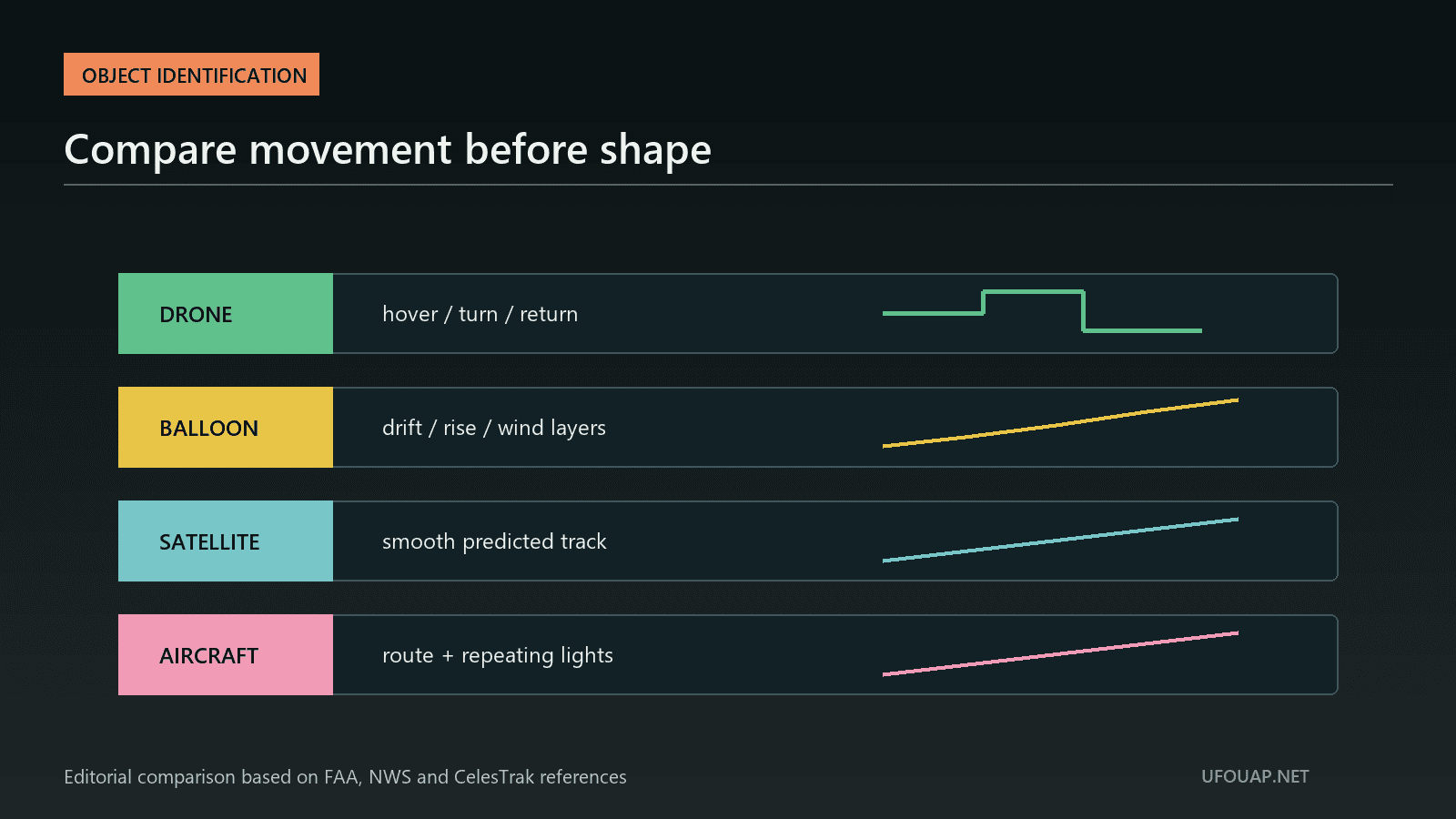
Drones can hover, turn, climb, descend, return along a route, and display steady or blinking navigation lights. Yet distance can hide sound and make a small nearby drone look like a large distant object. Hovering or maneuvering is a useful clue, not a complete identification.
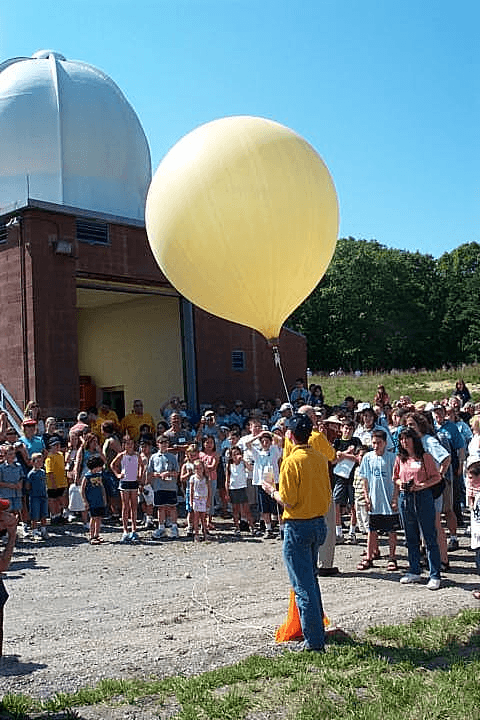
Balloons usually drift with winds at their altitude and may appear to brighten, fade, rotate or change shape. Satellites more often cross the sky on a smooth path for several minutes without hovering or abrupt turns; some fade when they enter Earth's shadow, while recently launched groups can appear as a train of lights. These are patterns to test against records, not visual shortcuts.
A practical verification workflow
Preserve the original file and record the exact time, observer location, viewing direction, elevation, duration and weather. Note whether the object hovered, drifted with the wind, followed a steady path, repeated a route, changed brightness, produced sound or passed behind a known landmark. Those details are more useful than labels such as fast, huge or strange.
Then compare the observation with local air traffic and drone activity, National Weather Service balloon operations and winds aloft, launch timing, and satellite tracking for the same location and minute. A proposed match is strongest when time, direction, duration and movement agree. Failure to find a match may reflect missing or inaccurate data; it does not by itself establish an extraordinary object.
Compare behavior before comparing silhouettes
Night video often destroys scale and turns navigation lights into blobs, so a silhouette can be misleading. A multirotor drone may hold position, make deliberate lateral moves and return against the wind, usually within local operating altitude and battery limits. A weather balloon normally drifts with the wind profile and may rise steadily before bursting; a distant balloon can seem stationary when moving toward or away from the observer. A satellite neither hovers locally nor turns sharply: it follows a smooth predicted path and may fade in Earth's shadow. Aircraft add repeated navigation or strobe patterns and a route that can sometimes be checked against flight records.
A source-by-source verification order
Begin with the original media and witness geometry, then check nearby airports and flight tracks, local drone restrictions or notices, upper-air balloon launches and winds, recent rocket launches, and orbital predictions. FAA sighting data can show recurring drone-report environments but does not identify a specific light by itself. National Weather Service balloon schedules and wind profiles can support a balloon match. CelesTrak can test satellites when the original time and location are precise. The identification should state which records agree, which are unavailable and what observation remains unexplained.
FAQ
Are drone sightings still worth documenting?
Yes. They may matter for airspace safety, privacy, infrastructure security, and public communication even when they are not anomalous.
How can you tell a drone from a UFO?
A drone may hover, turn, climb, descend or show navigation lights, but appearance alone is not enough. Compare the original recording with time, direction, local flight activity, sound, scale references and any repeatable route.
How can you identify a balloon sighting?
Balloons usually drift with the wind and may brighten, fade or change apparent shape as viewing conditions change. Check launch information and upper-air winds for the correct time and altitude; a visual resemblance by itself is not a confirmed match.
How can you check whether a light was a satellite?
A satellite normally follows a steady path for several minutes without hovering or making abrupt turns. Match the exact time, observer location and direction with satellite or launch records, while allowing for incomplete data and mistaken estimates of angle or speed.
Can a balloon move against the wind?
A free balloon follows the wind at its altitude, but winds can differ in direction between layers. Perspective can also make its ground-relative motion look unexpected, so upper-air data are more useful than surface wind alone.
Official sources used
- AAROAARO FAQwww.aaro.mil
- FAADrone Sightings Near Airportswww.faa.gov
- Federal Aviation AdministrationReport a drone sightingwww.faa.gov
- NASA ScienceIdentifying UFOs and UAPsscience.nasa.gov
- National Weather ServiceNOAA Observation Systemswww.weather.gov
- National Weather ServiceWeather balloon factswww.weather.gov
- CelesTrakSupplemental orbital element setscelestrak.org